This page was machine-translated and may differ from the original. View original
Samsung Electronics' Future Technology Development Project: Building on Five Years of Achievements and Looking to the Future

Plans to invest a total of 1.5 trillion won in subsidies by 2022
A breath of fresh air in academia, from assignment selection to evaluation management.
Efforts to secure technological competitiveness to strengthen national industrial competitiveness 
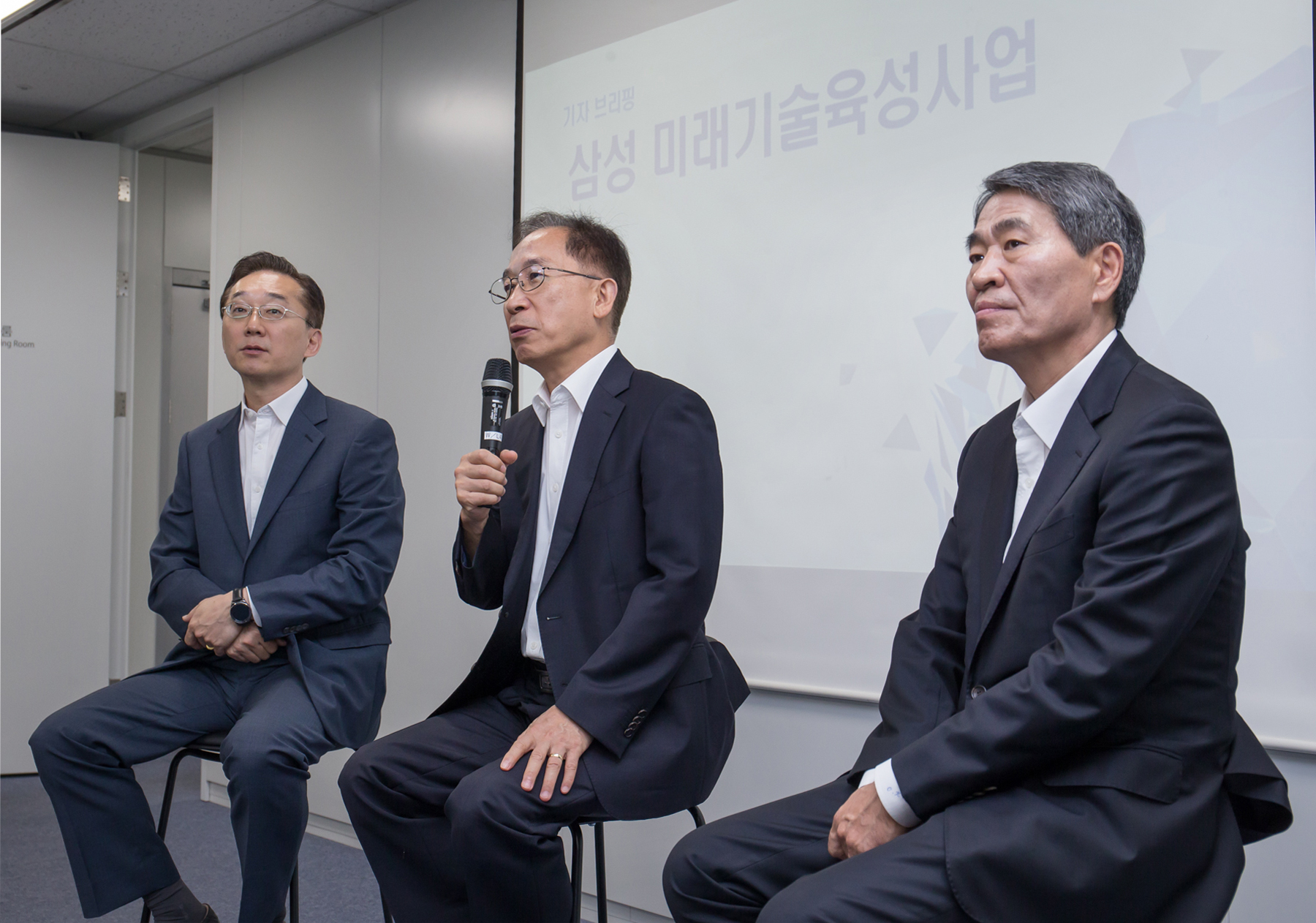
From left, Executive Director Jang Jae-soo, Chairman Kook Yang, and Chairman Kwon Oh-kyung
On August 13, Samsung Electronics held a press conference at the Samsung Electronics press room and briefed on the achievements and future plans of the future technology development project that began in 2013.
Samsung Electronics' Future Technology Promotion Project, which began in 2013 to foster the nation's future science and technology, has, after five years of effort, established itself as a cradle for challenging and creative research in the Korean science and technology community.
Samsung's Future Technology Promotion Project has provided research funding totaling 538.9 billion won to a total of 428 research projects, including 149 in basic science, 132 in materials technology, and 147 in ICT. A total of 7,300 researchers, including 1,000 professors, are participating from 46 domestic universities, including Seoul National University, KAIST, and POSTECH, as well as public research institutes, including KIST and the Korea Institute for Advanced Study.
In August 2013, Samsung established the Samsung Science and Technology Foundation (Basic Science) and the Samsung Electronics Science and Technology Center (Materials, ICT), and has been conducting research support projects for the first time in Korea as a private company. It plans to support future science and technology research with a total of 1.5 trillion won over the next 10 years until 2022.
Samsung's Future Technology Incubation Program is widely recognized for its significant impact on the Korean scientific community, spearheading a new research culture through fair project selection, the introduction of a flexible evaluation and management system that allows researchers to confidently tackle challenging problems, and support for open innovation, where research projects lead to innovation or startups in domestic companies.
Furthermore, as the first research support project for a private enterprise in Korea, it supports challenging research that is difficult for the government to support, discovers excellent new researchers, and contributes to securing national technological competitiveness.
Samsung Electronics plans to expand its support for technologies that form the basis of the Fourth Industrial Revolution, such as AI, IoT, and 5G, through future technology development projects and establish an open innovation system to share these technologies with academia and industry.
Pursuing innovative research results that change people's lives
Through five years of support from Samsung's Future Technology Development Program, research results are emerging across a wide range of fields that can revolutionize people's lives.
The research on targeted anticancer therapy by Professor Tae-Young Yoon of the Department of Life Sciences at Seoul National University (selected in 2014) is expected to usher in a new era of personalized anticancer treatment if successful. This is expected to significantly reduce the time and cost pharmaceutical companies invest in developing targeted therapies, as well as contribute to improving the quality of life for cancer patients by reducing their financial burden and treatment side effects. Professor Yoon's research project led to the creation of a venture company through support such as startup mentoring and investment introductions. Professor Yoon founded the venture company "Protina" in 2016 and has since registered 10 overseas patents and attracted over 10 billion won in investment (including government-funded research funds), accelerating R&D for commercialization.
Professor Park Moon-jung of the Department of Chemistry at POSTECH (selected in 2014) developed an interest in robotics that could provide arms and legs after observing children with disabilities as a child. She is currently researching an electric field-driven polymer actuator (motor) that performs linear motion, a feat unheard of in academia. If realized, Professor Park's research could lead to wearable robots and artificial muscles for people with disabilities. This research was selected for follow-up funding this year, allowing Professor Park to continue her research for another four years.
Professor Baek Jeong-min of the Department of Materials Science and Engineering at UNIST (selected in 2014) is developing a friction generator based on the principles of lightning. If realized, this research could be used to power wearable devices without batteries. Samsung Electronics is focusing on commercialization, purchasing Professor Baek's basic patents and co-filing patents for improvements.
Professor Jaejun Kim of the Department of IT Convergence at POSTECH (selected in 2016) is conducting a research project to develop a dedicated deep learning chip that allows each device to learn on its own, unlike existing deep learning that is performed by software algorithms built on servers. If successful, this project is expected to open up new areas for deep learning chip utilization.
Emphasize expertise, tolerate failure, and embrace open innovation.
Samsung's Future Technology Promotion Project is receiving positive reviews for changing the domestic research culture through the principles it has maintained over the past five years.
First, when selecting projects, we take great care to ensure professionalism, fairness, and objectivity in the evaluation process. Researchers write a two-page research proposal focused on their ideas. To ensure fairness, the reviewers, with their names and affiliations kept anonymous, conduct a written review, focusing on the innovativeness and challenge of the project. The reviewers then spend two days and one night in a dormitory, discussing the proposal in detail. Projects that pass the written review are then required to submit a 20-page research plan in English. The presentation review is then conducted by a panel of experts in the field, who comprehensively evaluate the research proposal's innovativeness and execution capabilities through a one-hour Q&A session.
The overseas review process is conducted by an international jury, including Nobel Prize winners, to assess the global competitiveness of the projects. Projects that pass both domestic and international review are ultimately selected. The jury pool consists of approximately 1,600 domestic and 400 international judges. To ensure a fresh perspective, at least 30% of the judges are new to the process each time.
Second, we encourage challenging and innovative research through flexible project management, where researchers take the initiative and are not held accountable for failure. Researchers autonomously propose research topics, objectives, budgets, and durations, and research goals do not include quantitative targets such as the number of papers or patents produced. Research funds can be executed early or carried over depending on the research situation. If significant initial facility investment is required, support is provided accordingly.
Additionally, in addition to the two-page research report each year, all annual evaluations and mid-term evaluations were eliminated, allowing researchers to focus on their research autonomously. Instead, secretariat staff visit researchers directly once or twice a year to listen to their concerns and identify project support needs. All intellectual property rights created through research remain with the university or research institution. Even if challenging research fails to achieve its goals, no one is held accountable, and the reasons for failure are utilized as intellectual property.
Third, we operate an open innovation model that helps research bear fruit through patent applications and startup support for technologies and ideas, and provides external partners with experience and know-how to ensure that these achievements lead to innovation for domestic companies.
In particular, in the ICT and materials sectors, we are implementing designated themes targeting technologies necessary for securing next-generation core technologies and fostering human resources, thereby fostering technology and human resources while simultaneously providing lateral support to enable the entire industry to innovate and grow. In addition, through R&D exchange meetings between companies and researchers, companies can infuse technology and researchers can set research directions. We operate differentiated programs such as patent application support through approximately 50 designated professional patent attorneys, and startup mentoring including investment brokerage and marketing support. 
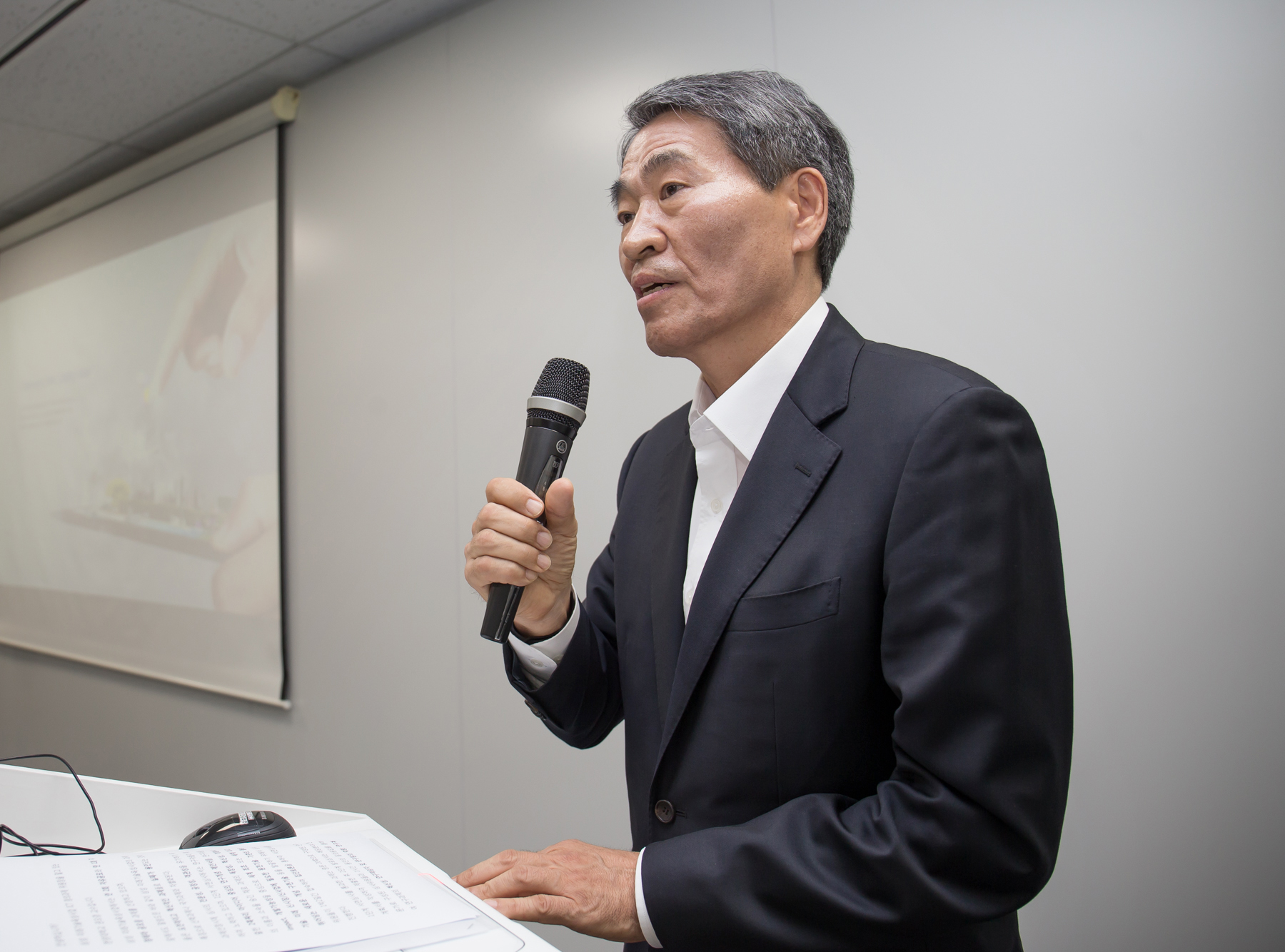
Kwon Oh-kyung, President of the National Academy of Engineering of Korea
Kwon Oh-kyung, president of the National Academy of Engineering of Korea (chairman of the review committee), said, “Previously, patents applied for by universities were limited to the level of disclosing technology,” and added, “Using Samsung Electronics’ patent infrastructure to improve the quality of professors’ patents is very important for maximizing research results.”
Fourth, we support the hosting of the Global Research Symposium (GRS), which provides a forum for sharing and discussing research findings with leading scholars from around the world. This not only enhances research quality but also raises global awareness of these findings. Held three times in 2017 in the fields of mathematical sciences, physics, and chemistry, the GRS attracted approximately 220 domestic and international researchers, including Nobel Prize winners. The participating researchers evaluated it as a helpful opportunity to share their research content and vision with world-renowned scholars and engage in in-depth discussions.
Starting this year, in order to fulfill the GRS's mission of "globalizing research" and to expand the participation of overseas scholars, we plan to expand our international reach, starting with a symposium on molecular neuroscience in Silicon Valley, USA in October.
We are committed to securing national competitiveness in future technologies by fostering an open innovation ecosystem.
Samsung Electronics plans to continue to dedicate itself to securing the nation's future technology competitiveness by supporting creative and challenging research projects that are difficult for the government to support through future technology development projects. In addition, we plan to establish an open innovation ecosystem so that the developed technical personnel and research results can be utilized by various companies, universities, research institutes, and startups in addition to Samsung.
Samsung plans to focus its investments on basic science through the Samsung Future Technology Foundation and expand support for future technologies based on the Fourth Industrial Revolution, including AI, IoT, next-generation communications, semiconductors, and bio, through the Samsung Electronics Future Technology Incubation Center. This will also contribute to the creation of quality jobs, particularly in the scientific community. 
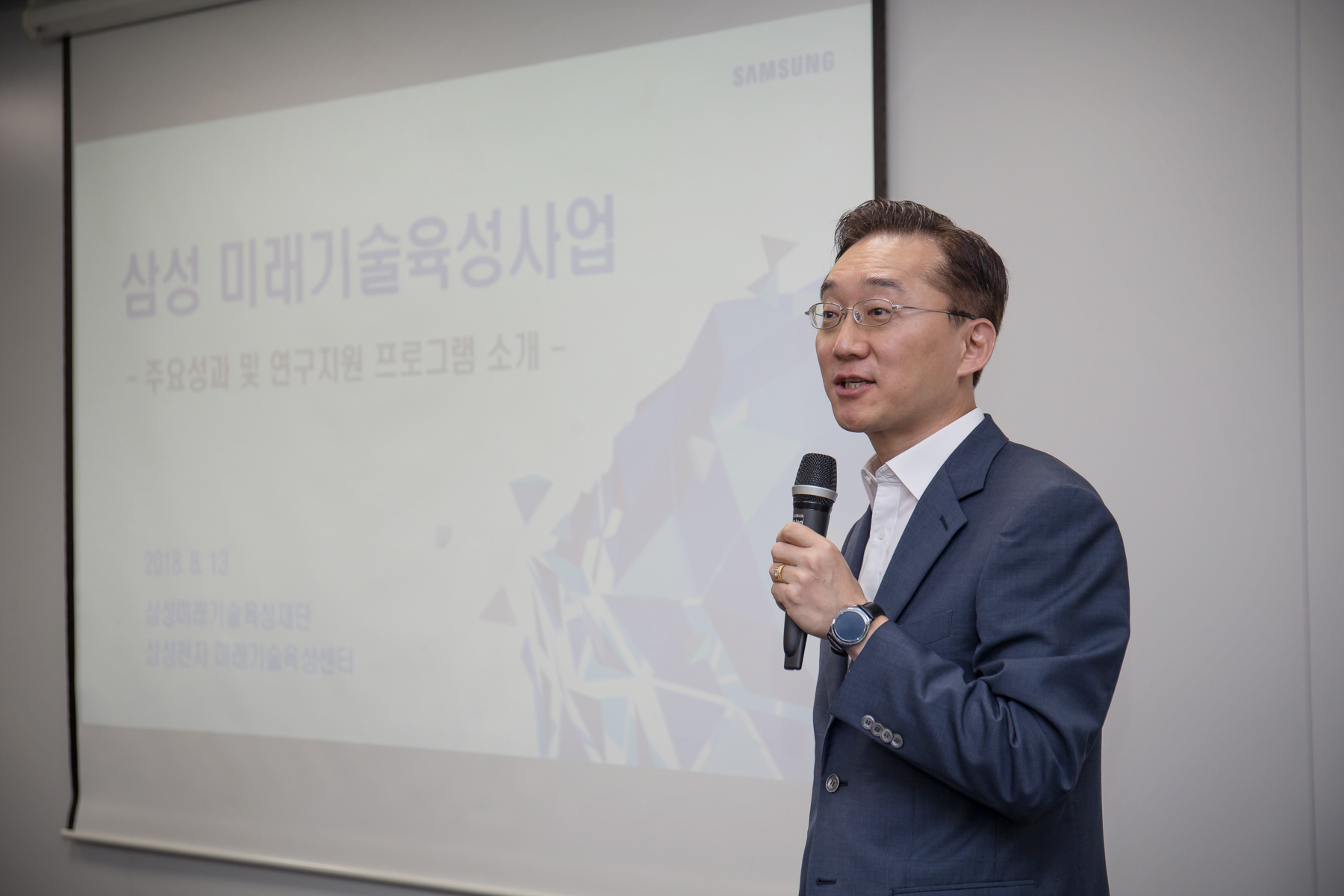
Jang Jae-su, Executive Director of the Future Technology Promotion Center
Jang Jae-soo, Executive Director of the Future Technology Promotion Center, said, “We will strive to improve research outcomes not only through research funding support but also through differentiated support programs that leverage Samsung’s experience and know-how.” 
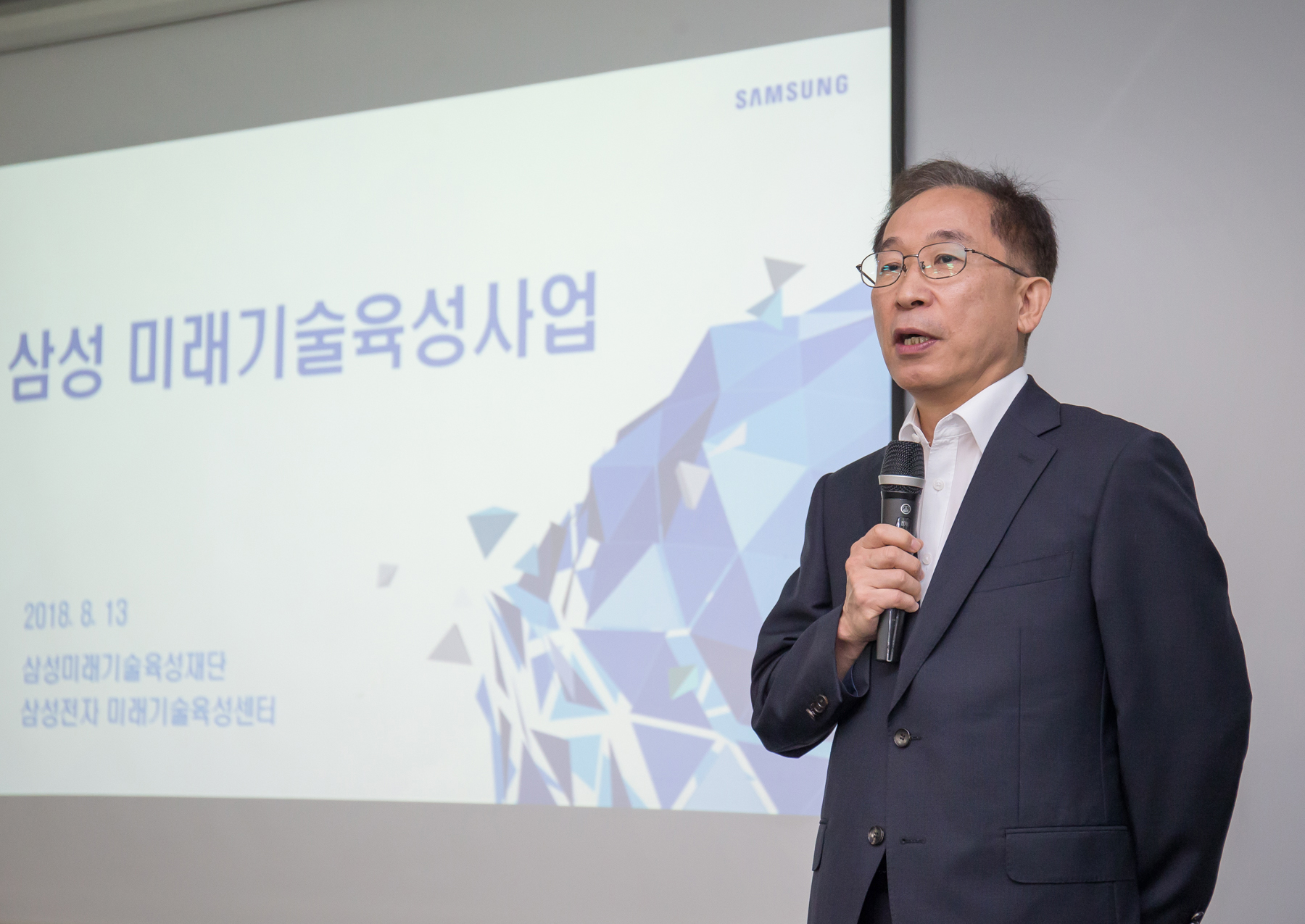
Chairman Kook Yang of the Future Technology Promotion Foundation
Kook Yang, Chairman of the Future Technology Promotion Foundation, stated, "Over the past five years, we have consistently strived to transform the research landscape and establish a new research support model. Going forward, we plan to maintain our original intention and actively support projects that pioneer new fields or tackle challenging challenges with ambitious goals."
A breath of fresh air in academia, from assignment selection to evaluation management.
Efforts to secure technological competitiveness to strengthen national industrial competitiveness

From left, Executive Director Jang Jae-soo, Chairman Kook Yang, and Chairman Kwon Oh-kyung
On August 13, Samsung Electronics held a press conference at the Samsung Electronics press room and briefed on the achievements and future plans of the future technology development project that began in 2013.
Samsung Electronics' Future Technology Promotion Project, which began in 2013 to foster the nation's future science and technology, has, after five years of effort, established itself as a cradle for challenging and creative research in the Korean science and technology community.
Samsung's Future Technology Promotion Project has provided research funding totaling 538.9 billion won to a total of 428 research projects, including 149 in basic science, 132 in materials technology, and 147 in ICT. A total of 7,300 researchers, including 1,000 professors, are participating from 46 domestic universities, including Seoul National University, KAIST, and POSTECH, as well as public research institutes, including KIST and the Korea Institute for Advanced Study.
In August 2013, Samsung established the Samsung Science and Technology Foundation (Basic Science) and the Samsung Electronics Science and Technology Center (Materials, ICT), and has been conducting research support projects for the first time in Korea as a private company. It plans to support future science and technology research with a total of 1.5 trillion won over the next 10 years until 2022.
Samsung's Future Technology Incubation Program is widely recognized for its significant impact on the Korean scientific community, spearheading a new research culture through fair project selection, the introduction of a flexible evaluation and management system that allows researchers to confidently tackle challenging problems, and support for open innovation, where research projects lead to innovation or startups in domestic companies.
Furthermore, as the first research support project for a private enterprise in Korea, it supports challenging research that is difficult for the government to support, discovers excellent new researchers, and contributes to securing national technological competitiveness.
Samsung Electronics plans to expand its support for technologies that form the basis of the Fourth Industrial Revolution, such as AI, IoT, and 5G, through future technology development projects and establish an open innovation system to share these technologies with academia and industry.
Pursuing innovative research results that change people's lives
Through five years of support from Samsung's Future Technology Development Program, research results are emerging across a wide range of fields that can revolutionize people's lives.
The research on targeted anticancer therapy by Professor Tae-Young Yoon of the Department of Life Sciences at Seoul National University (selected in 2014) is expected to usher in a new era of personalized anticancer treatment if successful. This is expected to significantly reduce the time and cost pharmaceutical companies invest in developing targeted therapies, as well as contribute to improving the quality of life for cancer patients by reducing their financial burden and treatment side effects. Professor Yoon's research project led to the creation of a venture company through support such as startup mentoring and investment introductions. Professor Yoon founded the venture company "Protina" in 2016 and has since registered 10 overseas patents and attracted over 10 billion won in investment (including government-funded research funds), accelerating R&D for commercialization.
Professor Park Moon-jung of the Department of Chemistry at POSTECH (selected in 2014) developed an interest in robotics that could provide arms and legs after observing children with disabilities as a child. She is currently researching an electric field-driven polymer actuator (motor) that performs linear motion, a feat unheard of in academia. If realized, Professor Park's research could lead to wearable robots and artificial muscles for people with disabilities. This research was selected for follow-up funding this year, allowing Professor Park to continue her research for another four years.
Professor Baek Jeong-min of the Department of Materials Science and Engineering at UNIST (selected in 2014) is developing a friction generator based on the principles of lightning. If realized, this research could be used to power wearable devices without batteries. Samsung Electronics is focusing on commercialization, purchasing Professor Baek's basic patents and co-filing patents for improvements.
Professor Jaejun Kim of the Department of IT Convergence at POSTECH (selected in 2016) is conducting a research project to develop a dedicated deep learning chip that allows each device to learn on its own, unlike existing deep learning that is performed by software algorithms built on servers. If successful, this project is expected to open up new areas for deep learning chip utilization.
Emphasize expertise, tolerate failure, and embrace open innovation.
Samsung's Future Technology Promotion Project is receiving positive reviews for changing the domestic research culture through the principles it has maintained over the past five years.
First, when selecting projects, we take great care to ensure professionalism, fairness, and objectivity in the evaluation process. Researchers write a two-page research proposal focused on their ideas. To ensure fairness, the reviewers, with their names and affiliations kept anonymous, conduct a written review, focusing on the innovativeness and challenge of the project. The reviewers then spend two days and one night in a dormitory, discussing the proposal in detail. Projects that pass the written review are then required to submit a 20-page research plan in English. The presentation review is then conducted by a panel of experts in the field, who comprehensively evaluate the research proposal's innovativeness and execution capabilities through a one-hour Q&A session.
The overseas review process is conducted by an international jury, including Nobel Prize winners, to assess the global competitiveness of the projects. Projects that pass both domestic and international review are ultimately selected. The jury pool consists of approximately 1,600 domestic and 400 international judges. To ensure a fresh perspective, at least 30% of the judges are new to the process each time.
Second, we encourage challenging and innovative research through flexible project management, where researchers take the initiative and are not held accountable for failure. Researchers autonomously propose research topics, objectives, budgets, and durations, and research goals do not include quantitative targets such as the number of papers or patents produced. Research funds can be executed early or carried over depending on the research situation. If significant initial facility investment is required, support is provided accordingly.
Additionally, in addition to the two-page research report each year, all annual evaluations and mid-term evaluations were eliminated, allowing researchers to focus on their research autonomously. Instead, secretariat staff visit researchers directly once or twice a year to listen to their concerns and identify project support needs. All intellectual property rights created through research remain with the university or research institution. Even if challenging research fails to achieve its goals, no one is held accountable, and the reasons for failure are utilized as intellectual property.
Third, we operate an open innovation model that helps research bear fruit through patent applications and startup support for technologies and ideas, and provides external partners with experience and know-how to ensure that these achievements lead to innovation for domestic companies.
In particular, in the ICT and materials sectors, we are implementing designated themes targeting technologies necessary for securing next-generation core technologies and fostering human resources, thereby fostering technology and human resources while simultaneously providing lateral support to enable the entire industry to innovate and grow. In addition, through R&D exchange meetings between companies and researchers, companies can infuse technology and researchers can set research directions. We operate differentiated programs such as patent application support through approximately 50 designated professional patent attorneys, and startup mentoring including investment brokerage and marketing support.

Kwon Oh-kyung, President of the National Academy of Engineering of Korea
Kwon Oh-kyung, president of the National Academy of Engineering of Korea (chairman of the review committee), said, “Previously, patents applied for by universities were limited to the level of disclosing technology,” and added, “Using Samsung Electronics’ patent infrastructure to improve the quality of professors’ patents is very important for maximizing research results.”
Fourth, we support the hosting of the Global Research Symposium (GRS), which provides a forum for sharing and discussing research findings with leading scholars from around the world. This not only enhances research quality but also raises global awareness of these findings. Held three times in 2017 in the fields of mathematical sciences, physics, and chemistry, the GRS attracted approximately 220 domestic and international researchers, including Nobel Prize winners. The participating researchers evaluated it as a helpful opportunity to share their research content and vision with world-renowned scholars and engage in in-depth discussions.
Starting this year, in order to fulfill the GRS's mission of "globalizing research" and to expand the participation of overseas scholars, we plan to expand our international reach, starting with a symposium on molecular neuroscience in Silicon Valley, USA in October.
We are committed to securing national competitiveness in future technologies by fostering an open innovation ecosystem.
Samsung Electronics plans to continue to dedicate itself to securing the nation's future technology competitiveness by supporting creative and challenging research projects that are difficult for the government to support through future technology development projects. In addition, we plan to establish an open innovation ecosystem so that the developed technical personnel and research results can be utilized by various companies, universities, research institutes, and startups in addition to Samsung.
Samsung plans to focus its investments on basic science through the Samsung Future Technology Foundation and expand support for future technologies based on the Fourth Industrial Revolution, including AI, IoT, next-generation communications, semiconductors, and bio, through the Samsung Electronics Future Technology Incubation Center. This will also contribute to the creation of quality jobs, particularly in the scientific community.

Jang Jae-su, Executive Director of the Future Technology Promotion Center
Jang Jae-soo, Executive Director of the Future Technology Promotion Center, said, “We will strive to improve research outcomes not only through research funding support but also through differentiated support programs that leverage Samsung’s experience and know-how.”

Chairman Kook Yang of the Future Technology Promotion Foundation
Kook Yang, Chairman of the Future Technology Promotion Foundation, stated, "Over the past five years, we have consistently strived to transform the research landscape and establish a new research support model. Going forward, we plan to maintain our original intention and actively support projects that pioneer new fields or tackle challenging challenges with ambitious goals."
본 기사에 대한 정정·반론·추후보도 청구는 보도 청구 안내를, 그간 게재된 보도문은 정정·반론보도 모아보기를 참고해 주세요.