



Signed a business agreement with Kwangwoon University for the establishment of Microcontroller (MCU) courses and the development of humanoid robots
 Published2012.06.11 17:47
- Freescale MCU Course launched starting Fall 2012
- Development of human-sized humanoid robot, “Frankie,” by the end of this year
- Foundation for fostering domestic robot specialists through training programs
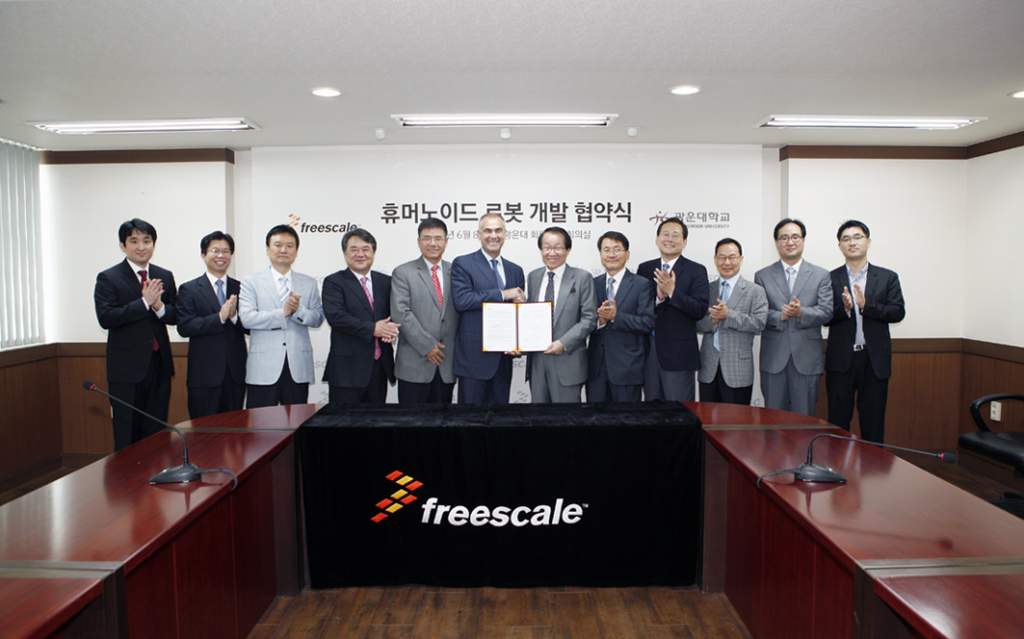
June 8, 2012 (requesting publication after 8:00 AM on June 11), Seoul, Korea — Freescale Semiconductor (NYSE: FSL, www.freescale.com ) is partnering with Kwangwoon University to develop a human-sized humanoid robot based on various long-term training programs designed to foster domestic robot specialists.
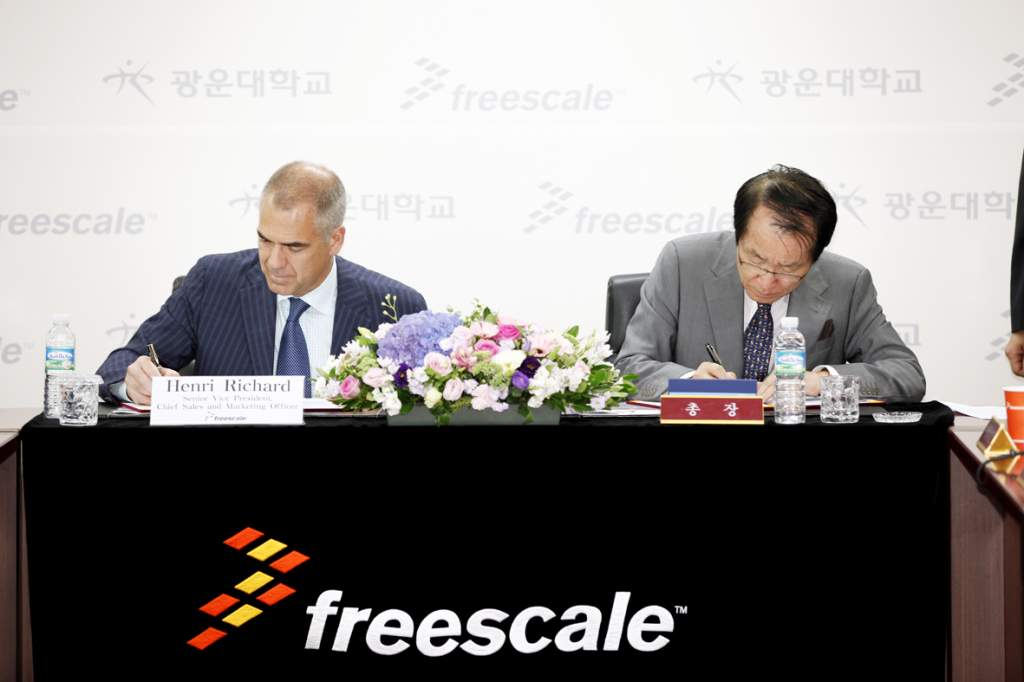
On June 8, a business agreement for the development of the robot industry, one of the future growth engine industries, was signed in the main conference room of Hwadogwan at Kwangwoon University, attended by Freescale Senior Vice President and Chief Sales and Marketing Officer Henri Richard, Kwangwoon University President Kim Ki-young, Freescale Korea President Hwang Yeon-ho, and Professor Park Il-woo of the Department of Robotics at Kwangwoon University.
Through this agreement, Freescale and Kwangwoon University have decided to promote the cultivation of domestic robot specialists and the strengthening of robot education capabilities through a long-term plan spanning the next 10 years. The plan includes the establishment of a robotics learning course starting in September 2012 to teach how to use Freescale semiconductor products for robot applications and development. Through this curriculum, students will develop "Frankie," a functional humanoid robot equipped with Freescale technology.
Freescale plans to help Kwangwoon University build humanoid robots equipped with various high-performance semiconductor technologies, including Freescale's Kinetis microcontrollers (MCUs), i.MX application processors, digital signal controllers (DSCs), PX series microcontrollers (MCUs), and Xtrinsic sensor product families.
Freescale's technology is widely used in commercial robots as well as in fields ranging from industrial manufacturing to personal services. At the 2011 Freescale Technology Forum US, the company first introduced a tower system mechatronics robot and development board named "FSLBOT," which is capable of walking, dancing, and interacting with external stimuli. FSLBOT is used as a robotics learning tool for everyone from advanced engineers to students and enthusiasts. For more information, please refer to Freescale's robotics solutions website ( www.freescale.com/robotics ).
"It is a very valuable opportunity to partner with Kwangwoon University, which has established and is operating the first robotics department in Korea," said Henri Richard, Vice President of Freescale. "We are pleased to help students gain valuable experience in the field of robotics by utilizing Freescale's industry-leading processors and motor control technologies."
Kwangwoon University President Kim Ki-young stated, “In line with the government’s policy to foster next-generation robots, Kwangwoon University, an IT-specialized university, plans to do its utmost to establish an industry-academia collaboration education system by jointly developing cutting-edge curricula that meet market demands with Freescale. This collaboration holds great significance for the globalization of domestic universities.”
Meanwhile, opportunities in the robot market are comprehensive, spanning medical, consumer products, home appliances, and industrial automation, and possess high growth potential. According to the Korea Institute for Industrial Economics and Trade (KEIT), the global robot market is expected to grow from $30 billion in 2013 to $100 billion in 2018. The size of the Korean robot market is projected to reach $10 billion in 2015, and the Korean government is actively working to lead the robot industry, including the establishment of robot theme parks in Incheon and Masan.
Kwangwoon University and the Department of Robotics
Boasting a 78-year history and producing future-oriented, creative talents, it is one of the universities in Seoul with the highest number and proportion of students majoring in electronic information (800 students per year, 42% of freshmen). Kwangwoon University’s School of Robotics began in 2010 with a student quota of 80 and a faculty of 10, and is led by Professor Jin-O Kim, who oversaw the South Korean government's robot strategy and planning. Professor Kim also holds the distinction of being the 106th recipient of the Joseph Engelberger Robotics Award, often referred to as the Nobel Prize of the global robotics industry. Kwangwoon University’s robot gaming team, ‘Ro:bit,’ operates on a 100% scholarship program and has achieved excellent results in various contests since its founding, including 2nd place in the world at the 2008 RoboGames in the US and 1st place in the world at the 15th Japan RoboOne competition in 2009.

관련뉴스

Intel Unveils Next-Generation 'Core Ultra Series 3' and vPro Platform for Enterprise PCs
인텔이 차세대 기업용 PC를 위한 ‘인텔 코어 Ultra 시리즈 3’와 최신 vPro 플랫폼을 공식 발표하며, 기업용 노트북부터 고성능 워크스테이션까지 폭넓은 수요 충족에 나섰다.
2026.03.26by 배종인 기자

ROHM Launches ESD Protection Diode Compatible with High-Speed Interfaces of 10Gbps or Higher
반도체 전문 기업 로옴(ROHM)이 10Gbps를 넘어서는 차세대 고속 데이터 통신 환경에 대응할 수 있는 ESD(정전기 방전) 보호 다이오드 ‘RESDxVx 시리즈’를 개발하며, 고속 인터페이스에서 요구되는 신호 품질 유지와 IC 보호 성능을 동시에 끌어올렸다.
2026.03.26by 배종인 기자
ST Launches 75V Drive IC Targeting 48V Industrial Motor Driving
ST마이크로일렉트로닉스가 48V급 산업용 구동 시스템 설계에 맞춘 75V 모터 드라이브 IC ‘STSPIN9P’ 시리즈를 공개했다. 새 제품군은 하프 브리지와 풀 브리지 구조로 구성돼 모터 종류와 출력 조건에 따라 설계를 확장할 수 있도록 한 것이 특징이다. 전원 회로와 보호 기능, 전류 감지 회로를 칩에 통합해 시스템 구성을 단순화했으며, 최대 500W급 애플리케이션까지 대응하도록 설계됐다. 회사는 레퍼런스 디자인과 데모 보드도 함께 제공해 산업 자동화, 로보틱스, 펌프, 팬, 조명, 섬유 기계 등에서 개발과 평가를 지원할 계획이다.
2026.03.26by 배종인 기자
Nordic supports security updates for the entire lifecycle of IoT devices at a single fixed cost
Nordic Semiconductor, a global leader in low-power wireless connectivity solutions, has unveiled a single fixed-cost licensing model that delivers FOTA (Firmware Over-the-Air) and device management capabilities throughout the device lifecycle via nRF Cloud, and introduced a new firmware update solution to prepare for the enforcement of the European Union's Cyber Resilience Act (CRA).
2026.03.26by 배종인 기자
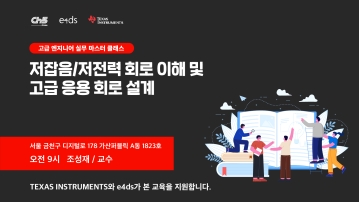
Practical Training in Low-Noise, Low-Power Circuit Design All in One Place… Training Fee Support
고감도 아날로그 회로와 센서 기반 시스템 설계 역량을 강화할 수 있는 ‘2026 고급 엔지니어 실무 마스터 클래스’가 오는 4월16일 서울 가산동 e4ds 컨퍼런스 센터에서 열린다. 이번 과정은 온라인이 아닌 오프라인 유료 실습 교육으로 진행되며, 현장 중심의 심화 학습을 원하는 엔지니어를 대상으로 한다. 이번 교육은 텍사스 인스트루먼트(Texas Instruments)가 교육비를 지원해 정가 25만원에서 10만원 할인 된 15만원에 참가할 수 있다.
2026.03.26by 배종인 기자











