



Improve GPS signal reception with an ultra-small LNA
 Published2012.06.25 11:26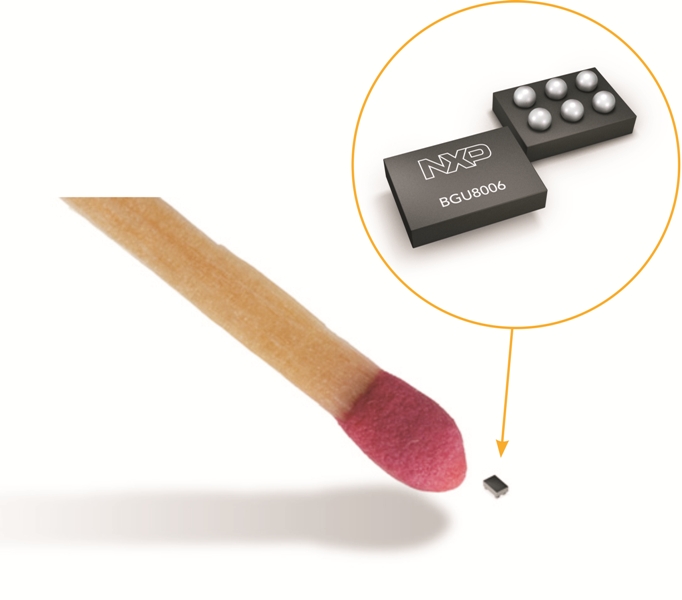
SAN JOSE, Calif., June 25, 2012 – NXP Semiconductors NV (NAS) today announced the BGU8006 low-noise amplifier, the smallest GPS LNA commercially available for ultra-small mobile devices. Housed in an ultra-small wafer-level chip-scale package (WLCSP), the new GPS LNA measures just 0.65 x 0.44 x 0.2 mm. Requiring only two external components, it saves 38% of PCB space compared to the smallest solution currently on the market. The LNA also achieves an ultra-low noise level of 0.60 dB, enabling it to dynamically suppress strong cellular and WLAN transmit signals for optimal reception of weak GPS signals. NXP showcased the BGU800x serial LNA at the IEEE MTT-S IMS2012 (International Microwave Symposium) in Montreal. http://www.youtube.com/watch?v=-mS_66-SuZI
“Smartphones, tablets, personal navigation devices and automotive telematics applications all suffer from poor network reception, requiring them to wait for data until the GPS finds a satellite signal and restarts,” said Erick Olsen, marketing director for RF small signal product line at NXP Semiconductors. “The newly announced, almost invisible, BGU8006 LNA helps maintain optimal GPS signal reception for as long as possible.” With GPS capabilities now so widely used, the ability to provide more accurate and faster Time to First Fix (TTFF) will significantly improve the user experience and enable operators to offer more sophisticated location-based services,” he explained.
The new BGU8006 LNA uses adaptive biasing, implemented in NXP’s state-of-the-art QuBIC4Xi SiGe:C BiCMOS process technology, to instantly detect any output power from a jammer and compensate by temporarily increasing current. Adaptive biasing compresses typical GPS LNAs to lower gain, generates intermodulation and harmonics that further weaken weak signals, and dynamically suppresses strong cellular, WLAN, and Bluetooth signals that can cause poor GPS reception. In the BGU8006, adaptive biasing improves linearity, achieving 10 dB better IP3 under interference conditions from -40 to -20 dBm, and providing effective GPS output power with jammer power up to -15 dBm.
The BGU8006 LNA uses Wafer-Level Chip-Scale Package (WLCSP) technology, which is ideal for space-constrained devices. WLCSP minimizes plastic inductance because it has no solder joints, bond wires, or interposer connections, optimizing package size, cost, and thermal properties. In addition to the BGU8006, NXP has also released the BGU8007 LNA in a 1.45 x 1.0 x 0.5 mm 6-pin leadless SOT886 package. Both of these LNAs require only one external matching inductor and one external decoupling capacitor, saving component cost, PCB space, and ease of design.
NXP's BGU800x series LNAs are suitable for a wide range of GPS-enabled applications today, including smartphones, feature phones, tablets, personal navigation systems, digital cameras, digital camcorders, RF front-end modules for phones, and integrated GPS chipset modules. For automotive telematics applications such as emergency calling (eCall) and toll collection systems, NXP offers the AEC-Q100 qualified BGU7004 and BGU7008.
Release Schedule
The BGU8007 LNA is currently available. Verification samples of the BGU8006 are expected to be available in Q3, with full-scale production scheduled for Q4 2012.
Related Links
• NXP BGU8006 LNA product information: http://www.nxp.com/pip/BGU8006
• NXP's GPS LNA: http://www.nxp.com/unleash-rf/lna/gps-lnas
• Video: World's Smallest GPS LNA Presented in WLCSP: http://www.youtube.com/watch?v=-mS_66-SuZI
• Video: NXP GPS and FM Low-Noise Amplifier: Best Reception in Smallest Footprint ( http://www.youtube.com/watch?v=IxSAPVLTRTw )
• NXP RF Manual (16th edition) http://www.nxp.com/products/related/rf-manual/

관련뉴스

Intel Unveils Next-Generation 'Core Ultra Series 3' and vPro Platform for Enterprise PCs
인텔이 차세대 기업용 PC를 위한 ‘인텔 코어 Ultra 시리즈 3’와 최신 vPro 플랫폼을 공식 발표하며, 기업용 노트북부터 고성능 워크스테이션까지 폭넓은 수요 충족에 나섰다.
2026.03.26by 배종인 기자

ROHM Launches ESD Protection Diode Compatible with High-Speed Interfaces of 10Gbps or Higher
반도체 전문 기업 로옴(ROHM)이 10Gbps를 넘어서는 차세대 고속 데이터 통신 환경에 대응할 수 있는 ESD(정전기 방전) 보호 다이오드 ‘RESDxVx 시리즈’를 개발하며, 고속 인터페이스에서 요구되는 신호 품질 유지와 IC 보호 성능을 동시에 끌어올렸다.
2026.03.26by 배종인 기자
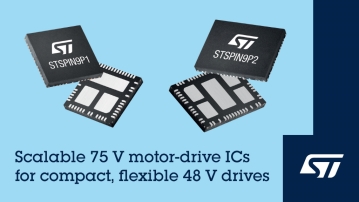
ST Launches 75V Drive IC Targeting 48V Industrial Motor Driving
ST마이크로일렉트로닉스가 48V급 산업용 구동 시스템 설계에 맞춘 75V 모터 드라이브 IC ‘STSPIN9P’ 시리즈를 공개했다. 새 제품군은 하프 브리지와 풀 브리지 구조로 구성돼 모터 종류와 출력 조건에 따라 설계를 확장할 수 있도록 한 것이 특징이다. 전원 회로와 보호 기능, 전류 감지 회로를 칩에 통합해 시스템 구성을 단순화했으며, 최대 500W급 애플리케이션까지 대응하도록 설계됐다. 회사는 레퍼런스 디자인과 데모 보드도 함께 제공해 산업 자동화, 로보틱스, 펌프, 팬, 조명, 섬유 기계 등에서 개발과 평가를 지원할 계획이다.
2026.03.26by 배종인 기자

Nordic supports security updates for the entire lifecycle of IoT devices at a single fixed cost
Nordic Semiconductor, a global leader in low-power wireless connectivity solutions, has unveiled a single fixed-cost licensing model that delivers FOTA (Firmware Over-the-Air) and device management capabilities throughout the device lifecycle via nRF Cloud, and introduced a new firmware update solution to prepare for the enforcement of the European Union's Cyber Resilience Act (CRA).
2026.03.26by 배종인 기자

Practical Training in Low-Noise, Low-Power Circuit Design All in One Place… Training Fee Support
고감도 아날로그 회로와 센서 기반 시스템 설계 역량을 강화할 수 있는 ‘2026 고급 엔지니어 실무 마스터 클래스’가 오는 4월16일 서울 가산동 e4ds 컨퍼런스 센터에서 열린다. 이번 과정은 온라인이 아닌 오프라인 유료 실습 교육으로 진행되며, 현장 중심의 심화 학습을 원하는 엔지니어를 대상으로 한다. 이번 교육은 텍사스 인스트루먼트(Texas Instruments)가 교육비를 지원해 정가 25만원에서 10만원 할인 된 15만원에 참가할 수 있다.
2026.03.26by 배종인 기자











