


90% of the world's largest companies have already automated their business processes.
 Published2019.06.27 09:01
A survey of 502 senior executives across eight countries.
| Most respondents worldwide are satisfied with the effectiveness of automation
A report has been released on the current state of automation and future prospects for companies around the world.
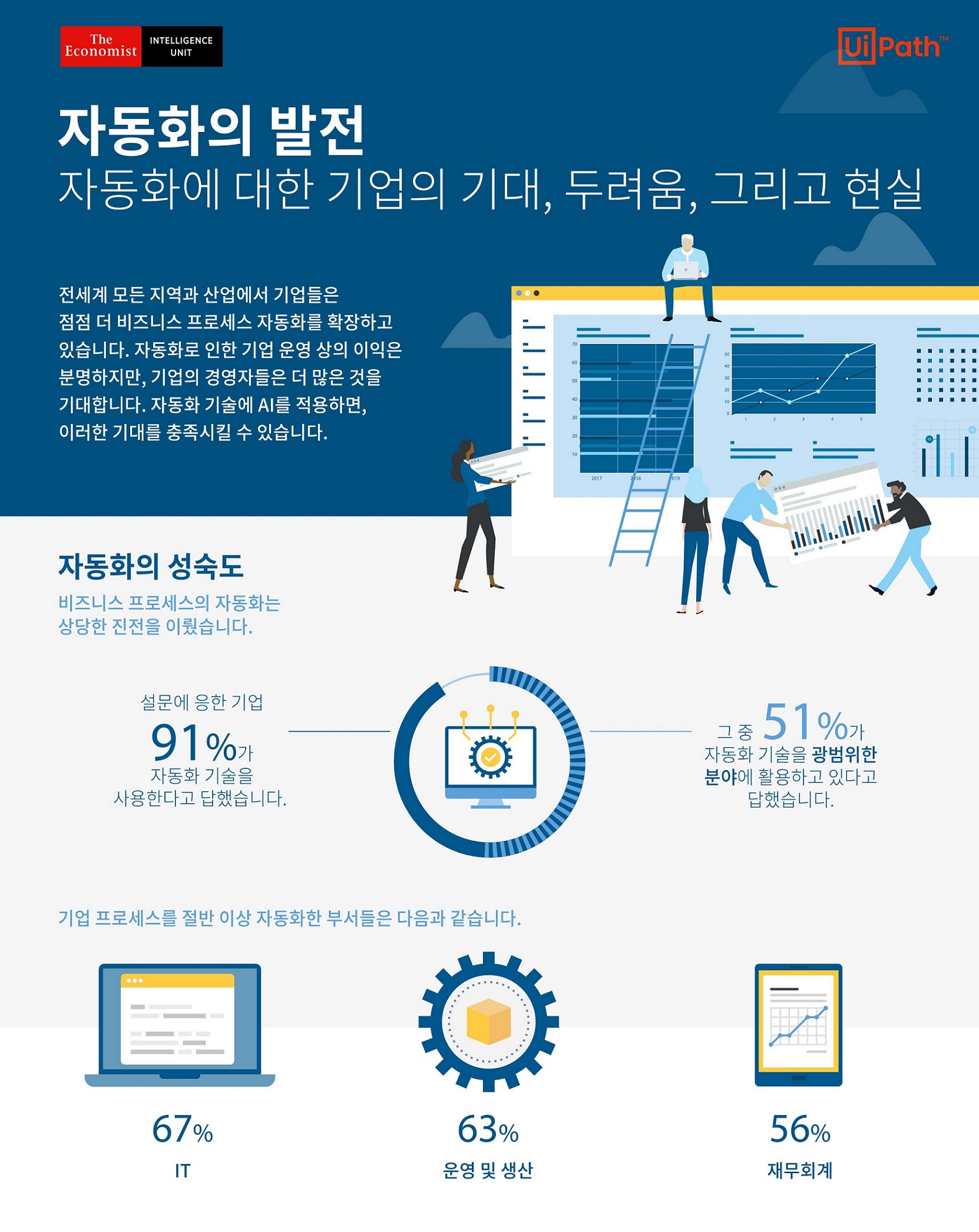
According to this survey conducted by UiPath in collaboration with the Economist Intelligence Unit (EIU), a research institute of the British business weekly magazine The Economist, more than 90% of organizations are adopting and using related technologies to automate business processes.
The survey was conducted with 502 senior executives from companies with annual sales of $250 million in eight countries: Canada, France, Germany, India, Japan, Singapore, the United Kingdom, and the United States. More than half of the companies surveyed were large corporations with annual sales of over $1 billion.
UiPath's survey results show significant progress in automating business processes, and automation will accelerate in more areas in the future.
According to the report, more than 90% of surveyed companies have already automated areas of their business, and 73% of them are very satisfied with the benefits of automation.
A majority of respondents, 88%, said automation would enhance human fulfillment, while 79% said automation would be most effective when it assists humans rather than replaces them. The main findings of the report are as follows:
Automation: A Top Priority for Executives in Digital Transformation
Automation has emerged as a top priority for C-level executives in their companies' digital transformation.
The responsibility for driving automation projects was identified as going to the CTO (29%), CEO (22%), and CIO (17%), in that order.
More than 70% of respondents said RPA and AI are priorities because they provide a competitive advantage in achieving their companies' strategic goals.
94% of the surveyed companies are pursuing digital transformation through automation, and the main benefits of automation technology include: ▲increased customer satisfaction ▲freeing employees from repetitive and simple tasks ▲increased work throughput ▲efficient product/service marketing ▲increased customer engagement ▲development of new revenue streams.
Manufacturing and IT operations are prioritized for automation.
The industry with the highest level of business process automation was manufacturing (61%), while government and public institutions (35%) showed the lowest level of automation among those surveyed.
Most companies that have adopted automation have done so for repetitive back-office tasks, most commonly in IT, customer service, and finance.
Key tasks for IT automation included managing passwords and service requests, and managing maintenance schedules during operations. Respondents identified customer service, marketing, and R&D as areas where automation is most urgently needed within the next two years.
Software robots should be introduced first, rather than hardware robots.
Software and hardwareThoughts about fairy tales also appeared differently.
69% of respondents said that software automation, such as RPA, is a higher priority than hardware robots to achieve strategic business goals.
Barriers to Automation Adoption
According to the report, despite the global trend toward automation, the adoption of automation is being delayed due to issues such as privacy and security.
Respondents in the public and healthcare sectors highlighted concerns about automation security.
Respondents cited limitations in technology implementation, a lack of relevant talent and capabilities, and employee resistance as barriers to widespread automation implementation.
Technological limitations appeared to be most severe in Asia, particularly Japan, while employee resistance to change appeared most pronounced in the UK.
Forty-two percent of respondents said it was important to provide training for automation and opportunities for employees to transition to new tasks after automation is implemented.
관련뉴스
델 EMC, 서울에 AI 익스피리언스 존 개소… 한국 기업 AI 프로젝트 지원에 소매 걷었다
델 EMC가 AI 익스피리언스 존을 서울에도 열었다. AI 익스피리언스 존은 역삼동 강남파이낸스센터에 위치한 델 EMC 본사의 코리아 솔루션 센터 내에 마련됐다. AI 익스피리언스 존은 한국 기업들이 AI를 비즈니스에 도입하기 위한 지원 허브로 기업들의 디지털 트랜스포메이션을 가속화한다. 서울을 포함한 아태지역 5개 도시에서 인텔과의 파트너십을 통해 선보이는 델 EMC의 AI 익스피리언스 존은 AI 프로젝트의 시작과 수행에 어려움을 겪는 기업들에게 체계적이고 실용적인 도움을 제공하기 위한 취지로 마련됐다.
2019.05.24by 이수민 기자

Smart city spending in the Asia-Pacific region excluding Japan is expected to reach $35.4 billion by 2022.
IDC의 전 세계 스마트 시티 지출가이드 보고서는 일본을 제외한 아시아 태평양 지역의 해당 시장 지출 규모가 2022년, 354억 달러에 이를 것으로 전망했다. 이는 2018년 전망치보다 16.8% 증가한 수치다. 또한, 싱가포르, 베이징, 상하이, 그리고 서울의 스마트 시티 프로그램 지출이 올해 40억 달러를 넘어설 것으로 내다봤다. IDC 아시아 태평양 공공 부문 리서치를 총괄하는 제럴드 왕은 “2018년 이전에는 클라우드 솔루션이 디지털 트랜스포메이션을 통한 스마트 시티 추진에 필수사항”이었다며, “정부가 사일로한 클라우드 우선 전환 노력을 디지털화 하는 것에서 통합된 여러 기관간의 허브 구현으로 전략을 전환함에 따라 교통 및 공공 안전과 같은 상호 연결된 생태계가 점점 더 요구되고 있다”고 말했다.
2019.06.06by 이수민 기자
NVIDIA's DLI will train AI experts across nine industries.
산업계 전반에서 비즈니스에 AI를 적용하고자 하는 기업들이 늘고 있다. 델 테크놀로지스가 올해 1월에 발표한 디지털 트랜스포메이션 인덱스에 따르면, AI는 아태지역 비즈니스 리더들에게 최우선 순위 과제 중의 하나다. 엔비디아는 AI 전문가 양성을 위해 다양한 노력을 기울이고 있다. 그 중 하나가 바로 딥 뉴럴 네트워크의 설계부터 훈련, 배포까지 다루는 글로벌 교육 프로그램인 딥 러닝 인스티튜트(DLI)다. 엔비디아 DLI 참가자들은 클라우드에서 GPU 가속 워크스테이션을 사용할 수 있으며, 최신 딥 러닝 프레임워크와 SDK를 통해 신경망을 최적화하고 구축하는 방법을 배울 수 있다.
2019.06.17by 이수민 기자
Nvidia invests $5 billion in Intel
NVIDIA and Intel, leaders in global AI computing technology, are now forging ahead in providing cutting-edge solutions through NVLink-based architecture integration. NVIDIA and Intel have officially announced a strategic partnership and stated that they will jointly develop customized data center and personal computing products to accelerate diverse applications and workloads ranging from hyperscale to enterprise and consumer markets, thereby laying the foundation for the next generation computing era.
2025.09.22by 배종인 기자
.jpg)
Applied Materials Launches Environmental Protection Campaign to Mark World Cleanup Day
어플라이드 머티어리얼즈 코리아(대표 박광선)가 ‘세계 청소의 날(World Cleanup Day)’을 맞아 동탄 신리천 일대에서 임직원 및 가족과 함께 환경 정화 활동을 펼치며, 기술 혁신을 넘어 지역사회와 함께하는 기업으로 거듭나고 있다.
2025.09.22by 명세환 기자











