


[Contribution] Bluetooth® Low Energy PEPS System with CAN Nodes
 Published2019.08.13 15:58
This article covers the selection of a suitable communication bus architecture for the automotive Bluetooth Low Energy PEPS (Passive-entry-passive-start) architecture, and provides an example of starting a vehicle with PEPS technology instead of a key, based on LIN and CAN, which are representative communication bus architectures for vehicles.
In automotive systems featuring passive-entry-passive-start (PEPS) using Bluetooth® low energy technology, drivers can start the electric motor (or engine in the case of an internal combustion engine) with a key fob that communicates with the vehicle access system instead of the car key.
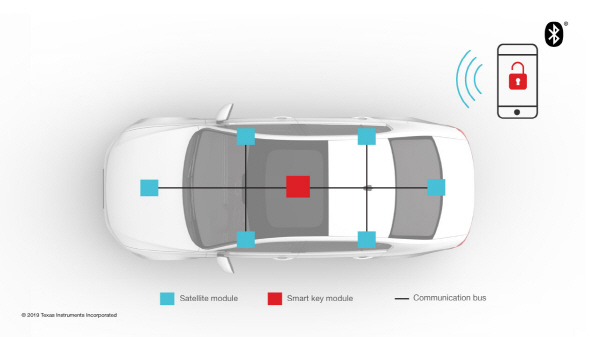
[Figure 1] shows a typical architecture of a Bluetooth low energy PEPS for vehicles, which consists of one central smart key module and nine satellite modules.
At this time, the nine satellite modules are a virtual number, and in reality, more or fewer satellite modules may be implemented. Also, looking at [Figure 1], you can see that the modules communicate with each other through the communication bus.
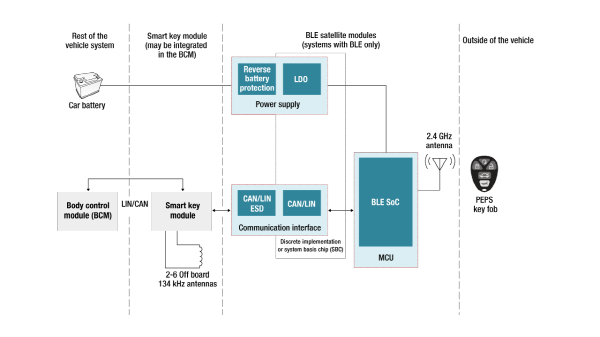
[Figure 2] is a typical block diagram of a Bluetooth low energy satellite module, which consists of a Bluetooth low energy system-on-chip (SoC) such as TI's SimpleLink ™ CC2640R2F-Q1, a power supply, and a communication interface (typically a transceiver).
In [Figure 2] below, you can see various modules included in the PEPS system, such as the smart key module as well as the body control module.
Both LIN and CAN are standard communication protocols widely used in automotive applications. The LIN communication system has a maximum baud rate of 19.2 Kbps, while Classical CAN offers 1 Mbps and CAN FD offers up to 5 Mbps.
LIN and CAN use message frames as the basis for establishing communication protocols, and data fields can transmit up to 8 bytes. The message frame length of LIN, which transmits 8 bytes, is 124 bits, while a standard CAN frame or CAN 2.0 frame can be up to 135 bits.
However, this assumes the worst-case bit stuffing, including interframe space. Therefore, the transmission speed of a LIN message frame is 6.46 ms, while a standard CAN message frame is only 135 µs, which is faster.
Which should I choose, LIN or CAN?
This means that CAN bus-based systems are more expensive than LIN bus-based systems, so CAN bus may not always be the best choice.
So which of these two protocols should you choose? One way to do this is to analyze the total number of bytes required for transmission.
If a Bluetooth low energy chip implements the computational algorithm in the satellite node, the number of bytes required to be transmitted can be reduced, so it can be satisfied with LIN communication alone.
On the other hand, if a Bluetooth low energy chip transmits all the raw measured data without any calculation, it would require a lot of bytes, making the CAN architecture a more suitable choice.
Another consideration is power consumption. LIN bus-based nodes typically consume less power than CAN buses in all operating modes. Specific power consumption figures can be found in each transceiver data sheet.
Application Cases
CAN communication capabilities can be easily added to satellite nodes with TI's new TCAN4550-Q1 system-basis chip ( SBC ), which integrates a CAN FD controller and transceiver. In addition to the integrated controller and transceiver, the SBC is self-contained and requires no additional power supply.
Additionally, the SBC has a watchdog timer that acts as a system-on-chip (SoC) monitor and provides voltage supplies for additional power components on the printed circuit board.
[Figure 3] shows a satellite node that can be implemented using the TCAN4550-Q1, which utilizes the functions of this device.
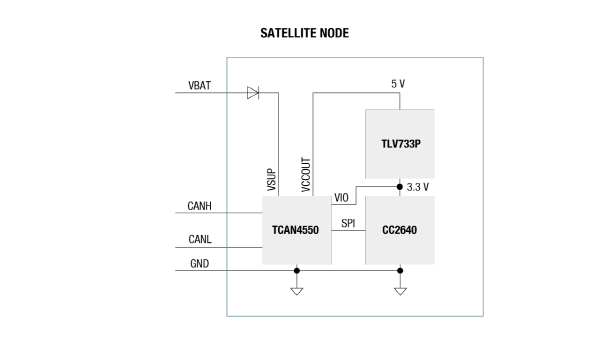
This regulator generates the 3.3V required for the CC2640R2F-Q1 Bluetooth low energy SoC, eliminating the need for a wide VIN regulator for power supply.
3.3V regulator output is V for TCAN4550-Q1It can also be used as an IO, eliminating the need for voltage level conversion between the Bluetooth low energy SoC and the TCAN4550-Q1.
Additionally, the TCAN4550-Q1's watchdog timer can monitor the execution of Bluetooth low energy SoC software. This highly integrated SBC enables cost-effective implementation of Bluetooth low energy hygienic nodes.
Now, Bluetooth low energy technology enables the implementation of next-generation PEPS systems in vehicles.
As developers grapple with the challenge of determining the optimal number of nodes required to meet PEPS requirements, the communication bus architecture plays a key role in the solution, with developers having a choice of communication protocols: LIN or CAN.
TI's LIN transceivers and the newly introduced TCAN4550-Q1 SBC, along with Bluetooth low energy SoCs and power management devices, provide a complete portfolio of devices to choose from as well as the flexibility to develop solutions optimized for automotive platforms.

관련뉴스
Microchip Announces Ultra-Low-Power Access Solutions for Smart Keys and Wearables
Microchip Technology (CEO Han Byung-don) has announced the industry's lowest-power PEPS (Passive Entry/Passive Start) solution. The two new devices, ATA5700 and ATA5702, provide an extended operating range of approximately 10 meters and consume extremely low power, delivering battery life up to 3 times longer than competing products even when operating in maximum sensitivity mode.
2016.11.23by 신윤오 기자

TI Brings Ethernet Connectivity to Its Wired and Wireless Communication MCU Platforms
TI has introduced Ethernet connectivity to the SimpleLink microcontroller (MCU) platform, a single platform offering hardware, software, and tool options for wired and wireless communication MCUs that enable developers to more easily connect sensors from gateways to the cloud. The new SimpleLink MSP432 Ethernet MCU is based on a high-performance 120MHz ARM Cortex-M4F core with integrated MAC and PHY, and can help shorten time-to-market for grid infrastructure and industrial automation gateway applications. The SimpleLink MSP432 Ethernet MCU integrates Ethernet MAC, PHY, USB, and CAN, allowing developers to reduce development time and simplify board layout. It can be configured to combine wired communications with wireless connectivity technologies such as Sub-1GHz, Wi-Fi, and Bluetooth through built-in serial interfaces, thereby enabling end nodes to connect to the cloud.
2017.11.29by 김지혜 기자

TI Launches Automotive System-Based Chip with Integrated CAN FD Controller and Transceiver
Texas Instruments announced the launch of an automotive system-based chip product that integrates a CAN FD controller and transceiver. The TCAN4550-Q1 is designed to meet requirements for high bandwidth and flexible data transmission rates in in-vehicle networks, enabling engineers to implement CAN FD interfaces or expand the number of bus ports with minimal hardware modifications across any microcontroller's SPI bus interface. With the newly released TCAN4550-Q1 SBC, engineers can easily upgrade or expand body control and lighting, ADAS, and automotive gateway designs to CAN FD while maintaining their existing microcontroller-based architecture.
2019.06.14by 이수민 기자
A single misaligned light means 'defect'… Vehicle interior lighting now guarded by semiconductors and software
Automotive interior lighting is moving beyond its role as 'auxiliary lighting.' As it becomes a core element of user experience (UX) that expresses brand identity through color and animation while reflecting driver preferences, the LED interior ambient lighting market is growing rapidly. In connection with this, we met in advance with Choi Young-jae, Research Director at Dabo Corporation, who will present a technical webinar session on "Intelligent LED Interior Lighting Solutions Illuminating Future Vehicles," to hear about market trends and changes in design requirements.
2026.08.28by 명세환 기자
TI, HEV·EV 트랙션 인버터용 다축 코어리스 전류 센서 TMCS2100-Q1 공개
Texas Instruments가 HEV·EV 트랙션 인버터용 다축 코어리스 홀 효과 전류 센서 TMCS2100-Q1을 공개했다. 수평·수직 자기장을 동시에 측정하는 다축 센싱 기술로 기존 단일 축 센서 대비 최대 20배 높은 정확도를 달성하며, 버스바 무개조 설계로 기계 설계 유연성을 확보했다. 800V 아키텍처 확산에 따른 고정확도 요구 충족과 소형화를 동시에 구현한다.
2026.08.27by 배종인 기자











