



Byco launches a power solution every two years that promises 25% higher power density and 25% lower power loss.
 Published2019.10.21 20:13
Based on advanced topology and packaging technologies
Power density increases by 25% every two years, while losses decrease by 25%.
Data is often referred to as the resource of the Fourth Industrial Revolution. However, utilizing this data requires something else: electricity.
As the amount of data to be processed increases, so does the power consumption. To address this, building a high-performance power system is necessary.
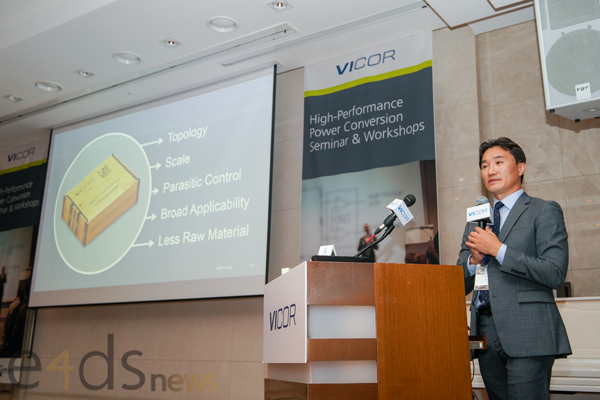
On the 18th, Byco held a press conference titled “Power Electronics at the Crossroads” at the L Tower in Yangjae-dong, Seoul, and announced its business strategy and vision.
This meeting is part of a series of high-performance power conversion seminars and workshops being held by Bycor in 12 cities across 8 countries, and was attended by Jeong Gi-cheon, CEO of Bycor Korea, Eric Wong, Vice President of Sales and Marketing for Asia, and Chris R. Swartz) was in attendance as Chief Engineer.
CEO Jeong Gi-cheon introduced Bycor as a company specializing in the conversion and regulation of power distribution networks (PDNs), manufacturing high-performance, high-density power modules, and having strengths in power distribution architecture, conversion topology, and packaging technology.
Focusing on the defense, communications, computing, industrial, and automotive markets, Vicor offers a diverse portfolio of modular power solutions, from front-end to point-of-load, enabling customers to easily build PDNs.
Topologies such as the Zero-Voltage Switching (ZVS) regulator, the 'double-clamp ZVS (DC-ZVS)' isolated DC-DC and AC-DC converter, and the 'sine amplitude converter (SAC)' isolated fixed-ratio DC-DC transformer were also introduced.
There are three packaging technologies used: 'VIA (Vicor Integrated Adapter)', which integrates adapters; 'ChiP (Converter Housed in Package)', which houses converters in packages; and 'SiP (System in Package)', which mounts and molds components on a substrate.
By leveraging these topologies and packaging technologies, Vicor aims to continuously release products that improve power density by 25% and reduce power loss by 25% every two years.
CEO Jeong Gi-cheon said, “There will come a time when power density that is three to four times higher than what it is now will be required,” and “Bycor will be supplying power trains, control systems, components, and packaging.” “We hold over 170 patents related to technology and reinvest 16% of our sales into R&D,” he said.
Meanwhile, “Bycor is currently reviewing power semiconductor businesses based on silicon carbide (SiC) and gallium nitride (GaN), which have higher power conversion efficiency than silicon (Si) and can operate at high voltages,” he said, adding, “We are developing vertical power delivery technology that places processors and power modules above and below the PCB to shorten the distance and increase power efficiency.”
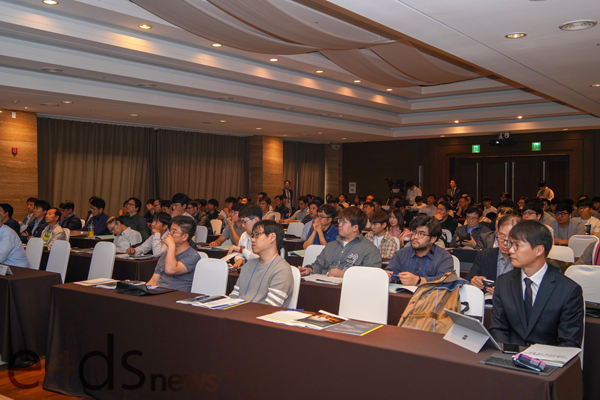
About 140 engineers (Photo = Reporter Lee Su-min)
Meanwhile, at the '2019 High-Performance Power Conversion Seminar and Workshop' held by Bycor after the press conference, Professor Ho-Young Cha, head of the Next Generation Semiconductor Lab at Hongik University, and Manager Woo-Jin Kang and Deputy Manager Hoe-Gwang Choi of Bycor Korea shared insights on power solutions with approximately 140 engineers.
Comments
Related news

Mouser Hosts Seminar on "Noise Reduction and Power-Efficient Power Supply Design for the 5G Era"
Mouser Electronics will hold the 2019 Mouser Power Design Seminar on the 21st at Conference Room 327, COEX, Samseong-dong, Seoul. At this seminar, Mouser will introduce the latest power management solutions along with products and components for power supply design in collaboration with Analog Devices, Vicor, and TE Connectivity. The seminar will also explain the latest market and technology trends, product selection guidelines, development tool utilization methods, and design techniques. This year's seminar theme is "Power Supply Design Seminar for Efficient Noise Reduction and Power Consumption," and will feature the latest techniques for designing new products that meet future trends and requirements, along with analysis of future prospects for 5G technology.
2019.06.14by 이수민 기자
Vicor Holds High-Performance Power Conversion Seminar and Workshop
Vicor will hold a 2019 High-Performance Power Conversion Seminar and Workshop on October 18th at L-Tower in Yangjae-dong, Seoul. Key agenda items include EMI mitigation, thermal modeling, PCB layout, DC-DC design, and AC-DC front-end implementation, analyzing today's power-related challenges through real application examples. Any engineer interested in AC-DC and DC-DC power system design is welcome to attend.
2019.10.01by 이수민 기자
KETI Successfully Develops SiC/GaN Drive Circuit for Power Semiconductors
KETI has developed high-performance driving technology for next-generation power semiconductor devices that enables miniaturization and high-efficiency design of power conversion equipment. By controlling power semiconductors at high switching frequencies, passive components such as inductors and capacitors within power conversion equipment can be designed with smaller dimensions, enabling miniaturization of the power conversion devices. Next-generation power semiconductors in the SiC and GaN families, which are attracting attention as next-generation materials in the current power semiconductor market, have lower conduction losses and switching losses compared to conventional Si-based devices, enabling operation at high switching frequencies.
2019.10.16by 이수민 기자

Intel Unveils Next-Generation 'Core Ultra Series 3' and vPro Platform for Enterprise PCs
Intel has officially unveiled the "Intel Core Ultra Series 3" for next-generation enterprise PCs and the latest vPro platform, addressing a wide range of demands from enterprise notebooks to high-performance workstations.
2026.03.26by 배종인 기자
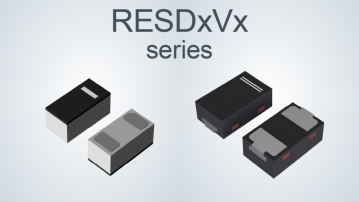
ROHM Launches ESD Protection Diode Compatible with High-Speed Interfaces of 10Gbps or Higher
Semiconductor specialist ROHM has developed the 'RESDxVx series' of ESD (electrostatic discharge) protection diodes capable of responding to next-generation high-speed data communication environments exceeding 10Gbps, simultaneously enhancing both signal quality maintenance required in high-speed interfaces and IC protection performance.
2026.03.26by 배종인 기자











