


Next-generation semiconductor process "5nm FinFET is falling, 3nm GAA is rising"
 Published2021.07.20 09:01
FinPET decreased and GAA increased.
GAA, evaluated as a core technology for 3nm semiconductor process
Nanometer (nm) is a unit of semiconductor circuit line width. The smaller the line width, the smaller the chip size, the lower the power consumption, and the faster the processing speed. In order to process more data than now, a 3nm process technology that is finer than 5nm technology is needed. Accordingly, the competition for semiconductor miniaturization process technology that is more advanced than FinFET is also expected to become fierce.
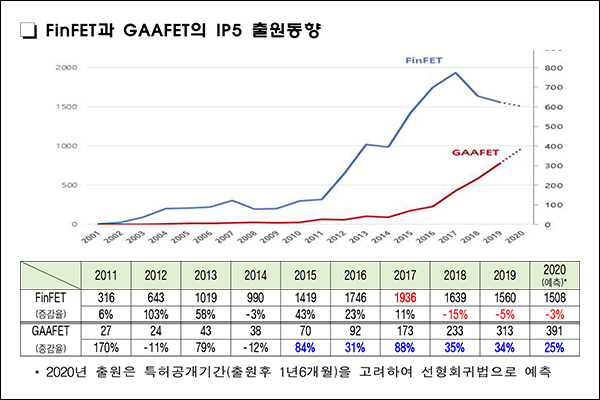
FinFET technology, which led the semiconductor miniaturization process technology, is declining, and Gate All Around (GAA) technology is emerging. The Patent Office announced on the 20th that after analyzing patents from five major countries, the number of patent applications for FinFET technology, the mainstay of semiconductor miniaturization process technology, has been decreasing since 2017, but GAA technology is increasing.
Unlike FinFET technology, which has three sides through which the current flows: top, left, and right, GAA technology is a next-generation technology that has four sides: top, left, right, and bottom.
FinFET technology peaked at 1,936 cases in 2017, then declined to 1,636 cases in 2018, 1,560 cases in 2019, and 1,508 cases (expected) in 2020. On the other hand, GAA patents showed an annual growth rate of nearly 30%, increasing to 173, 233, 313, and 391 (expected) during the same period.
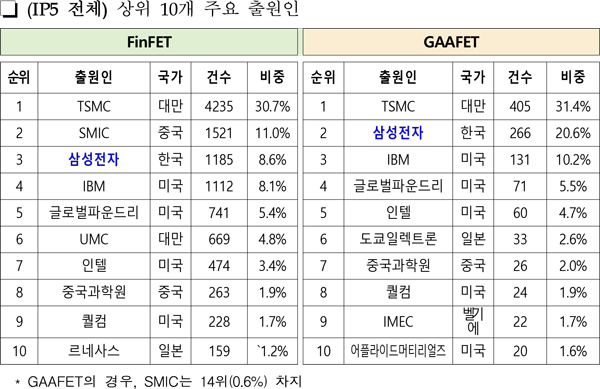
The order of FinFET technology applications was TSMC (30.7%), SMIC (11%), Samsung Electronics (8.6%), IBM (8.1%), and GlobalFoundries (5.4%). Taiwanese, Chinese, Korean, and American companies were seen competing for FinFET technology. The order of GAA technology patent applications was TSMC (31.4%), Samsung Electronics (20.6%), IBM (10.2%), GlobalFoundries (5.5%), and Intel (4.7%). Taiwanese and Korean companies are leading, and American companies are following suit.
Apart from the application, the GAA field is also expected to be a battle between TSMC and Samsung Electronics. Only two companies have properly utilized FinFET technology. The Apple M1 chip and Qualcomm Snapdragon 888 AP are the results of TSMC and Samsung Electronics’ FinFET technology, respectively.
Samsung Electronics plans to be the first in the world to apply GAA technology starting with the 3nm process next year. TSMC has announced that it plans to introduce this technology starting with the 2nm process in 2023. China's SMIC, which ranked second in the FinFET field, has fallen out of the rankings. In the future, the gap with China in this field is expected to widen further amid competition among Taiwan, Korea, and the United States.
“Currently, TSMC and Samsung Electronics are the only companies in the world that can manufacture semiconductor chips with process technology below 5nm,” said Bang Ki-in, an official at the Semiconductor Examination Division of the Korean Intellectual Property Office. “Considering Intel’s recent entry into the foundry business and the Biden administration’s concentrated investment in semiconductors, the technological competition for cutting-edge semiconductors is expected to intensify further.”
He added, “Ultimately, the shortcut to gaining an advantage in competition is who can succeed in innovation quickly and block latecomers with strong intellectual property rights.”
Comments
Related news

Apple Proves M1 Chip's Usability and Mini LED's Potential
Apple has unveiled iMac, iPad Pro, and other products equipped with the M1 chip. The M1 chip is an Arm core-based SoC manufactured by Apple itself, and is drawing attention for delivering higher performance than not only Qualcomm Snapdragon AP but also Intel Core CPU. With this new product announcement, Apple has signaled its commitment to expanding the M1 chip ecosystem and accelerating the commercial deployment of mini LED.
2021.04.22by 이수민 기자
.jpg)
Samsung Electronics Launches Server SSDs Supporting the SAS-4 Standard
Samsung Electronics has launched the PM1653, a server SSD supporting the SAS-4 standard. The PM1653 is a high-speed enterprise server-exclusive product to which sixth-generation V-NAND is applied for the first time, and it will be released in various capacities ranging from 800GB to a maximum of 30.72TB to meet customer demand.
2021.04.28by 강정규 기자
TSMC to Start Full-Scale EUV Production in Second Half
TSMC is ramping up production of Apple's A15 processor in the second half of the year, and it is anticipated that mass production using EUV equipment in the 5nm process will commence in earnest.
2021.07.07by 배종인 기자

Intel Unveils Next-Generation 'Core Ultra Series 3' and vPro Platform for Enterprise PCs
Intel has officially unveiled the "Intel Core Ultra Series 3" for next-generation enterprise PCs and the latest vPro platform, addressing a wide range of demands from enterprise notebooks to high-performance workstations.
2026.03.26by 배종인 기자
ROHM Launches ESD Protection Diode Compatible with High-Speed Interfaces of 10Gbps or Higher
Semiconductor specialist ROHM has developed the 'RESDxVx series' of ESD (electrostatic discharge) protection diodes capable of responding to next-generation high-speed data communication environments exceeding 10Gbps, simultaneously enhancing both signal quality maintenance required in high-speed interfaces and IC protection performance.
2026.03.26by 배종인 기자











