



Congatec Launches 20 IoT COMs Based on 11th Gen Intel Core
 Published2021.08.06 09:10
Intel's 10nm SuperFin Technology Raises Bandwidth Standards
Suitable for IoT gateways and edge computing use cases
Congatec Korea announced the launch of 20 new Computer-on-Modules (COMs) on the 4th, coinciding with the launch of the 11th Gen Intel Core series processors for IoT. Equipped with 11th Gen Intel Core vPro, Xeon W-11000E, and Celeron processors, the latest modules are ideal for demanding IoT gateways and edge computing applications.
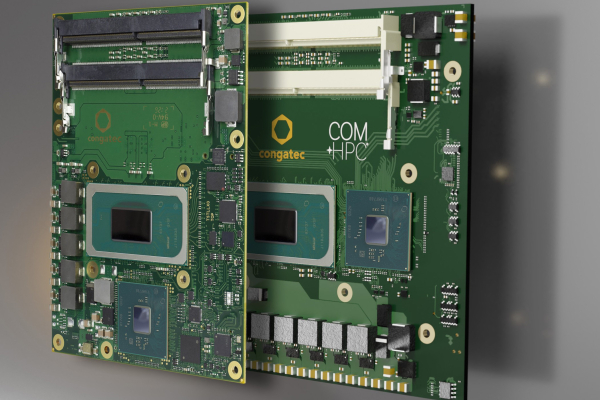
Congatec's COM-HPC Client and COM Express Type 6 modules are designed as two packages: a dedicated CPU and a Platform Controller Hub (PCH) based on Intel's 10nm SuperFin process technology. They provide up to 20 PCIe Gen 4 lanes for processing demanding workloads in real-time IoT/IIoT gateways and intelligent edge computing.
Equipped with up to 128GB of DDR4 SO-DIMM RAM, an integrated AI accelerator, and up to eight processor cores, it improves multi-threaded performance by up to 65% and single-threaded performance by up to 32%. Even in graphics-intensive workload environments, it delivers up to a 70% performance boost compared to previous models.
With improved GPU performance, it is expected to be utilized in edge applications in surgery, medical imaging, or electronic medical fields. This new platform supports 8K HDR video, which is essential for optimal diagnosis, and its AI capabilities and Intel's OpenVINO software toolkit allow clinicians to easily access and analyze deep learning-based diagnostic data.
Intel UHD Graphics, which supports up to four 4K displays simultaneously, can process 40 HD 1080p 30fps video streams simultaneously, creating a 360-degree view. This capability is crucial for factory automation, machine vision for quality inspection in manufacturing processes, spatial and urban safety systems, logistics, agriculture, construction, collaborative robots, and autonomous vehicles.
With the built-in 'Intel Deep Learning Boost', AI and deep learning inference algorithms are executed simultaneously on the GPU and CPU, increasing the speed of inference processing and situational awareness.
The new platform also ensures the safe operation of mobile vehicles, robots, and stationary machinery. These applications require real-time support. The new product is designed to run RTOSs such as Real-Time Linux and Wind River VxWorks. It also supports hypervisor technology from Real-Time Systems, officially supported by Intel. Customers can utilize an integrated package that includes support from the relevant ecosystem.
Additionally, it provides 'Intel TCC (Time Coordinated Computing)' and 'TSN (Time Sensitive Networking)' technologies to support IIoT/Industry 4.0 gateways and edge computing devices. Security features that protect against system attacks have also been strengthened.
The 'conga-HPC/cTLH COM-HPC Client Size B Module (120 × 120 mm)' and the 'conga-TS570 COM Express Basic Module (125 × 95 mm)' are available with the latest scalable Intel processors, and some can be used at temperatures from -40 to 85°C.
It supports up to 128GB of 3200MT/s DDR4 SO-DIMM memory, and ECC is provided as an optional feature. 4th generation PCIe supports 20 lanes (x16, x4) for COM-HPC modules and 16 lanes for COM Express, allowing connection to high-bandwidth devices. 3rd generation PCIe can also utilize 20 lanes for COM-HPC and 8 lanes for COM Express.
To support ultra-fast NVMe SSDs, the COM-HPC module provides a single PCIe x4 interface to the carrier board. The COM-Express board features an onboard NVMe SSD to optimally utilize all of the native Gen 4 lanes supported by the new processors. For additional storage, the COM-HPC Express includes two Gen 3 SATA slots, while the COM-Express includes four SATA slots.
The COM HPC module provides two USB 4.0 ports, two USB 3.2 Gen 2 ports, and eight USB 2.0 ports, while the COM Express module provides four USB 3.2 Gen 2 ports and eight USB 2.0 ports that are PICMG compliant. The COM HPC module provides two 2.5 GbE ports for networking, while the COM Express module runs one GbE port.
TSN is supported in both modules. The COM-HPC version provides sound via I2S and SoundWire, while the COM Express module provides sound via HDA. A comprehensive board support package is provided, including Real-Time Systems' hypervisor support for major RTOSs, including Linux, Windows, and Android.
Comments
Related news
Congatec Launches Durable 11th Gen Intel Core-Based COM
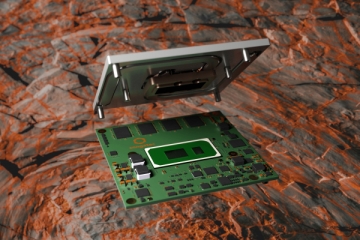
Congatec Korea has launched 'conga-TC570r COM Express,' a new computer-on-module (COM) product based on 11th generation Intel Core processors with enhanced shock and vibration resistance, utilizing soldered RAM. The 'COM Express Type 6 Compact Module' with an operating temperature range of -40°C to 85°C meets the impact resistance and vibration resistance requirements for harsh transportation conditions.
2021.07.16by 강정규 기자

Maxim Unveils IoT MCUs with Enhanced AI Inference Performance Using NN Technology
Battery-powered AI systems requiring facial recognition, such as industrial smart security cameras, home cameras, and retail store cameras, need low-power solutions that can operate for as long as possible. Maxim announced that in collaboration with AI specialist Xilience, it has added facial recognition functionality from edge video and images by applying Detectum neural network (NN) technology to its MAX78000 ultra-low-power NN MCU.
2021.07.28by 이수민 기자

New Intel Xeon W-3300, Supporting Input/Output Intensive Workloads
Intel has launched the Intel Xeon W-3300 processor family for workstation professionals. This high-performance single-socket solution with enterprise-level security features is designed for applications that handle input/output intensive workloads utilizing many threads. It is suited for AI, architecture engineering and construction, and media and entertainment sectors.
2021.08.02by 이수민 기자
Camera for Both Humans and Machines: ST BrightSense 5MP Dual Shutter Image Sensor
Video consumed by humans and imagery analyzed by machines impose different requirements on the sensor in terms of shutter method and wavelength band. Until now, sensors had to be separated or supplemented with companion chips and high-performance processors, and this cost and complexity became a bottleneck in vision system design. The ST BrightSense next-generation 5MP image sensor (VD5943, VD1943, VB5943, VB1943) with 2.25 µm pixels supports both global and rolling shutters, and through on-chip staggered HDR (up to 100 dB), on-chip RGB-IR separation and 5MP NIR smart upscaling, and frame-by-frame context switching, absorbs both requirements internally at the sensor level. This white paper describes the rationale, choices, trade-offs, and results of each design decision based on presentation slides and technical Q&A, and specifies application boundaries. The product is scheduled for mass production in February 2026, and evaluation and sampling are currently available.
2026.10.13by 편집부

AI-based Universal Robots Automation Solution
In manufacturing environments where declining labor populations overlap with frequent production item changes, existing programming-based robot automation requires reconfiguration from weeks to several months each time product models change. This white paper takes this flexibility gap as its starting point and synthesizes, based on webinar presentation materials and technical Q&A, what collaborative robots gain and forfeit compared to industrial robots, why process automation is transitioning from rule-based to learning-based (4th generation) approaches, and how Universal Robots' hardware, software, and partner ecosystem implement this. Additionally, it clarifies the application boundaries and limitations, including that AI Accelerator is still at the development kit stage.
2026.10.13by 편집부











