


Samsung Electronics: "Expanding DRAM capacity to 100Gb or more on a single chip using 10nm or less"
 Published2023.10.21 03:00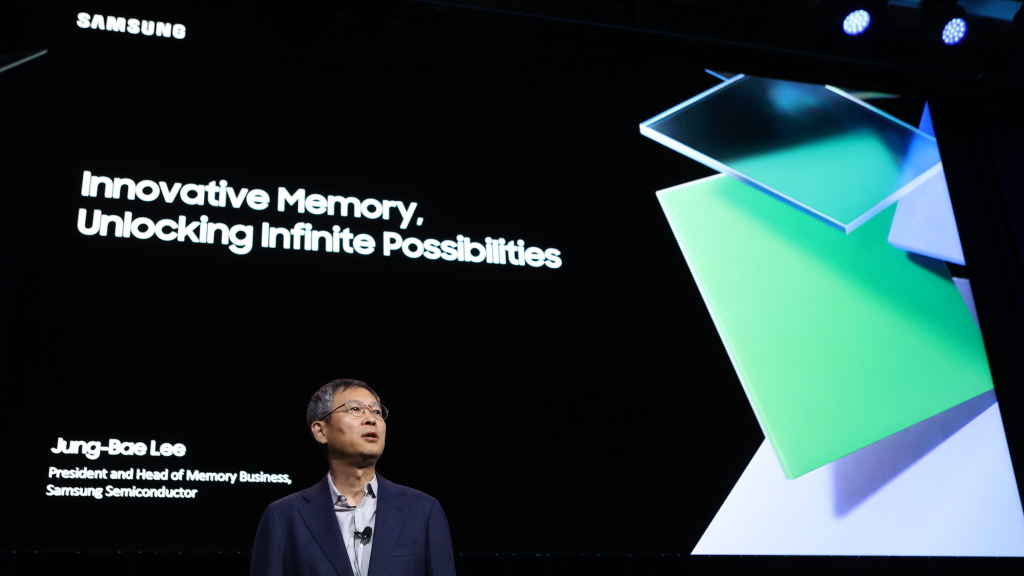
▲Lee Jung-bae, President of the Memory Business Division, is giving a presentation at 'Samsung Memory Tech Day 2023.'
HBM3E DRAM 'Shinebolt' Processes Up to 1.2TB of Data Per Second
Samsung Electronics, which is developing 11nm-class DRAM with the goal of achieving the industry's highest level of integration, announced that it plans to expand the capacity to over 100Gb (gigabit) on a single chip by introducing a new 3D structure in 10nm and lower DRAM.
Samsung Electronics held 'Samsung Memory Tech Day 2023' at the McEnery Convention Center in Silicon Valley on the 20th and unveiled a number of next-generation memory solutions that will lead the era of ultra-large AI.
The event, held under the theme of “Memory Reimagined,” was attended by approximately 600 global IT customers, partners, and analysts. Samsung Electronics Memory Business Division President Lee Jung-bae, Americas General Manager Jim Elliott, and other key industry figures introduced trends in the semiconductor market and key products.
On this day, Samsung Electronics shared technology trends by application such as Cloud, Edge Devices, and Automotive, and introduced the ultra-high-performance HBM3E DRAM that will lead AI technology innovation.;Shinebolt', 'LPDDR5X CAMM2' that will change the landscape of the next-generation PC/laptop DRAM market, and 'Detachable AutoSSD (removable vehicle SSD)' that can be used in segments through storage virtualization, etc., were unveiled as differentiated memory solutions.
“The era of hyper-large-scale AI is a point where technological innovation and growth opportunities intersect, and it will be a time of challenge and greater leaps forward for the industry,” said Lee Jung-bae, President of Samsung Electronics’ Memory Business. “We will continue to lead the memory market by driving innovation through limitless imagination and bold challenges, and by providing expanded solutions that overcome limitations through close collaboration with customers and partners.”
Additionally, CEO Lee Jeong-bae emphasized at the event that the company would overcome the challenges faced in the era of ultra-large AI by introducing new structures and materials.
Samsung Electronics, which began mass production of 12nm-class DRAM in May, announced that it is also developing the next-generation 11nm-class DRAM with the goal of achieving the industry's highest level of integration.
Samsung Electronics is preparing to introduce a new 3D structure in DRAMs under 10 nanometers, which will allow it to expand capacity to over 100 Gb (gigabits) on a single chip.
Samsung Electronics announced that it is developing the highest number of layers that can be implemented in a double stack structure in its 9th generation V-NAND and has successfully secured an operating chip for mass production early next year.
Samsung Electronics emphasized that it will prepare for the 1,000-layer V-NAND era by reducing the cell's flat surface area and height, thereby reducing volume and increasing the number of layers, through channel hole etching, a key technology.
Cloud systems are evolving into structures that can optimize the use of computing resources. Accordingly, high-bandwidth, low-power memory that can support high-performance systems and storage virtualization for multi-access are required.
Samsung Electronics, which ushered in the HBM era by commercializing HBM2 for high-performance computing (HPC) for the first time in the industry in 2016, has now unveiled its next-generation HBM3E DRAM, ‘Shinebolt.’
'Shine Bolt' provides high performance of up to 9.8 Gbps per data input/output pin, which means it can process up to 1.2 TB of data per second.
Samsung Electronics has implemented high-level stacking by filling the gaps between chips through optimization of NCF (Non-conductive Film) technology, and has also improved thermal characteristics by maximizing thermal conductivity.
Samsung Electronics announced that it is currently mass-producing HBM3 8-layer and 12-layer products, and is also delivering samples of the next-generation product, HBM3E, to customers.
We will also provide customized turnkey services that combine next-generation HBM DRAM, cutting-edge packaging technology, and foundry.
In addition, they introduced the '32Gb DDR5 (Double Data Rate) DRAM' with the largest capacity to date, the industry's first '32Gbps GDDR7 (Graphics Double Data Rate) DRAM', and 'PBSSD (Petabyte Storage)' that dramatically improves storage capacity and allows processing of massive amounts of data with a minimum number of servers.
Recent AI technologies are evolving into hybrid forms that distribute and coordinate workloads between the cloud and edge devices to smoothly process exploding data.
Samsung Electronics has unveiled a solution that supports high performance, high capacity, low power, and small form factor on user devices.all.
In particular, the industry's first 7.5Gbps LPDDR5X CAMM2 (Compression Attached Memory Module) attracted the attention of attendees as a product that will change the landscape of the next-generation PC and laptop DRAM market.
In addition, the company unveiled 9.6Gbps LPDDR5X DRAM, LLW (Low Latency Wide I/O) DRAM specialized for on-device AI, next-generation UFS products, and high-capacity QLC SSD BM9C1 for PCs.
As autonomous driving systems become more advanced, the automotive memory market is demanding high-bandwidth, high-capacity DRAM and shared SSDs that can share data with multiple SoCs (Systems on Chips).
Samsung Electronics has unveiled the 'Detachable AutoSSD (a removable SSD for vehicles)', which allows a single SSD to be partitioned and used by multiple SoCs through storage virtualization.
This product supports sequential read speeds of up to 6,500 MB/s and offers 4 TB of capacity. Additionally, it is implemented with a detachable form factor, allowing for easy SSD replacement, making it easy to upgrade performance.
Samsung Electronics also introduced high-bandwidth GDDR7 for vehicles and LPDDR5X with reduced package size, and announced that it will contribute to mobility innovation through optimal memory solutions.
Meanwhile, Samsung Electronics announced various innovative technologies in line with the market trend of increasing energy efficiency in data centers and minimizing environmental impact.
Samsung Electronics plans to reduce the power consumption of memory used in data centers, PCs, and mobile devices by securing ultra-low power technology, and reduce carbon emissions by applying recycled materials in portable SSDs.
Additionally, the company announced that it will contribute to customers' energy savings by increasing the space efficiency and rack capacity of server systems with next-generation solutions such as PBSSD.
Samsung Electronics emphasized collaboration with stakeholders, including customers and partners, throughout the entire semiconductor supply chain and announced its commitment to actively participating in overcoming the global climate crisis through technologies that make technology sustainable.

Comments
Related news
Intel Unveils Next-Generation 'Core Ultra Series 3' and vPro Platform for Enterprise PCs
Intel has officially unveiled the "Intel Core Ultra Series 3" for next-generation enterprise PCs and the latest vPro platform, addressing a wide range of demands from enterprise notebooks to high-performance workstations.
2026.03.26by 배종인 기자
ROHM Launches ESD Protection Diode Compatible with High-Speed Interfaces of 10Gbps or Higher
Semiconductor specialist ROHM has developed the 'RESDxVx series' of ESD (electrostatic discharge) protection diodes capable of responding to next-generation high-speed data communication environments exceeding 10Gbps, simultaneously enhancing both signal quality maintenance required in high-speed interfaces and IC protection performance.
2026.03.26by 배종인 기자
ST Launches 75V Drive IC Targeting 48V Industrial Motor Driving
ST Microelectronics has unveiled the 'STSPIN9P' series of 75V motor drive ICs tailored for 48V-class industrial drive system design. The new product family is characterized by half-bridge and full-bridge configurations that enable design scalability according to motor type and output conditions. Power supply circuits, protection functions, and current sensing circuits are integrated on-chip to simplify system configuration, and the devices are designed to support applications up to 500W maximum. The company plans to provide reference designs and demo boards to support development and evaluation in industrial automation, robotics, pumps, fans, lighting, and textile machinery.
2026.03.26by 배종인 기자

Nordic supports security updates for the entire lifecycle of IoT devices at a single fixed cost
Nordic Semiconductor, a global leader in low-power wireless connectivity solutions, has unveiled a single fixed-cost licensing model that delivers FOTA (Firmware Over-the-Air) and device management capabilities throughout the device lifecycle via nRF Cloud, and introduced a new firmware update solution to prepare for the enforcement of the European Union's Cyber Resilience Act (CRA).
2026.03.26by 배종인 기자

Practical Training in Low-Noise, Low-Power Circuit Design All in One Place… Training Fee Support
The "2026 Advanced Engineer Practical Masterclass" to strengthen competencies in high-sensitivity analog circuit and sensor-based system design will be held on April 16 at the e4ds Conference Center in Gasan-dong, Seoul. This program will be conducted as an offline paid hands-on training session, not online, and is targeted at engineers seeking on-site intensive learning. Texas Instruments will provide educational support for this training, allowing participation at 150,000 won, a 100,000 won discount from the original price of 250,000 won.
2026.03.26by 배종인 기자











