


Bycor Solves AI Satellite Computing Power Challenges
 Published2025.12.22 10:05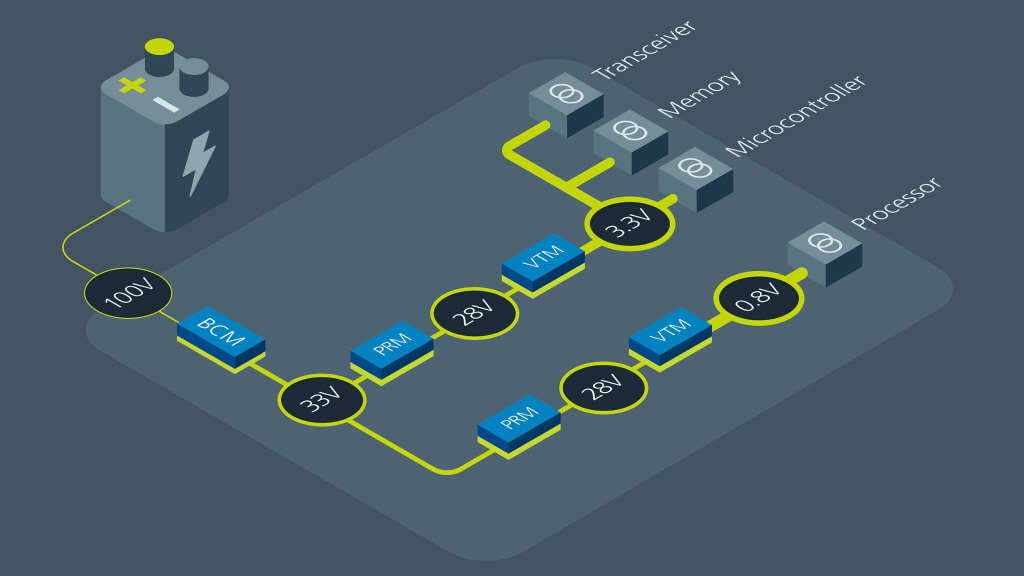
▲Bycor PDN provides high power density
Vicor has provided Spacechips with radiation-tolerant power modules that provide stable high-current, low-voltage power, enabling Spacechips' AI1 satellite processor to perform high-performance AI calculations even in space environments.
SpaceChips announced on the 22nd that it is accelerating the development of next-generation space applications through the AI1 transponder that uses Vicor's high-density power module.
For long-term missions of small satellites, high-performance computing capabilities and a stable power supply that can withstand radiation and heat environments are essential, and this collaboration is evaluated as a key foundation for meeting these technological requirements.
With the increase in small satellites performing missions over the past 5 to 10 years, the power requirements for ultra-fine process FPGA and ASIC-based processors are rapidly increasing.
Existing power networks are facing limitations due to complex conditions such as low-voltage and high-current power supply, radiation resistance, and heat management.
To address this, SpaceChips has launched the AI1 Transponder, an onboard processor card featuring an AI accelerator based on the Adaptive Compute Acceleration Platform (ACAP).
AI1 transponder is up to It provides 133 TOPS of computational performance and supports real-time autonomous computing in various fields such as Earth observation, in-space maintenance, assembly, and manufacturing (ISAM), signals intelligence (SIGINT), intelligence, surveillance, and reconnaissance (ISR), and communications.
“Many spacecraft operators simply don’t have the RF bandwidth they need to send all the data back to the ground,” said Rajan Bedi, CEO of SpaceChips. “The solution is to process the data in orbit with AI and downlink only the key insights.”
To reliably power AI computing in space environments, SpaceChips integrated Vicor's Factorized Power Architecture (FPA™) into the AI1 transponder.
FPA is a structure that maximizes power supply efficiency by separating the DC-DC conversion function into an independent module.
Bycor's radiation-resistant power module consists of the BCM® (Bus Converter Module) that provides isolation and 28V step-down, the PRM™ (Pre-Regulator Module) that regulates voltage, and the VTM™ (Voltage Converter Module) that converts 28V DC to 0.8V.
This structure is optimized for AI processors that require high current and low voltage, and maintains high reliability even in space environments.
“Bycor’s solutions deliver high power density in a very small footprint, significantly increasing the efficiency and flexibility of satellite design,” said Rajan Bedi, CEO.
Additionally, Bycor power modules provide dual powertrain-based redundancy, ensuring stable power supply even in space applications where fault tolerance is not possible.
This allows communications and SIGINT operators to plan and modulate RF frequencies based on real-time traffic demands. The method and communication standards can be changed autonomously.

관련뉴스

Vicor Power Solutions Makes the Fastest Electric Motorcycle
바이코 DCM4623 DC-DC 컨버터가 라이트닝 모터사이클(Lightning Motorcycles)의 12V 전자 제어장치, 조명 시스템, 계기판 및 센서에 전원을 공급하는 부품으로 사용 중에 있다.
2023.09.06by 배종인 기자
Bycor Solves Automotive Electrification Challenges with Power Modules with Highest Efficiency and Power Density
혁신적인 고성능 전력 모듈 분야의 선도기업 바이코(Vicor)가 북미 최대의 자동차 기술 행사인 WCX™에서 5개의 세션에 걸쳐 발표를 진행하며, 최고의 효율성과 전력 밀도를 갖춘 전력 모듈로 자동차 전동화 문제를 해결할 수 있는 방안을 제시했다.
2024.05.07by 배종인 기자
Bycor Launches DCM3717 and DCM3735 DC-DC Power Module Family
전력 공급 네트워크(PDN)가 효율 극대화를 위해 12V에서 48V 아키텍처로 전환하는 추세 속에서 48V 중심의 전력 모듈을 지원하는 신제품들이 속속 모습을 드러내고 있다.
2025.03.27by 명세환 기자
.jpg)
Byco opens the door to mid-level vehicle applications with ultra-compact active suspension power module
혁신적인 고밀도 전력 모듈을 제공하는 바이코(Vicor)가 800V 고전압을 48V로 변환하는 고정 비율 DC-DC 컨버터 모듈(BCM6135)을 소형 액티브 서스펜션 시스템의 핵심 부품으로 공급하며, 기존 고급 차량에만 국한됐던 액티브 서스펜션 기능을 중급 차량에도 적용할 수 있도록 해, 주행 안전성 및 승차감을 크게 향상시키는 데 기여할 전망이다.
2025.06.09by 배종인 기자
Bycor to Demonstrate High-Performance Modular Power Solutions at 2025 Power Electronics Conference
Viko, a leading company in the innovative high-performance power module field, plans to demonstrate efficient modular power solutions that realize innovative design across a wide range of industrial technologies at the 2025 Power Electronics Conference to be held at Pyeongchang Alpensia Convention Center from July 7th to 10th.
2025.06.23by 배종인 기자











