


TI Innovates Data Center and EV Design Paradigm with Next-Generation Isolated Power Modules
 Published2026.03.24 11:53
.jpg)
Park Su-min, FAE at TI Korea, is introducing a next-generation isolated power module.
70% Size Reduction: Reduces PCB area, weight, and component count, achieving 3 times higher power density.
As power demand surges due to the proliferation of AI and electric vehicles, the technology to reliably supply more power in limited spaces is emerging as a key challenge across industries. In response to this demand, Texas Instruments (TI) has unveiled high-performance isolated power modules featuring proprietary packaging technology, presenting a new direction for power design.
TI introduced a next-generation isolated power module targeting data centers and electric vehicles during an online press conference on the 24th.
Park Su-min, FAE at TI Korea who gave the presentation, emphasized, “Power density is no longer just a simple performance indicator, but a key factor determining system competitiveness,” adding, “We have entered an era where efficiency, heat generation, EMI, and reliability must be satisfied simultaneously in smaller spaces.”
The newly unveiled UCC34141-Q1 and UCC33420 power modules feature TI's proprietary IsoShield™ multi-chip packaging technology.
This technology integrates a high-performance planar transformer and an isolated power stage into a single package, achieving up to three times higher performance compared to conventional discrete component-based designs.It implements power density.
At the same time, the solution size can be reduced by up to 70%, significantly reducing PCB area, weight, and the number of components.
Park Su-min, an FAE, explained, “Existing isolated power supply designs required controller ICs, transformers, and numerous passive components, resulting in high design complexity and a high probability of errors. IsoShield technology integrates these elements into a single SiP, reducing single points of failure and ensuring both safety and reliability.”
Another feature is that it supports everything from functional insulation to basic and reinforced insulation.
These power density innovations are particularly significant for data centers and electric vehicles.
With the proliferation of AI and cloud computing, data centers must integrate more computational performance into the same rack space, and power supply and thermal management are acting as bottlenecks.
TI's isolated power modules support the implementation of next-generation data center architectures by providing high power density in server and rack power designs while maintaining efficiency and safety.
The effect is also clear in the electric vehicle sector.
In situations where vehicle interior space is limited, the miniaturization and weight reduction of power converters are directly related to driving range.
Power modules equipped with IsoShield technology can be applied to various areas, such as OBCs, DC-DC converters, and gate driver bias power supplies, and meet the temperature and reliability standards required in automotive environments while reducing size and weight.
TI has built a portfolio of over 350 power modules, including this technology, and is simultaneously aiming to reduce design time and costs through packaging innovations such as MagPack™ and IsoShield™.
Park Su-min FAE is &ldqu“As the level of integration of power modules increases, the design burden on engineers decreases, and system performance can be improved more quickly,” he said.
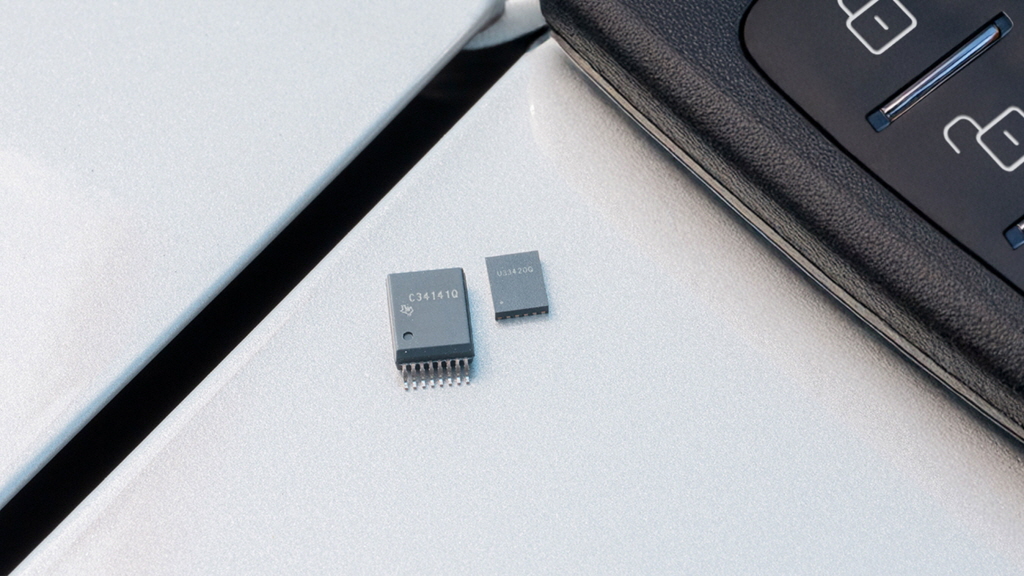
▲ TI's next-generation isolated power modules, UCC34141-Q1 and UCC33420

Comments
Related news

TI to Unveil Expanded Automotive Semiconductor Portfolio at CES 2026
Texas Instruments (TI) showcased new product lines at CES 2026, held in Las Vegas, USA from the 6th to the 9th, including high-performance computing SoCs that maximize edge AI performance, a single-chip 8x8 4D imaging radar transceiver, and a 10BASE-T1S PHY that extends Ethernet to vehicle edge nodes, presenting key technologies for implementing Level 3 autonomous driving.
2026.01.06by 배종인 기자
High-performance SoCs, accelerating the era of autonomous driving, are rapidly emerging as a key player in the automotive industry.
According to a Technical Article from Texas Instruments titled "Why Scalable High-Performance SoCs Are the Future of Autonomous Vehicles," automotive manufacturers are accelerating their transition to software-defined vehicles (SDVs) by adopting centralized computing platforms instead of distributed electronic control unit (ECU) architectures, enabled by high-performance systems-on-chip (SoCs) that simultaneously offer scalability and performance.
2026.01.27by 명세환 기자
TI Launches System-Level Solutions Strategy for the Robotics Market
Texas Instruments (TI) held a press briefing where Giovanni Campanella, Vice President of Industrial Automation and Robotics, visited Korea to unveil changes in robotics technology and TI's product and policy direction in response. Campanella positioned the robotics market as a next-generation core growth area and announced that TI will fully accelerate its "system-level" solution strategy beyond individual semiconductor components.
2026.02.09by 명세환 기자
TI and NVIDIA Accelerate Commercialization of Physical AI Collaborative Humanoid Robots
As competition over technology for humanoid robots to enter real industrial and everyday environments intensifies, Texas Instruments (TI) and NVIDIA have announced a strategic partnership to implement next-generation Physical AI.
2026.03.09by 배종인 기자
.jpg)
Humanoids: The Key is Motor Control and Power Efficiency
The key to humanoid robot design lies in precise internal systems rather than external appearance similar to humans. Technical documentation recently released by Texas Instruments (TI) emphasizes the importance of high-degree-of-freedom motor control, high-efficiency and compact design utilizing GaN-based power devices, and precision control through high-resolution current and voltage sensing. When combined with redundant architecture considering functional safety and fast shutdown design, a reliable robot capable of operating in shared spaces with humans can be completed.
2026.03.10by 배종인 기자











