


KAIST Implements 'Ising Machine' Using Only Standard CMOS... Opens New Path for Combinatorial Optimization Computation
 Published2026.05.06 08:00
▲ Conceptual diagram of an AI-generated silicon ising machine
KAIST has developed next-generation computing hardware that rapidly solves combinatorial optimization challenges using only standard CMOS semiconductor processes, and its application in various industries such as logistics, finance, and semiconductor circuit design is expected.
KAIST announced on the 22nd that a joint research team led by Professor Yang-Kyu Choi and Professor Sang-Hyun Kim of the Department of Electrical and Electronic Engineering recently implemented an oscillator-based ising machine hardware using only silicon CMOS, which is the mainstay of existing semiconductor processes.
By rapidly converging combinatorial optimization problems—which seek optimal solutions from a vast number of cases—into a physical synchronization process, it is expected to have broad industrial applications, such as logistics route optimization, financial portfolio construction, and semiconductor circuit design.
Combinatorial optimization is considered a difficult problem where computation time on conventional computers increases rapidly as the problem size grows.
The research team transformed this into an energy minimization form of the Ising model and focused on a structure that finds a solution by utilizing collective dynamics in which multiple oscillators exchange signals and align their phases.
In this case, the phase of the oscillator corresponds to the spin state, and the coupling between oscillators corresponds to the spin interaction.
Existing CMOS-based approaches have difficulty controlling frequency deviation and coupled circuitsThe complexity of the road network imposed limitations on large-scale integration.
The research team announced that they proposed a new structure in which both the oscillator and the coupler are composed of a single silicon transistor, enabling precise correction of frequency deviations using gate voltage and the implementation of multi-bit coupling capable of incorporating weights.
In the performance verification, the Max-Cut problem, a representative combinatorial optimization task, was solved.
Small-scale performance was verified using actual hardware, while 100-node scale performance was checked using semi-empirical simulations based on experimental data.
Max-Cut is a problem of dividing a network into two groups such that the sum of the connections (weights) between the groups is maximized, and it is used in various fields such as logistics, telecommunications, and semiconductor design.
Another significance of this achievement is that it utilized the standard CMOS process used in existing semiconductor factories without the need for special materials or separate processes.
It is evaluated that it has increased the potential for mass production and commercialization by lowering the burden of additional facility investment.
Professor Choi Yang-kyu stated, “This is a case where scalability and precision were secured simultaneously with a silicon-based single device,” mentioning the potential for application in industries requiring large-scale optimization.
KAIST doctoral student Sung-Yoon Yoon and Dr. Jun-Pyo Kim participated in the study as co-first authors, and the results were published in the international academic journal Science Advances.
The research was conducted with support from the National Research Foundation of Korea’s Next-Generation Intelligent Semiconductor Technology Development Project, the National Semiconductor Laboratory Support Core Technology Development Project, and the PIM Artificial Intelligence Semiconductor Core Technology Development Project.

관련뉴스
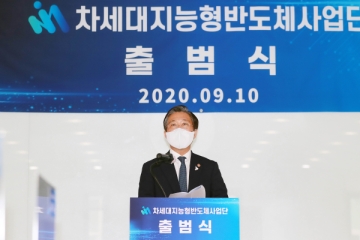
Launch of a Single Business Group Overseeing Next-Generation Intelligent Semiconductor Business
과기정통부와 산업부가 경기도 성남시에 위치한 반도체산업협회에서 차세대지능형반도체사업단 출범식을 열고 차세대 지능형 반도체 개발과 이를 뒷받침할 생태계 구축을 위한 MOU를 체결했다. 사업단이 총괄하는 차세대 지능형 반도체 기술개발 사업에는 10년간 1조96억 원이 투입된다.
2020.09.11by 이수민 기자
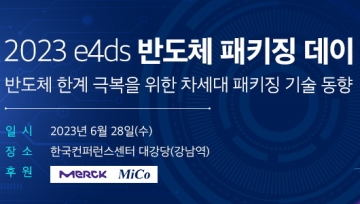
Overcoming semiconductor limitations is now packaging
인텔, 네패스, 어플라이드 머티어리얼즈, 현대차증권, 차세대지능형반도체사업단, 한양대학교가 참여하는 반도체 패키징 전문 세미나인 ‘2023 e4ds 반도체 패키징 데이’가 오는 6월28일 수요일 한국컨퍼런스센터 대강당에서 개최된다.
2023.06.07by 명세환 기자
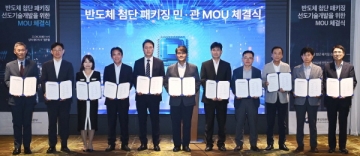
Semiconductor Advanced Packaging, Public-Private Partnership
The Ministry of Trade, Industry and Energy, Samsung Electronics, SK Hynix, LG Chem, Hana Micron, Protec, Sapion Korea, Simtec, the Next-Generation Intelligent Semiconductor Business Division, the Korea Semiconductor Industry Association, the Korea Institute of Industrial Technology Evaluation and Planning, and other companies in the materials, parts and equipment (MPM) sector, semiconductor advanced packaging specialists (OSAT), and fabless enterprises concluded an agreement on cooperation for semiconductor advanced packaging technology development.
2023.08.29by 배종인 기자
.jpg)
DGIST Secures Ultra-High-Efficiency On-Off Control Technology for Magnetic Memory
대구경북과학기술원(DGIST, 총장 이건우) 화학물리학과 유천열 교수 연구팀이 자성메모리 동작을 위한 스핀-궤도 토크를 전기장을 인가해 초고효율로 온-오프 제어하는 기술을 개발하는 데 성공했다. 이번 연구 결과는 세계적 권위 국제학술지 ‘Science Advances’에 3월19일 온라인판에 게재됐다. 이번 연구결과는 차세대지능형반도체기술개발(소자)사업의 지원을 받아 수행하여 ‘Electrically Switchable ON-OFF Spin-Orbit Torque in an Ionic-Gated Metallic Trilayer’라는 제목으로 국제 저명 학술지 ‘Science Advances’ 최신호에 선정·게재됐다.
2025.03.20by 배종인 기자
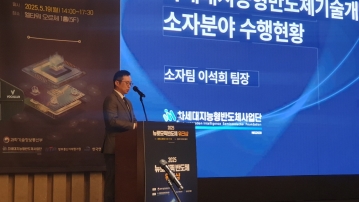
“Next-generation intelligent semiconductor, targeting 1 teraflops of computing efficiency by 2029”
이석희 차세대지능형반도체사업단 소자팀 팀장이 지난 19일 엘타워에서 개최된 ‘2025 뉴로모픽반도체 워크샵’에서 ‘2025 차세대지능형반도체기술개발사업 소자분야 수행현황’을 발표하며, “연구진들은 2029년까지 프로토타입을 구현하여 1 테라플롭스의 연산 성능을 갖춘 차세대 반도체 기술을 완성하는 것이 목표”라며 “이를 위해 원천 기술 확보, 코어 설계, 플랫폼 구축 등이 진행될 예정”이라고 밝혔다.
2025.05.26by 배종인 기자











