


Infineon Launches 2300V SiC-Based Power Module… Improves High-Voltage Energy System Efficiency
 Published2026.05.13 10:34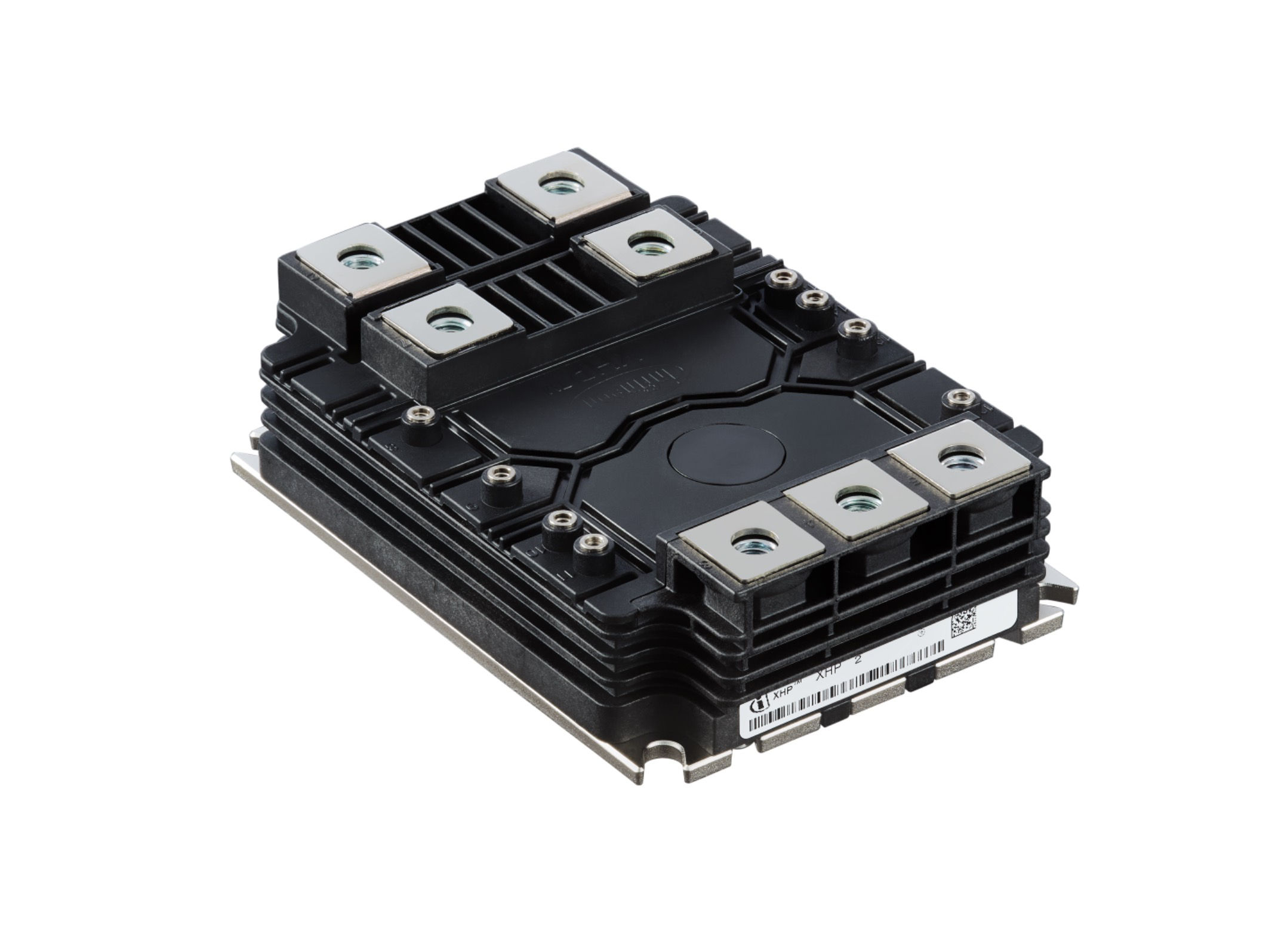
XHP™ 2 Module with 1500V DC Link Support Unveiled, Achieving 300kW/L Power Density
Infineon Technologies has presented a foundation for simultaneously improving efficiency and power density in high-voltage energy systems through its XHP™ 2 power module, which utilizes 2300V SiC MOSFETs.
Infineon announced on the 13th that it has launched the XHP™ 2 CoolSiC™ power module, which supports a maximum DC link voltage of 1500V.
With the recent expansion of renewable energy, the increasing voltage of power conversion systems is becoming a major trend. This is because higher voltage allows for a reduction in current, thereby improving system efficiency. Consequently, there is a growing demand for power semiconductors that operate stably even in high-voltage environments.
This product is characterized by the application of a silicon carbide (SiC)-based 2300V MOSFET, which simultaneously reduces switching losses and conduction losses compared to existing silicon devices. It offers on-resistance (RDS(on)) of 1mΩ to 2mΩ and 4kV or 6kV isolation voltage options, and is designed to facilitate parallel configuration through a symmetric switching structure.
These technical characteristics lead to improved efficiency and miniaturization at the system level. Inverters can operate at higher switching frequencies to reduce harmonics, and allow for reduced equipment size or increased power density based on the same output.
Applications include high-voltage-based renewable energy facilities such as wind, solar, and battery energy storage systems. The standardized XHP 2 package is designed to balance performance and efficiency according to various application requirements.
In addition, durability against thermal and mechanical stress was ensured by applying .XT interconnection technology, and the assembly process was simplified and thermal performance consistency was maintained through the option of pre-coated thermal conductive interface material (TIM).
The improvement effect was also confirmed in actual performance verification. In the wind power demo system, a power density of 300 kW/L was achieved, and in the battery storage system test, semiconductor losses were found to be less than 0.7% of the total output. This is interpreted as an indicator showing that efficiency improvement and loss reduction are possible simultaneously in high-voltage power conversion systems.

Comments
Related news

Infineon and NVIDIA Expand Collaboration on Humanoid Robot Development
Infineon announced plans to advance system architecture for Physical AI together with NVIDIA, accelerating the entire process from robot design to commercial deployment.
2026.03.17by 배종인 기자
Infineon to Maintain No. 1 Position in Automotive Semiconductor Market by 2025… 36% MCU Market Share
Infineon maintained its position as the number one player in the global automotive semiconductor market for six consecutive years in 2025. The global market size increased to $74.4 billion compared to the previous year, and Infineon recorded a market share of 12.8%. The company's market share in automotive microcontrollers expanded to 36.0%. It held the top position in Europe, China, and Korea, while recording the second position in North America and Japan.
2026.04.14by 명세환 기자
Infineon, No. 1 Automotive Semiconductor Manufacturer, Accelerates Transition to 'RISC-V', Core Pillar of SDV
Infineon Technologies, the global leader in automotive semiconductors, is positioning RISC-V (Reduced Instruction Set Computer - Five) as a core pillar of its next-generation vehicle computing platform, directly addressing the rapidly increasing workloads within automobiles.
2026.04.20by 배종인 기자

[Interview] Song Byung-chul, Infineon Manager, “CYT3AB5 Completes 10BASE-T1S Implementation for SDV Era”
The core of SDV transition is that vehicles shift from hardware-centric to software-centric architecture and are integrated based on central computing. This enables easier OTA updates and feature expansion, allowing continuous evolution of vehicles. The increasingly complex electrical architecture is addressed through zone-based architecture, and OEMs gain benefits including reduced wiring, weight, and costs as well as improved development efficiency. In body network applications, 10BASE-T1S attracts attention as a practical technology for ethernet transition, and when applying it, the MCU's ethernet processing and security response capabilities are key criteria. Infineon TRAVEO™ T2G is an MCU that balances performance, power consumption, and scalability, while CYT3AB5 complements the portfolio as a product specialized for 10BASE-T1S. In this regard, we met with Infineon's General Manager Song Byung-chul to hear about the technology changes following SDV transition and Infineon's competitiveness.
2026.04.28by 배종인 기자
Infineon and Valeo Jointly Develop Laser-Based Automotive Ground Projection Module
Infineon and Valeo are collaborating on the development of automotive ground projection modules utilizing laser beam scanning (LBS) technology. The technology projects high-resolution images on the ground surface around vehicles to enhance user experience and presents possibilities for expanding road safety functions through V2X-based visual communication. Initial products will be based on dual-color output, with full-color implementation also planned for the future. The module is expected to enable various applications including message transmission upon vehicle approach and warning display.
2026.04.28by 배종인 기자











