



Hanyang University Develops Pure SiO₂-Based Selective Device… Presents Potential for Next-Generation Memory Application
 Published2026.05.15 14:53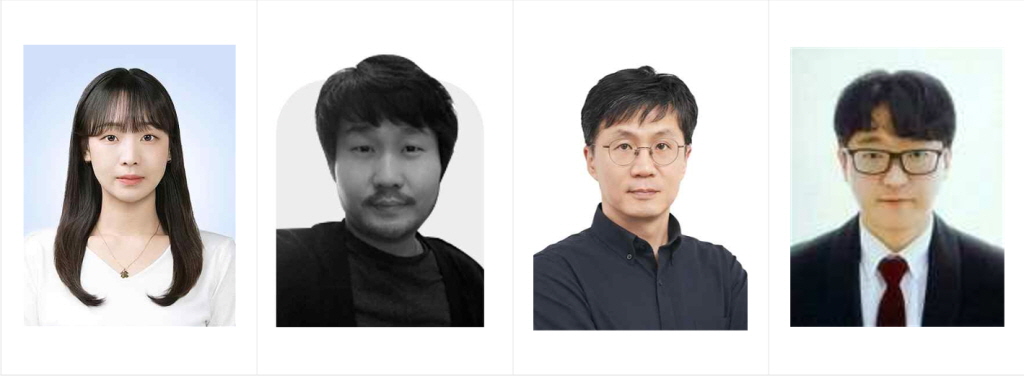
▲ (From left) Researcher Kim Hye-rim of Hanyang University, Professor Park Tae-ju of Hanyang University, Vice President Kim Su-gil of SK Hynix, and Dr. Jang Jae-hyuk of the Korea Basic Science Institute
A research team at Hanyang University developed a selector device using pure silicon dioxide (SiO₂) and elucidated its operating principle. It is evaluated as a technology that simultaneously secures the stability and process compatibility required for next-generation high-density memory structures.
A research team led by Professor Tae-Joo Park at Hanyang University announced on the 14th that they have implemented a pure SiO₂-based selector and elucidated the operating principle of the device.
The research results explained that the structure is compatible with CMOS (Complementary Metal-Oxide Semiconductor) processes and suggests potential applications in next-generation memory and computing technologies.
■ Implementation of SiO₂-based selection device
Recently, 3D structured memory technology is being utilized in the semiconductor industry to cope with the increase in data throughput.
Among these, the crossbar array is considered a structure capable of achieving high integration density, but it has been pointed out that there are limitations to stable operation due to the 'sneak path' problem, where current flows to unselected cells.
To solve this, the research team focused on a selector that controls the current flow.
Unlike existing chalcogenide-based or metal ion composite oxide materials, SiO₂, an insulator widely used in semiconductor processes, was utilized.
A thin film of SiO₂ with a thickness of about 5 nm was formed between the upper and lower TiN electrodes using atomic layer deposition (ALD), and it was confirmed that a 'threshold switching' characteristic in which current flows only above a specific voltage was observed.
The device showed a switching speed of approximately 400ns and a durability of more than 10 cycles, and it was found that it could be fabricated in a process below 300℃ and maintained stability even after heat treatment.
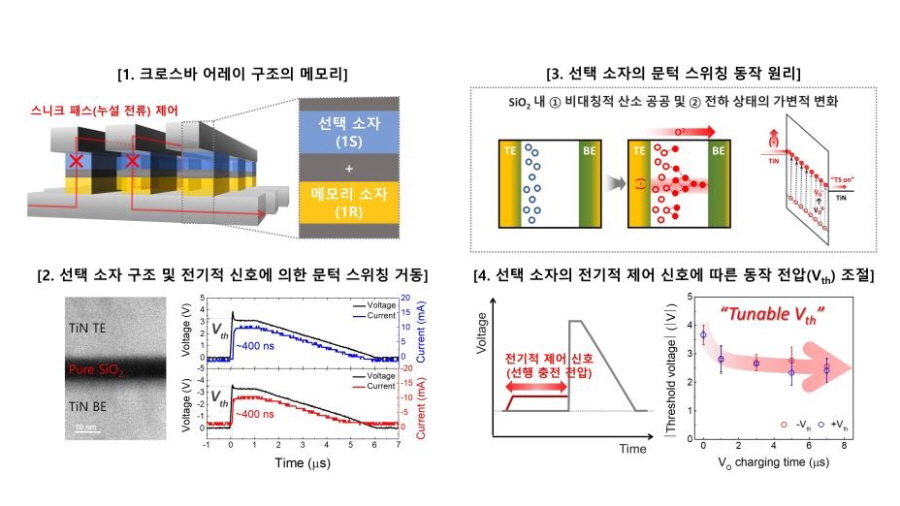 <b▲ Image of a pure SiO2-based high-reliability selective device developed by a research team led by Park Tae-ju of the Department of Materials Science and Engineering at Hanyang University through industry-academia collaboration with SK Hynix
■ Elucidation of Oxygen-Based Operation Mechanism
The research team also conducted an analysis of the operating mechanism along with the device implementation.
Through the analysis of the interface structure and electrical properties, it was confirmed that oxygen vacancies within SiO₂ act as a major factor in the formation of threshold switching characteristics.
In particular, they stated that a phenomenon was observed in which the current increased rapidly as the distribution of oxygen vacancies and the charge state changed during the electrical generation process. The research team explained that these results suggest that the operating voltage of the device can be controlled by adjusting the state of oxygen vacancies.
This research was conducted through industry-academia collaboration with SK Hynix and supported by the National Research Foundation of Korea and the Korea Basic Science Institute.
The research results were published in the international academic journal 'ACS Applied Materials & Interfaces' on April 1 and selected as a cover article.

관련뉴스
Launch of a Single Business Group Overseeing Next-Generation Intelligent Semiconductor Business
과기정통부와 산업부가 경기도 성남시에 위치한 반도체산업협회에서 차세대지능형반도체사업단 출범식을 열고 차세대 지능형 반도체 개발과 이를 뒷받침할 생태계 구축을 위한 MOU를 체결했다. 사업단이 총괄하는 차세대 지능형 반도체 기술개발 사업에는 10년간 1조96억 원이 투입된다.
2020.09.11by 이수민 기자
Overcoming semiconductor limitations is now packaging
인텔, 네패스, 어플라이드 머티어리얼즈, 현대차증권, 차세대지능형반도체사업단, 한양대학교가 참여하는 반도체 패키징 전문 세미나인 ‘2023 e4ds 반도체 패키징 데이’가 오는 6월28일 수요일 한국컨퍼런스센터 대강당에서 개최된다.
2023.06.07by 명세환 기자
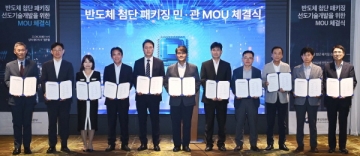
Semiconductor Advanced Packaging, Public-Private Partnership
The Ministry of Trade, Industry and Energy, Samsung Electronics, SK Hynix, LG Chem, Hana Micron, Protec, Sapion Korea, Simtec, the Next-Generation Intelligent Semiconductor Business Division, the Korea Semiconductor Industry Association, the Korea Institute of Industrial Technology Evaluation and Planning, and other companies in the materials, parts and equipment (MPM) sector, semiconductor advanced packaging specialists (OSAT), and fabless enterprises concluded an agreement on cooperation for semiconductor advanced packaging technology development.
2023.08.29by 배종인 기자
.jpg)
DGIST Secures Ultra-High-Efficiency On-Off Control Technology for Magnetic Memory
대구경북과학기술원(DGIST, 총장 이건우) 화학물리학과 유천열 교수 연구팀이 자성메모리 동작을 위한 스핀-궤도 토크를 전기장을 인가해 초고효율로 온-오프 제어하는 기술을 개발하는 데 성공했다. 이번 연구 결과는 세계적 권위 국제학술지 ‘Science Advances’에 3월19일 온라인판에 게재됐다. 이번 연구결과는 차세대지능형반도체기술개발(소자)사업의 지원을 받아 수행하여 ‘Electrically Switchable ON-OFF Spin-Orbit Torque in an Ionic-Gated Metallic Trilayer’라는 제목으로 국제 저명 학술지 ‘Science Advances’ 최신호에 선정·게재됐다.
2025.03.20by 배종인 기자
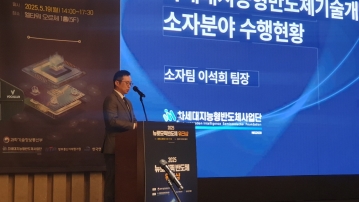
“Next-generation intelligent semiconductor, targeting 1 teraflops of computing efficiency by 2029”
이석희 차세대지능형반도체사업단 소자팀 팀장이 지난 19일 엘타워에서 개최된 ‘2025 뉴로모픽반도체 워크샵’에서 ‘2025 차세대지능형반도체기술개발사업 소자분야 수행현황’을 발표하며, “연구진들은 2029년까지 프로토타입을 구현하여 1 테라플롭스의 연산 성능을 갖춘 차세대 반도체 기술을 완성하는 것이 목표”라며 “이를 위해 원천 기술 확보, 코어 설계, 플랫폼 구축 등이 진행될 예정”이라고 밝혔다.
2025.05.26by 배종인 기자











