



ROHM Develops Power Solution for Automotive SoCs… Applying PMIC and DrMOS Combination
 Published2026.05.19 11:21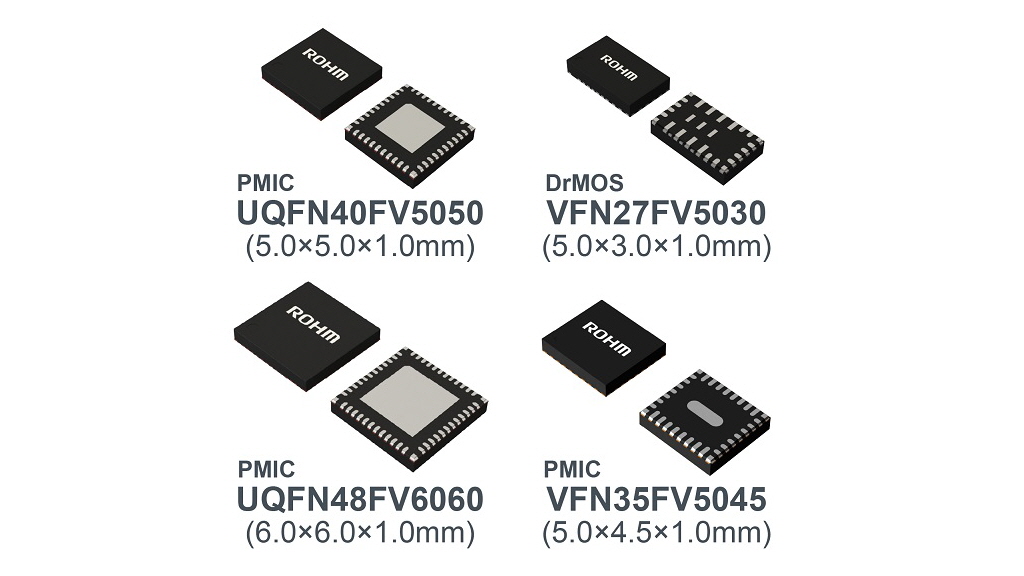
ROHM is developing power solutions applicable to automotive SoCs (System-on-a-Chip) to respond to the expansion of autonomous driving and automotive electronic systems. It is characterized by securing power design flexibility to meet various performance requirements through a structure combining PMIC and DrMOS.
ROHM announced on the 19th that it has developed a power solution combining the 'BD968xx-C series' PMIC for automotive SoCs and the 'BD96340MFF-C' DrMOS.
The solution is designed to be applied to automotive applications such as ADAS, driver monitoring systems (DMS), and sensing cameras.
■ Power configuration corresponding to SoC performance
This solution is based on a structure that combines a main PMIC, a sub-PMIC, and DrMOS.
Power configurations can be flexibly designed according to the SoC's performance and application, enabling support for systems ranging from entry-level to high-performance.
In particular, it provides a scalable structure to meet the low-voltage and high-current requirements of SoCs, and the entire product family is designed to meet the automotive reliability standard AEC-Q100.
In addition, the main PMIC includes voltage, current, and temperature monitoring and protection functions, configured to ensure the stability required in a vehicle environment.
■ Alleviating the burden of power design
Existing automotive SoC power designs often involved a design burden because circuits had to be designed individually according to the requirements of the manufacturer or generation.
Accordingly, ROHM configured a solution based on the concept of a 'Configurable PMIC' that can set the output voltage and power sequence. This allows the power configuration to be adjusted according to system requirements.
The company explained that this method can contribute to reducing design effort and improving power efficiency during product development.
■ Expanded application of ADAS, cockpits, etc.
The solution responds by classifying power ranges according to the application. High-performance SoCs can be applied to ADAS, DMS, and vehicle integrated cockpit systems; medium-performance SoCs to surround view and parking assistance; and low-power SoCs to sensing cameras and various control systems.
Recently, automotive semiconductors are facing increasing performance demands due to ECU integration and the proliferation of domain architectures, while simultaneously requiring high reliability and precise power control.
ROHM anticipates that this solution will play a role in responding to these changes by supporting high-performance automotive SoCs and power design in system integration environments.
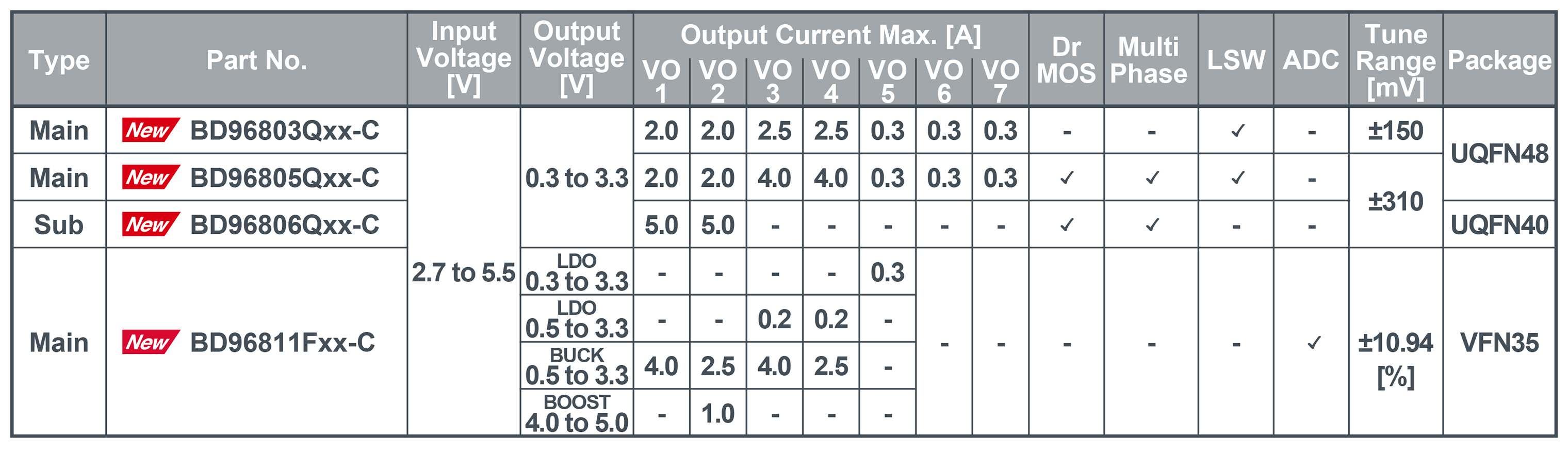
▲PMIC lineup

Comments
Related news
ROHM Strengthens VCSEL-Based High-Speed, High-Precision Sensing Technology
Rohm, a semiconductor and sensor specialist, has newly developed a compact analog proximity sensor 'RPR-0730' that enables precise detection of high-speed moving objects by adopting an infrared VCSEL (Vertical Cavity Surface Emitting Laser) with higher directivity than conventional LEDs.
2025.10.29by 배종인 기자

AI Has Started Learning on the Field? The Role of Industrial AI Being Transformed by ROHM
AI's center of gravity is shifting from the cloud to the edge. Japanese semiconductor company ROHM is leading this transformation by developing an "On-Device Learning MCU" that performs both learning and inference directly on the device itself without cloud dependency. It addresses the network latency, security risks, and installation cost issues that plagued traditional cloud-based AI, ushering in an era of autonomous AI where machines learn and make decisions independently. ROHM's MCU directly analyzes data generated from factory motors and sensors, learns normal operational states, and then detects anomalies to implement predictive maintenance. Unlike conventional pre-trained edge AI, it is distinguished by its ability to relearn and adapt to changes in the field. The core technologies are the lightweight neural network-based algorithm 'Solist-AI™' and the dedicated AI accelerator 'AxlCORE-ODL', enabling high-speed, low-power learning within the MCU. This combination reduces CPU load and theoretically achieves AI computations up to 1,000 times faster. This technology is being applied across various industrial environments including detecting subtle vibration anomalies in motors, predicting photoelectric sensor degradation, and identifying cracks based on acoustic emission. The differentiation points are that cloud pre-training is unnecessary, field relearning is possible, and it operates completely independently without network connectivity. ROHM's on-device AI goes beyond simply being a semiconductor—it accelerates the "intelligentization" of industrial equipment and establishes the foundation for manufacturing to transition to a Performance-as-a-Service model. An era where AI permeates into circuits? ROHM's tiny chip stands at the starting point of that revolution.
2025.11.05by 명세환 기자
ROHM Innovates High-Current Power Supply Design with 500mA LDO Regulator
ROHM has developed the 'BD9xxN5 series' 500mA-rated LDO regulator IC that significantly enhances design flexibility for high-current power supplies. Targeting 12V and 24V primary power systems in automotive, industrial equipment, and telecommunications infrastructure applications, the product features ROHM's proprietary stability control technology 'Nano Cap™'.
2026.01.27by 배종인 기자
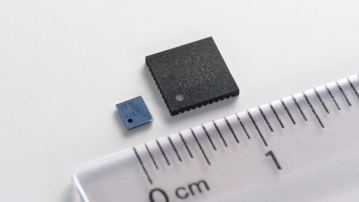
ROHM Unveils NFC Wireless Charging Chip Set for Ultra-Small Wearable Devices
Semiconductor specialist ROHM has introduced an NFC-based wireless charging IC chipset optimized for ultra-compact wearable devices such as smart rings and smart bands, consisting of the 'ML7670' receiver chip and 'ML7671' transmitter chip, enabling stable wireless power delivery even in small device environments.
2026.03.13by 배종인 기자
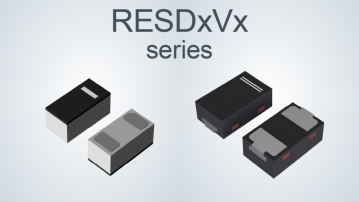
ROHM Launches ESD Protection Diode Compatible with High-Speed Interfaces of 10Gbps or Higher
Semiconductor specialist ROHM has developed the 'RESDxVx series' of ESD (electrostatic discharge) protection diodes capable of responding to next-generation high-speed data communication environments exceeding 10Gbps, simultaneously enhancing both signal quality maintenance required in high-speed interfaces and IC protection performance.
2026.03.26by 배종인 기자











