



Hanjayeon Transfers LMFP and Sodium Battery Electrode Technology to JR Energy Solution
 Published2026.05.27 09:31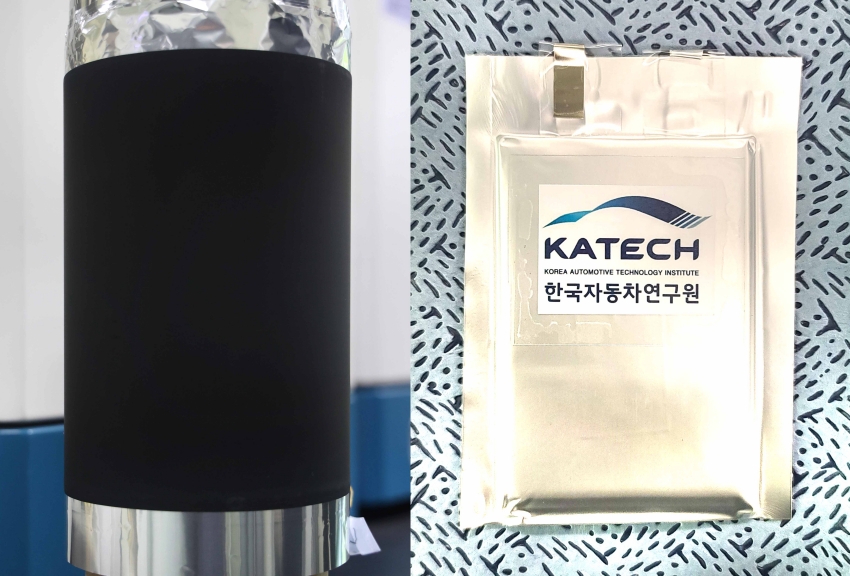
Improvement in manganese leaching and capacity loss issues, emphasis on applicability to existing electrode processes
The Korea Automotive Research Institute announced on the 27th that it has transferred two electrode technologies related to lithium manganese iron phosphate (LMFP) and sodium batteries to JR Energy Solution, a company specializing in battery electrodes.
LMFP is a cathode material that increases energy density by adding manganese to existing lithium iron phosphate (LFP) batteries. However, there was a problem where manganese dissolved into the electrolyte during the charging and discharging process, reducing battery life and storage performance.
Hanjayeon suppressed manganese leaching in high-temperature environments by applying a special aqueous binder that adsorbs manganese cations. The researchers explained that this improved battery life and storage performance by more than 15% compared to existing models.
Sodium batteries are considered a candidate for low-cost batteries because they can reduce the burden of raw materials compared to lithium batteries, but the problem of initial capacity loss during the manufacturing process has been pointed out as a limitation to commercialization. Hanjayeon stated that by forming a sacrificial anode coating layer on top of the anode layer, they reduced irreversible capacity loss and increased energy density by more than 20%.
The transferred technology is highlighted for its applicability in production sites, as it can be integrated into existing electrode manufacturing processes. By enabling improvements in battery characteristics without requiring separate equipment investment or significant cost increases, it can reduce the burden of commercialization for small and medium-sized electrode companies.
However, verifying long-term reliability and securing cost competitiveness remain challenges in the actual mass production phase. This technology transfer is significant in that it enables domestic electrode companies to secure the technological foundation to respond to the next-generation mass-market battery sector.

Comments
Related news
Hanjayeon Secures Advanced Testing Infrastructure for Future Aviation Mobility
The Korea Automotive Research Institute (hereinafter referred to as KARI) has broken ground on the "Green UAM-AAV Core Component Testing and Evaluation Center," a key infrastructure for the eco-friendly future aviation mobility (AAM) industry, in the Seosan Bio-Wellbeing Special Zone in Galmari, Buseok-myeon, Seosan-si, Chungcheongnam-do, together with the Korea Aerospace Administration, Chungcheongnam-do, and Seosan-si.
2025.11.07by 배종인 기자
Global Automotive Industry in 2026, 'Test of Transformation'
The Korea Automotive Technology Institute (KATECH) recently forecasted through a special industrial analysis report that significant changes in the global automotive industry will enter a critical testing phase starting in 2026. The report presented five key issues for the automotive industry in 2026: △autonomous driving and robotics △powertrain electrification △software-defined vehicles (SDV) and user experience (UX) △complete vehicle market dynamics △and global core component supply.
2026.02.06by 배종인 기자
Korea Automotive Research Institute and Bumhan Fuel Cell Sign MOU for Full-Cycle Technology Development for Liquid Hydrogen Mobility
The Korea Automobile Research Institute and Bumhan Fuel Cell have signed a memorandum of understanding to strengthen competitiveness in the liquid hydrogen-based hydrogen mobility industry. The two organizations plan to promote full-cycle technology development and demonstration cooperation covering storage, charging, and utilization of liquid hydrogen, and to expand technology applications to both defense and civilian sectors. The agreement also includes infrastructure construction, testing and evaluation support, and identification of joint domestic and international research projects. Liquid hydrogen is a form created by cooling gaseous hydrogen to minus 253°C, reducing its volume to approximately 1/800th of the original, and is characterized by enabling large-capacity storage and transportation.
2026.02.12by 명세환 기자
.jpg)
2025–2029 project carried out through the Industrial Transition Joint Training Center
The Korea Automotive Research Institute is implementing job transition training for incumbent workers and providing corporate consulting support to the parts industry, which is in transition toward future vehicles, through the Industrial Transition Joint Training Center project of the Ministry of Employment and Labor. The Institute will operate the project for five years from 2025 to 2029, and concluded agreements with 161 companies last year. This year, the Institute plans to advance its training curriculum and expand consulting services, with full-scale operations to commence from next month.
2026.02.24by 명세환 기자
.jpg)
Korea Autonomous Driving Institution Designated as Korea's First Accredited Testing Agency
The Korea Automotive Research Institute has established the nation's first nationally accredited testing system for low-speed autonomous vehicles. By expanding the accreditation scope of the Korea Laboratory Accreditation Scheme (KOLAS) based on the international standard ISO 22737, it is now possible to verify the performance and safety of autonomous shuttle buses and last-mile mobility in an accredited manner. The institute plans to evaluate the perception, decision-making, and control functions of autonomous driving systems through test scenarios that reflect actual road environments. With this designation, domestic companies are expected to be able to obtain internationally recognized test reports, which will reduce certification burdens in the process of entering overseas markets.
2026.03.16by 배종인 기자











