


Terra Quantum and Apex.AI Successfully Apply Post-Quantum Cryptography to Robots and SDVs
 Published2026.07.27 11:01
Terra Quantum and Apex.AI announced on the 27th that they have successfully implemented PQC, standardized by the National Institute of Standards and Technology (NIST), for communication between Apex.AI's robot software operating environment and cloud-based control systems.
This implementation was achieved by applying quantum-resistant cryptographic algorithms without altering the existing communication workflow and distributed software architecture.
Software-defined vehicles (SDVs), autonomous systems, and connected robots currently being introduced are often designed to operate over several decades.
These systems rely on communication with cloud services for monitoring, diagnosis, and software updates, but there are growing concerns that existing public-key cryptography systems could be rendered ineffective if cryptographically significant quantum computers emerge.
Both companies stated that this implementation presents a practical path for enterprises to begin transitioning to quantum-resistant security systems at this stage.
This solution is a configuration that combines Terra Quantum's PQC technology with Apex.AI's Apex.OS.
Apex.OS provides a software foundation for software-defined robots and intelligent machines, and plays a role in enabling secure communication between the edge and the cloud.
Both companies explained that since the approach involves only replacing existing encryption technology, there is no need to redesign application logic or communication architecture.
Application fields include robotics, autonomous mobility, industrial automation, logistics, aerospace, defense, and critical infrastructure.
In particular, NATO's multi-domain operations (MuIt was stated that, based on the concept of Ti-Domain Operations, it can be applied to environments requiring interoperable communication infrastructure across multiple operational domains, such as ground, air, sea, cyber, and space.
“This implementation demonstrates that NIST-standardized post-quantum cryptography is ready to protect today’s cloud-connected systems,” said Markus Pflitsch, CEO of Terra Quantum. “It presents a practical path to achieving quantum tolerance without redesigning existing software architectures.”
Jan Becker, CEO of ApexAI, said, “For companies developing platforms that will operate for years or even decades, post-quantum security preparation is a challenge that must be considered from the early stages of architecture and product planning.”

Comments
Related news

Ibis, Completes Total SW Supply Base for Future Vehicles
IBIS Co., Ltd. (CEO Nam Ki-mo) has acquired the Korea business rights of Apex.AI, establishing the foundation to supply comprehensive software solutions and technologies for future vehicles such as SDVs.
2024.10.22by 배종인 기자
Apex.AI and LG Electronics Join Hands to Develop HPC for SDV
Apex.AI, a leading provider of reliable and certified software for mobility, and LG Electronics, a global leader in electronics, have signed an MOU and are launching joint research and prototype development of a next-generation high-performance computer (HPC) that integrates advanced driver assistance systems (ADAS) and cluster controllers into a single platform.
2024.12.18by 배종인 기자
Apex AI Attracts Strategic Investment from LG Electronics
Apex.AI, a leading company in the field of safety-certified software for mobility and software-defined vehicles (SDV), has secured strategic investment from LG Electronics. This investment is expected to accelerate LG Electronics' advancement in software-defined vehicle (SDV) technology, expand Apex.AI's global presence, and strengthen collaboration within Korea.
2025.02.26by 명세환 기자
Apex.AI and QNX Collaborate to Accelerate Deterministic AI for Autonomous and Robotic Systems
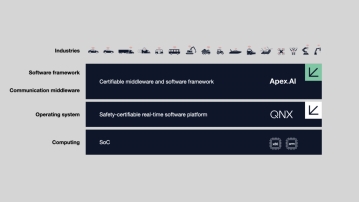
Apex.AI, an AI-based autonomous systems software company, has officially achieved compatibility between its AI-native operating system Apex.OS and the QNX Software Development Platform (SDP) 8.0.
2026.01.05by 명세환 기자

Apex AI Selects HL Clemov as Next-Generation ADAS Controller Middleware Partner
I don't see any text to translate in your message. Please provide the Korean text that you'd like me to translate into English, and I'll translate it according to the rules you've specified.
2026.02.03by 명세환 기자











