



Mouser anticipates expanded demand for automotive emission control electronic components ahead of Euro 7 implementation
 Published2026.09.04 11:38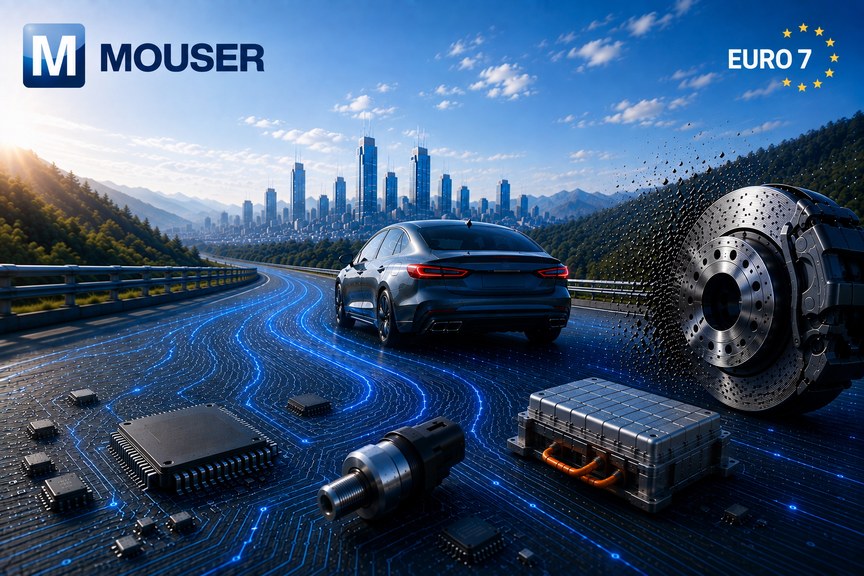
유로 7은 2026년 11월 29일부터 EU 내 신규 승용차·승합차에 우선 적용되며, 2027년 11월 29일 경형 차량(LDV), 2028년 트럭·버스 순으로 확대된다.
EU 역외 제조사도 EU 시장 판매 시 규정 준수 의무가 부과된다.
지난 1년간 미세 플라스틱(microplastics) 관련 구글 검색이 전 세계적으로 135% 증가했으며, 브레이크 발생 입자가 전 세계 미세 플라스틱의 약 28%를 차지한다는 연구 결과도 있어 규제 대응 압력이 높아지고 있다.

△배기가스 및 후처리 제어 △브레이크·타이어 미세입자 배출 관리 △배터리 내구성 및 온보드 모니터링이다.
미세입자 분야에서는 제동 분진과 타이어 마모를 측정·관리하기 위한 차내 센싱·제어 시스템과 테스트·측정 장비 개발이 확대될 것으로 예상했다.
배터리 분야에서는 하이브리드·전기차의 배터리 상태, 에너지 흐름, 시스템 진단을 더 정밀하게 추적하는 모니터링 기술 수요가 커질 것으로 전망했다.

Comments
Related news
Mouser, ams OSRAM 'OSLON Black IR:6 C-Series' Automotive LED Supply
Mouser Electronics has begun supplying ams OSRAM's 'OSLON Black IR:6 C-Series' infrared LEDs domestically. The product suppresses red glow through chip-level filtering at a 940nm wavelength and enhances nighttime illumination performance, supporting in-vehicle sensing applications such as driver face and gaze detection, occupant monitoring, and child presence detection.
2026.08.07by 배종인 기자

Mouser Operating Industrial Edge AI and Power Management Resource Hubs
Mouser Electronics is operating two dedicated resource hubs for industrial edge AI design. Providing practical, implementation-focused content from AI inference workload analysis through energy harvesting to production-level power architecture design. Offering in one place guides and stocked component pathways necessary for implementing real-time analysis, predictive maintenance, and anomaly detection in embedded systems, including TinyML implementation, PMIC multi-rail sequencing, SiC-based power modules, and battery energy storage architectures.
2026.08.10by 명세환 기자
Mouser, beginning supply of MediaTek 'Genio 420' IoT platform
Mouser Electronics has begun supplying MediaTek's generative AI-enabled IoT platform 'Genio 420'. Built on a 6nm process, this platform supports both low-power edge AI processing and on-device generative AI simultaneously, and can be applied to home automation, smart appliances, and commercial displays. It features standard WiFi 6E and Bluetooth 5.3 support along with enhanced security capabilities.
2026.08.18by 배종인 기자
[Technical Contribution] Mouser: "RF Communication Performance Determined by Signal Chain Components and Interconnect Quality"
The Mouser Electronics Technical Content Staff discusses the fundamental principles of RF signal chain components and interconnects.
2026.08.19by 편집부

Mouser Shines Light on Quantum Computing Technology with Latest EIT Series Release
Mouser Electronics has unveiled the latest installment of its 'EIT' series, which focuses intensively on quantum computing technology. Covering diverse topics including qubits, error correction, AI, and post-quantum security, the content is provided in multiple formats such as podcasts, technical articles, and infographics. Engineers and researchers can gain insight into the possibilities and challenges of quantum systems, which currently face error rate and scalability limitations but are approaching the practical implementation stage through advances in quantum error correction technology.
2026.08.20by 배종인 기자











