



ETRI and KAIST Win First Place in International Robot Pathfinding AI Competition
 Published2026.09.16 09:17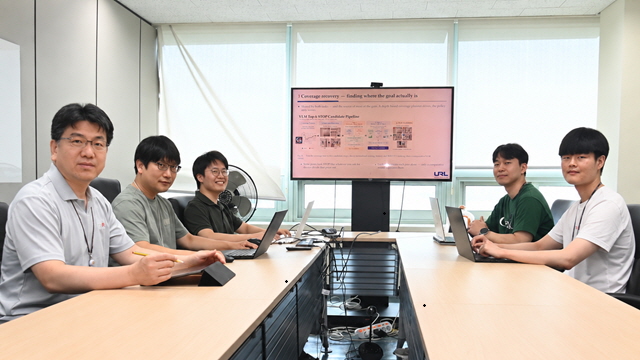
Robot vision-language navigation (VLN) technology jointly developed by ETRI and KAIST achieved world-leading results at an international competition. The technology verified this time can be combined with existing robot mobility systems without additional training, and is expected to be applied to various service robots ranging from guide robots for the visually impaired to manufacturing and logistics robots.
ETRI's Field Robotics Research Division and Professor Myung Hyun's research team from KAIST's Department of Electrical Engineering participated as the 'URL-FRRS' alliance team, and while the success rate was the same as the second-place team, it was confirmed as the final first place by being submitted earlier.
To solve this, the team fine-tuned a vision-language model (VLM) with approximately 8 billion (8B) parameters for robot navigation and applied a cosine annealing restart strategy that augments stopping data.
Additionally, the team developed 'CoRe-VLN (Coverage-based Recovery for VLN)' technology.
When a robot determines it has reached the destination and stops, instead of immediately terminating the mission, it uses four-directional video and distance information to sequentially re-verify △whether the instructed location matches △the target's color and material, and △the actual distance to the target.
If the location is determined to not be the destination, the system autonomously generates a new search path and sequentially checks candidate locations.
Based on this, the research team plans to train a VLA (Vision-Language-Action) model and build training data on the scale of 50,000 environmental reasoning cases and 100,000 movement trajectories.
ETRI plans to first apply this technology to research on the guide robot for the visually impaired called 'Eddie', and expand it by 2029 to develop on-device mobility intelligence technology that operates VLM on domestic AI semiconductors (K-NPU) for autonomous movement in manufacturing and logistics sites without precise maps.
This research was conducted with support from the Ministry of Science and ICT and IITP's 'Guide Dog: Development of Mobility Intelligence Technology for Guide Robots for the Visually Impaired' project and the 'Core Technology Development Project for On-Device Application Support for Autonomous Agents'.

Comments
Related news
ETRI Assumes Chair of ITU-T Autonomous Vehicle Standardization; SDV International Standard Established
ETRI has secured the chair position of the ITU-T autonomous driving standardization working group and established the first international standard in the software-defined vehicle (SDV) field. Cha Hong-gi, Director of the Intelligence Information Standards Research Division, was appointed as the new chair of Q10/21, and a recommendation defining SDV core functions, service management, and vehicle connectivity technical requirements was officially adopted. Through this, a common standard has been established for SDV platforms that previously differed by manufacturer, which is expected to contribute to strengthening the global competitiveness of domestic automotive and ICT companies.
2026.08.07by 명세환 기자
ETRI and Busan City Launch Demonstration of AI and Digital Twin-Based Urban Flooding Prediction Platform
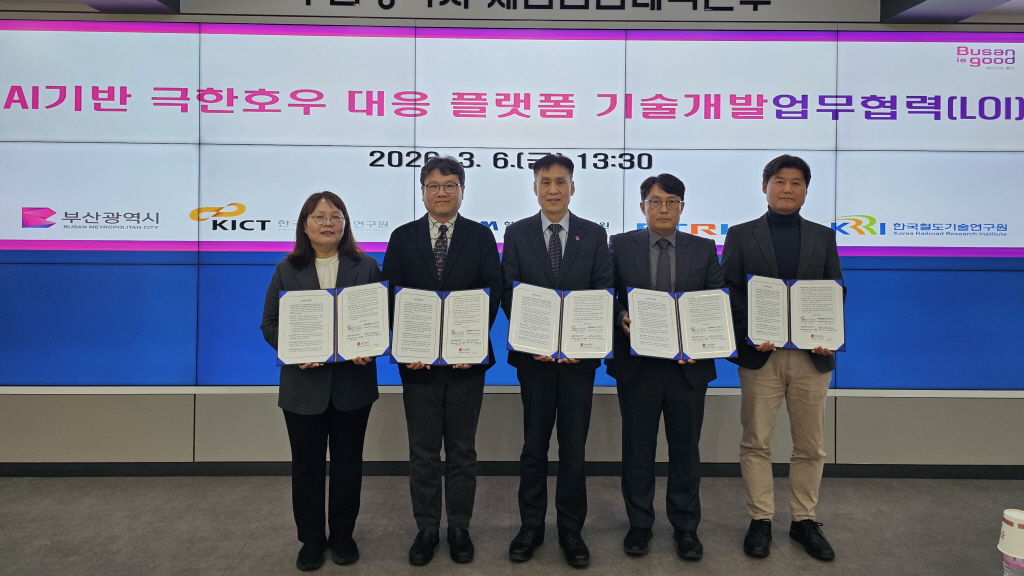
ETRI and Busan City, along with four institutions including the Korea Institute of Civil Engineering and Building Technology, Korea Institute of Geoscience and Mineral Resources, and Korea Railroad Research Institute, have begun development of an urban flooding prediction platform leveraging AI and digital twin technologies. This project, which will be implemented over five years starting in 2025 with a budget of approximately 33.8 billion won, will develop a hybrid flooding prediction model through comprehensive analysis of CCTV footage, sensor data, and historical inundation data. By combining physical simulation with AI technology, the project aims to replicate the city's drainage flow in a digital environment and realize a smart safe city by detecting and predicting flooding risks at an early stage.
2026.08.19by 명세환 기자
ETRI Unveils AI Vision and AIDC Strategy at 50th Anniversary Conference
The Electronics and Telecommunications Research Institute (ETRI) will hold 'ETRI Conference 2026' in Seoul on September 1st to commemorate its 50th anniversary. ETRI President Park Se-woong will present 'A Warm World Living Together Led by AI·DX Innovation' as a new vision, and will disclose the nation's AI innovation strategy ranging from core AI scientist technologies such as shared multimodal foundation models and AI Co-Scientist to ultra-high-speed network infrastructure. The initiative will be centered on five strategic focus areas including artificial intelligence, physical AI, three-dimensional communication, spatial media, and ADX convergence, along with the 4E Combination strategy.
2026.08.26by 명세환 기자
Kuntech and ETRI Develop On-Device AI Model Obfuscation and Data Flow Analysis Technology
Kuntech is developing technology to protect AI models and inference code in on-device AI environments through a national research project led by ETRI. By combining MLIR-based obfuscation and data flow analysis technology, it blocks internal structure analysis of AI models deployed on devices. Model information is concealed through de-identification, parameter encapsulation, and neural structure obfuscation, and two related patents have been filed.
2026.09.07by 배종인 기자
ETRI and Korea Military Academy Sign MOU for Joint Development of AI Defense Technology
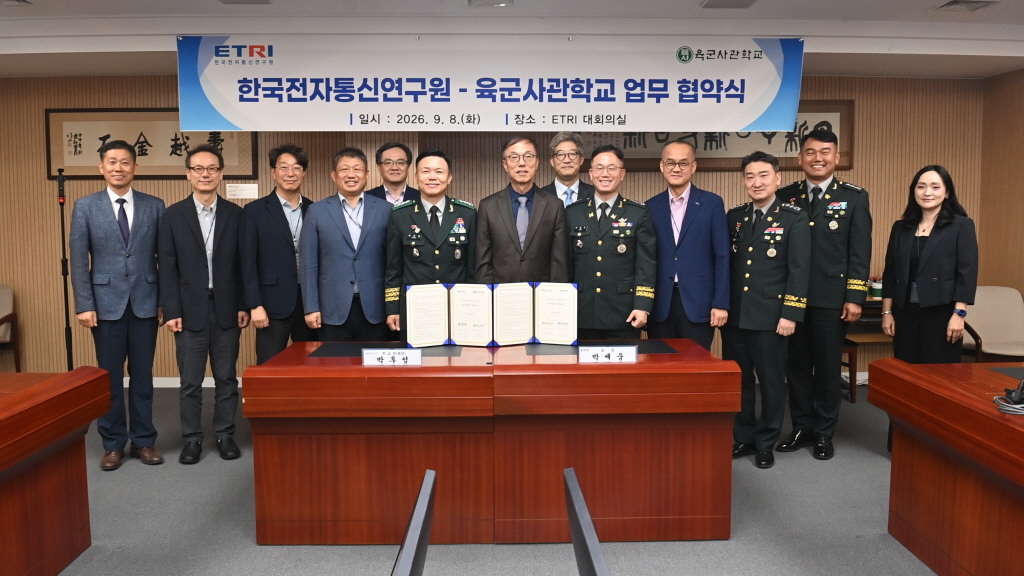
ETRI and Korea Military Academy have concluded an institutional-level joint research agreement for AI defense technology. Through AI-in-glass-based wearable devices, the collaboration will support real-time situational awareness and decision-making for combat personnel, with expansion to small-unit command and control technology. The four core technologies—spatial intelligence, personal AI agents, low-power displays, and AR devices—will be integrated for development, with promotion of application across various fields including industry, medical, and disaster safety.
2026.09.08by 배종인 기자











