



Kaspersky Launches 'Kaspersky Next Optimum,' Modular Security Platform for SMBs
 Published2026.09.21 11:35
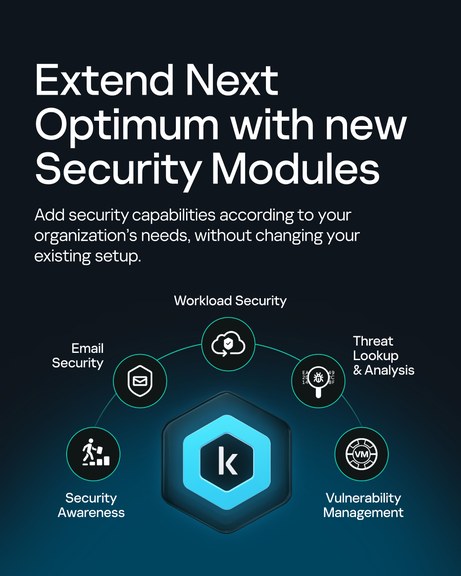 A modular security platform has emerged that allows SMBs to minimize security gaps while progressively expanding their protection scope. A key feature is the ability to select and add necessary functions without replacing existing infrastructure.
The core of this update comprises five security modules: △security awareness △email security △workload security △threat investigation and analysis △vulnerability management. Kaspersky states that enterprises can introduce required functions sequentially, starting with their current needs.
The primary reasons cited for SMBs switching security vendors were compatibility and integration issues with existing solutions (26%) and the need for unified platform consolidation (23%).
The security awareness module focuses on responding to phishing and social engineering attacks, and is suited for organizations where a security culture is not yet established.
The email security module operates by blocking threats before they reach users, while the workload security module targets hybrid cloud environments.
The threat investigation and analysis module supports in-depth analysis of suspicious files and accelerates incident response, while the vulnerability management module simplifies the process of identifying and resolving vulnerabilities across the IT environment.
Each module operates in combination with existing endpoint, EDR (Endpoint Detection and Response), XDR (Extended Detection and Response), and MXDR (Managed XDR) capabilities.
Previously available only in Kaspersky Next XDR Optimum and MXDR Optimum, it has now been included in Kaspersky Next EDR Foundations to reflect customer demand.
Administrators can conduct simulations using pre-configured phishing templates and verify security awareness improvement progress through automated reporting features.
It detects account compromises early by correlating analysis of leaked credentials with security alerts and authentication attempts.
Additionally, mobile and tablet-optimized management features and Telegram-based incident notification capabilities have been improved.
Notifications include incident priority, affected assets, recommendations, and links to the relevant incident.
Lee Hyo-eun, Country General Manager of Kaspersky Korea, stated, "Most domestic small and medium-sized enterprises do not have dedicated security teams," and added, "We designed the platform to enable organizations to strengthen security incrementally as needed without completely changing existing infrastructure."

Comments
Related news
.jpg)
Kaspersky Launches Threat Intelligence Reporting Platform
Kaspersky has launched a threat intelligence reporting service that delivers over 200 in-depth security reports annually through an interactive platform. Moving beyond the conventional static PDF format, the service significantly enhances security analysts' threat analysis efficiency through real-time exploration, linked indicators of compromise, detection rules, CVE information, and customizable filtering by country and industry.
2026.06.29by 명세환 기자
Kaspersky GReAT Detects Complex Function RAT Malware 'CrystalX RAT'
Kaspersky's GReAT has detected a new remote access trojan (RAT) called 'CrystalX RAT' that integrates information stealing, keylogging, clipper, and spyware functionality. This malware is equipped with capabilities for stealing account credentials, modifying cryptocurrency wallet addresses, and real-time surveillance. It is being distributed through YouTube and Telegram in the form of malware-as-a-service (MaaS). As the entry barriers to cybercrime continue to lower, additional security threats are raising concerns.
2026.07.20by 명세환 기자
.jpg)
Kaspersky: “99% of Companies Recognize IT Security as a Business Growth Strategy”
A survey conducted by Kaspersky covering 1,800 respondents across 18 countries revealed that 99% of enterprises recognize IT security as a core strategic asset that extends beyond defensive measures to enable digital transformation and sustainable growth. Data protection (35%) and the capability to safely adopt new technologies (27%) have emerged as the top priorities for security investments, and with the rising threats of supply chain attacks and AI exploitation, enterprises are accelerating their transition toward integrated platform-based solutions.
2026.07.30by 명세환 기자
Kaspersky KCS, DevSecOps Optimization·GitHub Actions Error Detection Enhanced
Kaspersky has released a new version of its container security solution KCS. The update adds features including GitHub Actions configuration error detection, custom security policies, control plane deep audit, and SBOM export to streamline DevSecOps workflows and strengthen software supply chain security. Node agent performance has improved 2.5 times, and dynamic admission control processing speed has improved 10 times, enabling protection of the entire lifecycle of container applications in on-premises and isolated network environments.
2026.08.05by 명세환 기자

Kaspersky Shares Cybersecurity Cooperation Plans at WSIS Forum 2026
Kaspersky participated in the UN-affiliated WSIS Forum 2026 and shared insights on strengthening cyber resilience for SMEs and AI governance. The company collaborated with national agencies including Nigeria and Indonesia to discuss methods for securing cybersecurity capabilities for SMEs with limited security investment capacity, and presented the necessity of cross-border incident response cooperation to build trust in the Agentic AI environment.
2026.08.13by 명세환 기자











