



SKT and KISTI Jointly Develop Digital Twin Interoperability Technology for Quantum Cryptography Communication Network
 Published2026.09.22 09:43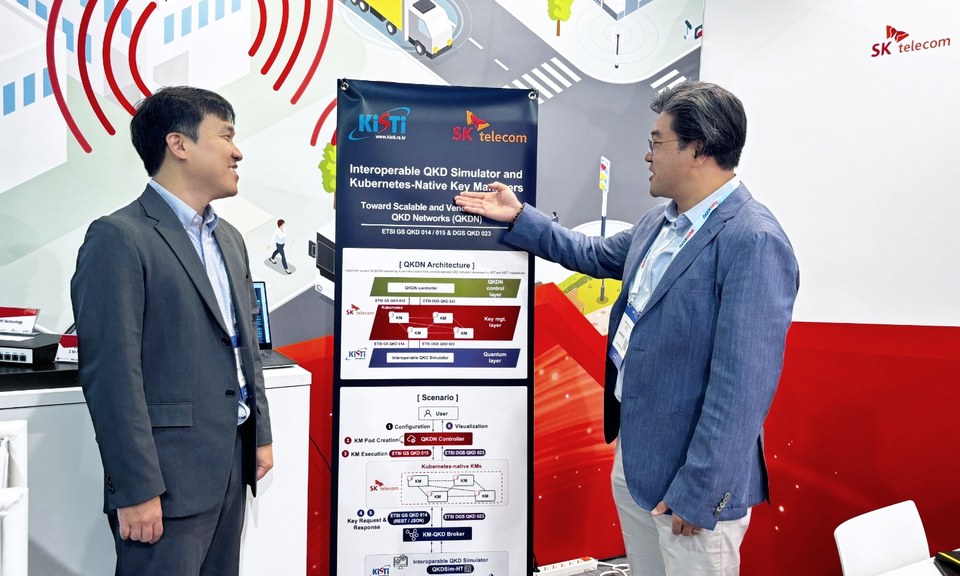
This technology was developed through the Ministry of Science and ICT's "QKD Network Efficiency Expansion and Resource Optimization Element Technology" and "Quantum Cryptography Communication Network Technology Development Based on National Research Infrastructure" projects, with the exhibition held at the SK Broadband booth.
Quantum cryptography communication networks face limitations in that physical conditions such as optical cable length and optical loss are difficult to change retroactively and equipment costs are high, making it challenging to test various configurations in advance.
The two institutions implemented this verification process in a virtual environment.
When the key management system requests a quantum key, the simulator virtually implements actual equipment characteristics and surrounding environmental conditions such as communication distance, optical loss, reception efficiency, and post-processing algorithms, and delivers the generated quantum key along with performance and status information in real-time.
The two institutions explained that equipment placement and configuration values verified in the virtual environment can be directly applied to the actual operational environment, functioning as a digital twin.
Kubernetes is an open-source platform that automatically handles the deployment, scaling, and management of containerized applications distributed across multiple servers.
Due to this structure, the key management system can be operated flexibly in accordance with various network environments and scenarios created by the simulator.
KISTI developed a QKD simulator that virtually reproduces various conditions such as communication distance and optical loss.
They also highlighted that the application of an ETSI standard-based interface enables future interoperability with quantum cryptography equipment developed by other institutions and companies, securing scalability.
Joong-Seok Song, Director of KISTI's Network Future Technology Research Division, said, "We have established a foundation to virtually implement a quantum cryptography communication environment and verify it in interoperability with an actual key management system. We will develop this into a core technology that enhances interoperability and scalability."

Comments
Related news
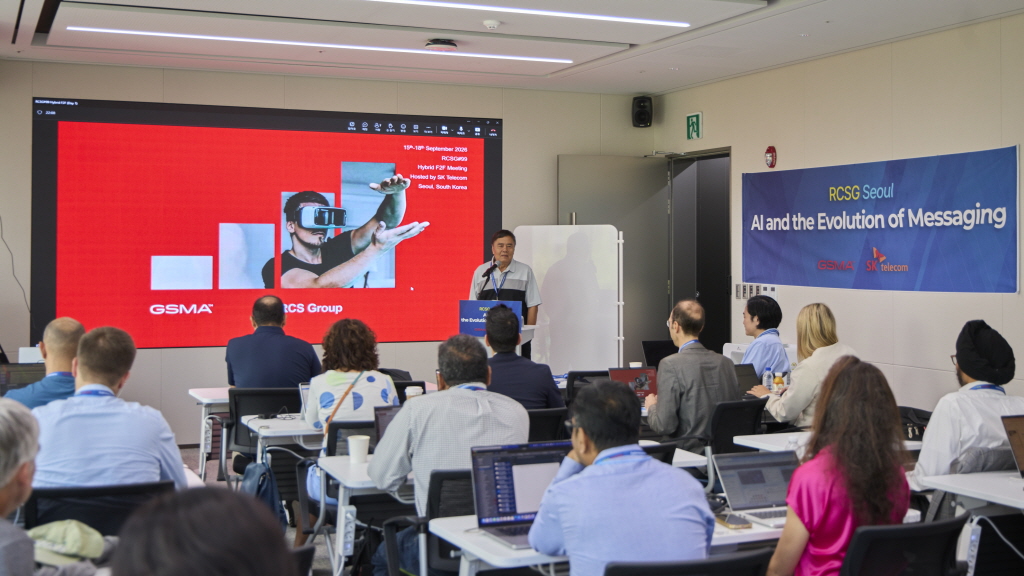
SKT Hosts GSMA RCS Standardization Conference...Proposes Messaging as AI Agent Approval Channel
At the GSMA RCS standardization conference held by SKT in Seoul, SKT proposed as an international standard a structure in which users provide final approval via RCS message before an AI agent confirms a transaction. At this conference attended by 16 companies including AT&T, Google, and Samsung Electronics, a special session titled 'AI and the Evolution of Messaging' will be newly established, where discussions will cover AI trust and user control, and improvements to brand registration procedures. SKT is advancing the construction of an AI trust infrastructure by combining existing telecommunications capabilities with AI.
2026.09.15by 명세환 기자
SKT Selected as Top-Tier Enterprise for 5 Consecutive Years in KS-CQI
SK Telecom has been selected as a top-tier enterprise for five consecutive years in the Call Center Quality Index (KS-CQI) evaluation administered by the Korean Standards Association. By applying AI across all consultation processes, the company provides real-time satisfaction monitoring and customized coaching, and has established a 24-hour consultation system through AI chatbot and call bot advancement. Simultaneously, by strengthening education to convert complex telecommunications terminology into everyday language, SK Telecom achieved high scores in customer reliability and courtesy evaluations.
2026.09.15by 명세환 기자
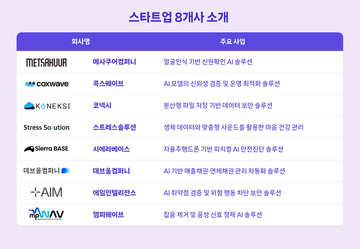
SKT Strengthens AI Collaboration with 8 Startup CEOs
SK Telecom is strengthening cooperation with startups to discover business opportunities in the AI era. CEO Jung Jae-heon met with 8 startup representatives to listen to business challenges and discuss mutual growth strategies, and provides support including mentoring, investment attraction, and international exhibition participation through the collaboration platform 'SKTCH'. The company plans to create new business opportunities by combining telecommunications and AI infrastructure with startups' innovative technologies, with a goal of nurturing 500 companies by 2030.
2026.09.16by 배종인 기자
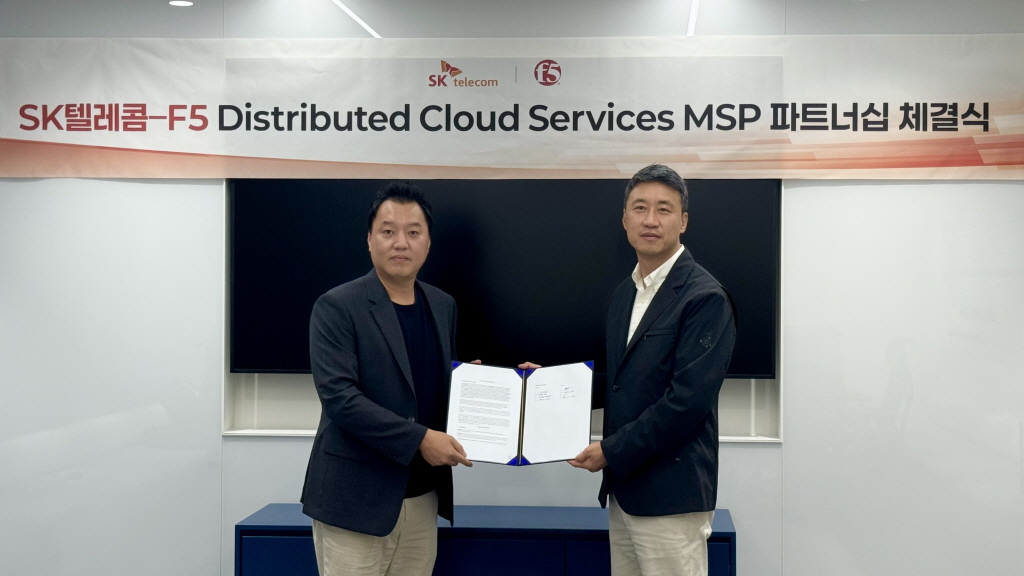
SKT·F5, AI Cloud Security Partnership Agreement
SK Telecom has concluded an AI cloud security partnership with global security company F5. SKT has been selected as Korea's first F5 Distributed Cloud MSP partner, acquiring WAF, API security, DDoS, and bot defense technologies. The company plans to provide enterprise solutions that integrate build, operation, and security to address increasingly complex security threats in multi-cloud environments during the Agentic AI era.
2026.09.16by 명세환 기자
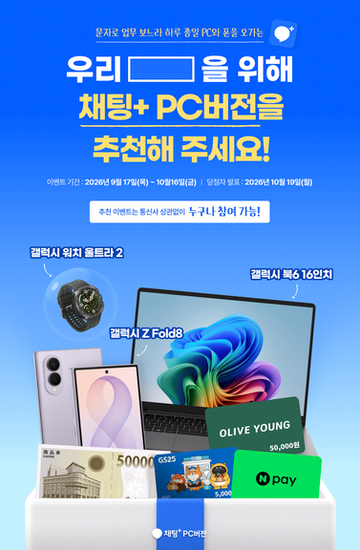
SKT Launches Recommendation and Installation Event for 'Chat+ PC Version'
SKT and Samsung Electronics are jointly running a prize event worth 20 million won through October 16 to expand users of the PC text messaging service 'Chat+ PC Version.' The service, which has achieved a high satisfaction rate of 83.7%, allows users to send and receive text messages on PC using their existing Galaxy smartphone numbers, and scheduled message and text style features are set to be added by the end of this month.
2026.09.17by 명세환 기자











