



UNIST suppresses vaporization losses while maintaining 97% of liquefied hydrogen storage capacity
 Published2026.09.30 08:59
Verification of MOF material reducing liquefied hydrogen vaporization loss, storage period extended 3-fold
Research results show that applying porous materials inside liquefied hydrogen storage tanks can significantly reduce losses from hydrogen evaporation while minimizing reductions in storage capacity.
A research team led by Professor Oh Hyun-cheol from the Department of Chemistry at UNIST, in collaboration with Professor Moon Hoe-ri from Ewha Womans University and researchers from the Technical University of Munich in Germany, announced on the 29th that they have verified technology reducing boil-off loss occurring during liquefied hydrogen transportation and storage by utilizing metal-organic frameworks (MOF).
Liquefied hydrogen is advantageous for mass storage and transportation, but when external heat enters, some of it converts to gas and is lost. The research team analyzed whether MOF, a porous material with numerous micropores inside, can reduce such losses during the hydrogen adsorption process.
Reducing losses while maintaining liquefied hydrogen storage capacity
The research team conducted experiments and simulations on two types of MOF materials: IRMOF-20 and MIL-53.
Analysis results showed that when IRMOF-20 was applied, the storable hydrogen amount maintained approximately 97% compared to liquefied hydrogen storage alone. Conversely, the period during which hydrogen evaporates and is completely depleted increased more than 3-fold, from approximately 64 days to 221 days.
Researchers analyzed that hydrogen was stored more densely within the porous pores than in liquid hydrogen, making it possible to minimize reductions in storage capacity.
The other material, MIL-53, showed hydrogen evaporation suppression effects but resulted in storage capacity decreasing to approximately half the original level.
Expectations for advances in liquefied hydrogen transportation technology
The research team explained that additional heat is required for hydrogen adsorbed inside MOF to be released; therefore, heat entering inside the tank is partially absorbed and the evaporation rate is slowed.
This research is significant in demonstrating that in liquefied hydrogen storage technology, additional loss reduction is possible not only through improved thermal insulation performance but also by utilizing material-based adsorption technology.
Professor Oh Hyun-cheol stated, "We confirmed that by optimizing the pore structure and hydrogen storage characteristics of MOF, evaporation losses can be reduced while maintaining storage capacity," and added, "Additional verification in actual storage tank environments is necessary."
This research result has been published in the international academic journal Nature Communications.

Comments
Related news
UNIST and KAUST Achieve 31% Efficiency in Atmospheric Process Tandem Battery
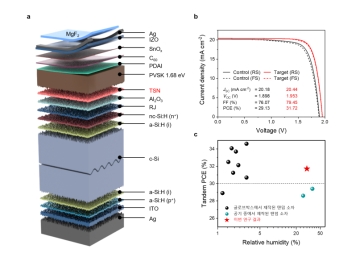
Researchers from UNIST Professors Sang-il Suk and Kyung-jin Choi's team and a joint research team with KAUST have developed an interfacial coating technology that enables high-efficiency perovskite-silicon tandem solar cells to be fabricated even in general atmospheric environments. The research team applied a three-component coating layer comprised of the conventional SAM interfacial material plus GDMA and AG, achieving an efficiency of 31.72% in cells manufactured in air. The certified efficiency was confirmed as 31.36%. This achievement is evaluated as a technology that reduces dependence on moisture and oxygen blocking equipment and increases the possibility of large-area production of next-generation tandem solar cells.
2026.06.11by 배종인 기자
UNIST Develops Memristor Semiconductors for 6G and Satellite Communications
Researchers at Ulsan National Institute of Science and Technology (UNIST) have developed a semiconductor device capable of reducing power consumption in 6G and satellite communication environments. The structure enables simultaneous high-frequency communication and signal computation, presenting possibilities for improving communication chip design efficiency.
2026.06.22by 배종인 기자

UNIST Identifies Principles of Multimodal AI Performance Improvement… Paper Accepted for ICML 2026
UNIST (Ulsan National Institute of Science and Technology) announced on the 26th that Professor Yoon Sung-hwan's research team has elucidated the principles of performance improvement in multimodal AI from the perspective of 'loss landscape.' The research has been accepted to the International Conference on Machine Learning (ICML 2026).
2026.06.29by 배종인 기자
UNIST Develops On-Chip AI-Based Wearable Patch… Real-time Analysis of Biosignals and Harmful Gases
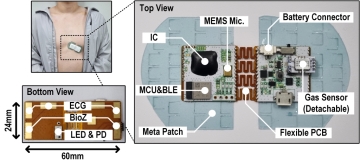
A research team at UNIST has developed wearable patch technology that simultaneously analyzes biometric signals and environmental information. The technology is characterized by the application of an on-chip artificial intelligence architecture that performs real-time analysis within the device without transmitting data externally.
2026.06.30by 배종인 기자

UNIST Accelerates Robust AI Learning with Quantum Computing
A research team led by Professor Yoon Sung-hwan at UNIST and a research team led by Professor Kim Joong-heon at Korea University have developed 'QRIM (Quantum Robust Inner Minimization)', a robust reinforcement learning technique based on quantum algorithms. The research results have been accepted to the International Conference on Machine Learning (ICML 2026).
2026.07.06by 배종인 기자











