



Xcena and Portrai Join Forces to Build CXL-Based Bio Data Infrastructure
 Published2026.10.06 10:25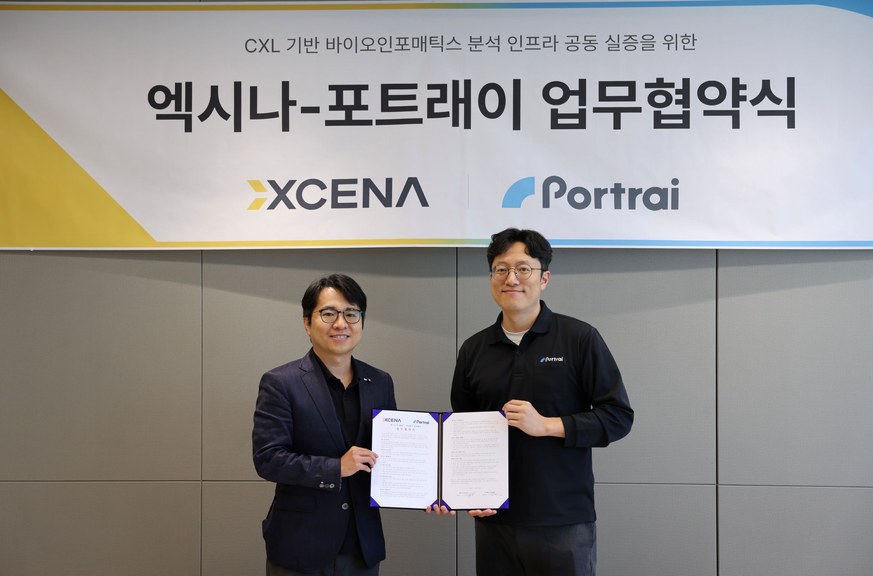
The signing ceremony was held at Xcena's office in Pangyo, attended by Kim Ju-hyun, CPO (Chief Product Officer) of Xcena, and Lee Dae-seung, CEO of Portrai.
The two companies announced that they will jointly develop and validate computing infrastructure capable of processing large-scale spatial omics data through this MOU.
'InfiniteMemory' is a solution that connects SSDs to CXL memory expansion devices to support large-scale data workloads that are difficult to process with DRAM alone, allowing utilization of wider memory space without modification to existing applications, according to Xcena's explanation.
In this pre-validation, data at approximately 35 million cell scale was successfully analyzed.
Additionally, they plan to finalize methods for applying Xcena's 'MX1' to Portrai's AI and bioinformatics infrastructure.
Lee Dae-seung, CEO of Portrai, remarked, "As data scale increases rapidly, the importance of computing infrastructure that can process it stably is also growing. Through joint validation, we will advance this into a system applicable to actual research and new drug development environments."

Comments
Related news
Panesia Establishes Its Position as a Leader in AI Data Centers and Next-Generation HPC Interconnects
Panesia (CEO Jeong Myung-soo), a leading provider of interconnect solutions in the AI infrastructure and HPC (High-Performance Computing) sectors, has established itself as a next-generation interconnect technology leader in the global AI data center and HPC markets, presenting a new paradigm for accelerating AI and HPC workloads through its proprietary CXL 3.2/PCIe 6.4 fabric switch and MPI-over-CXL solution.
2025.11.24by 배종인 기자

Panesia receives Minister of Trade, Industry and Energy Award for CXL International Cooperation Achievement
Domestic fabless startup Panasia has received a commendation from the Minister of Trade, Industry and Energy for outstanding achievements in industrial technology international cooperation at the 'Global Advanced Industry Technology Cooperation Forum 2025'. The award recognizes Panasia's accomplishments in international cooperation related to CXL (Compute Express Link) technology, with Kwon Mi-ryeong, Chief Strategy Officer (CSO) and Chief Operating Officer (COO) of Panasia, receiving the commendation on behalf of the company.
2025.12.05by 배종인 기자
SKT and Panesia Jointly Develop Next-Generation AI Data Center Architecture Based on CXL
SK Telecom announced that it has signed a Memorandum of Understanding (MOU) with Panesia for joint development of a "next-generation AI datacenter (DC) architecture" based on CXL (Compute eXpress Link) at MWC26 held in Barcelona, Spain. The two companies will transition from an expansion method centered on GPU addition to a structure that flexibly connects and combines CPU, GPU, and memory, thereby improving resource utilization efficiency and reducing cost burden. They will expand the scope of resource connection, previously limited within servers, to the rack unit level, and will also review the application of CXL-based connectivity in place of general-purpose networks during GPU collaborative computing processes. After validating utilization rate, latency, and throughput using actual AI models, they plan to disclose deliverables by the end of 2026 and promote large-scale environmental demonstration and commercialization.
2026.03.04by 배종인 기자
.jpg)
Memory expansion through the combination of chiplet SoC, DRAM, and system integration technology
Samsung Electronics, the Electronics and Telecommunications Research Institute (ETRI), and fabless company Primetech have launched joint development of a CXL-based ultra-large-capacity memory solution. The initiative aims to implement a memory-centric computing architecture to supplement existing processor-centric server structures in order to reduce the data processing burden in AI and high-performance computing environments. Samsung Electronics will handle DRAM and memory management technology, Primetech will provide chiplet-based CXL controller SoC, and ETRI will be responsible for integrated system implementation. The three organizations plan to validate large-scale memory pooling and management technologies to establish a foundation for expanding the domestic CXL ecosystem and responding to next-generation data center infrastructure.
2026.04.06by 배종인 기자
Panesia, AI Data Center Connectivity Innovation
Panesia will begin mass production of a fusion switch chip supporting both PCIe 6.4 and CXL 3.2 in the second half of this year.
2026.04.16by 배종인 기자











