


Workday Declares Evolution into Enterprise AI Platform Beyond HR Company
 Published2026.10.07 16:29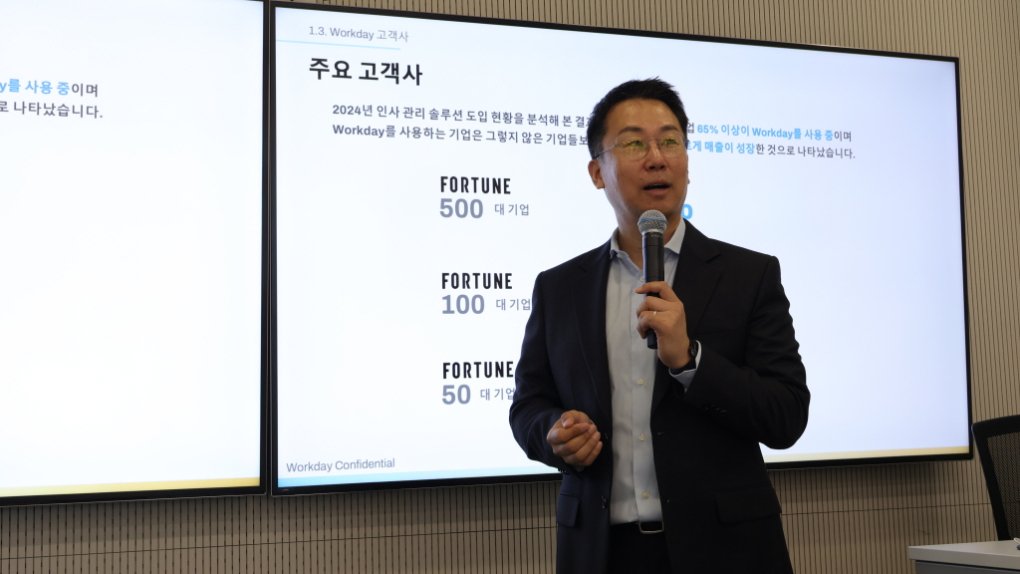
Presenting New Growth Axes: AI Agents, Skill-Based Talent Management, and Global Workforce Operations
'Workday Learning' Restructures All Employee Experience Within Workday Based on AI
"We will position ourselves as a strategic partner rather than a technology supplier in Korean enterprises' AI transformation journey, with AI agents, skill-based talent management, and global workforce operations as our new growth axes."
Workday Korea held a press briefing at its Seoul office in Gangnam-gu on the 7th, unveiling its second-half business strategy and AI vision, officially transitioning from its existing image as an HR company to an "enterprise AI platform" company.
At the event, CEO Huh Jung-yeol stated, "The market is now moving from the stage of reviewing AI to the stage of actual implementation and execution," adding "Workday will become a partner that designs new HR operating models suited to the AI era together with our customers."
The most frequently mentioned keyword at this briefing was "safe AI."
Whereas companies focused on the potential of AI utilization until last year, attention has now concentrated on security, regulatory, and governance issues that may arise when actually applying AI to business operations this year.
CEO Huh Jung-yeol identified time, risk, and cost as the most important factors companies consider in their AI adoption process.
He stated, "Enterprise companies look at how safely AI can be operated rather than how intelligent it is," and added "AI with built-in approval systems, authority management, compliance, and audit trail functions will gain competitive advantage going forward."
To achieve this, Workday presented an AI strategy framework of "Anticipate, Advise, and Act."
The vision goes beyond simply answering questions to proactively predict business changes, support decision-making, and ultimately perform actual work tasks through AI.
In particular, the company attempted to differentiate itself from the competitive AI agent strategies that have recently emerged.
While many companies focus on increasing the number of agents, Workday is concentrating on redesigning the business processes themselves.
The recruitment process was cited as a prime example.
Among complex workflows such as applicant review, interview scheduling coordination, and evaluation processes, AI agents will take full responsibility for specific stages, providing tangible productivity improvements that enterprises can experience.
The company defined this as "competition in workflow redesign rather than competition in agent numbers."
Another notable aspect of this event was the "skill-based talent management" strategy.
CEO Huh Jung-yeol forecast that organizations in the AI era will be reorganized around capabilities rather than job levels.
While job functions and titles were previously the standard for talent management, going forward, the skills individuals possess and how quickly they can expand them will become competitive advantages.
He emphasized, "The key to AI-native organizations is understanding what capabilities employees possess rather than what job level they hold," and stressed "skill-based talent management will become a core element of corporate competitiveness going forward."
The actual business strategy has also been realigned in this direction.
Workday Korea presented four growth axes: AI agents, skill-based talent management, global HR operations, and expansion of the partner ecosystem.
Particularly in the Korean market, the company plans to intensify its focus on large enterprises with high global business proportions.
Key target industries include semiconductors, manufacturing, biotech and pharmaceuticals, entertainment, gaming, logistics, and finance.
These are fields that commonly require global workforce management and complex organizational operations.
The company anticipates rapid growth in demand for AI-based talent operations within these industries.
The strengthened partner strategy is interpreted in the same context.
Workday Korea secured multiple new partners this year and is embarking on domestic ecosystem expansion.
Beyond existing implementation and operations-focused partnerships, the company plans to expand collaborative areas to include AI consulting, organizational transformation, global payroll management, and AI agent operations.
Meanwhile, a demo presentation of Workday Learning powered by Sana, a new product offering, was conducted at the briefing.
The core features include automatically creating educational content using generative AI, providing personalized AI tutors, and recommending learning paths tailored to employees' roles and skills.

Comments
Related news
.jpg)
Time saved by AI is wasted on manual work again… Korean companies confirm 'rework burden'
Domestic companies are experiencing constraints in generating substantive results despite reducing work hours through AI adoption, as they spend additional time correcting and verifying generated outputs. While 69% of respondents reported improved productivity following AI implementation, 31% of workers were found to spend 1-2 hours per week revising or rewriting AI-generated content. A limitation has also been identified wherein the time gained through AI is reabsorbed into existing work structures through management and review tasks, failing to translate into return on investment (ROI). Experts analyze that productivity innovation cannot be completed through technology adoption alone, and must be accompanied by structural job reorganization and enhancement of talent capabilities. #Workday
2026.03.11by 배종인 기자
Workday Appoints Heo Jeong-yeol as New Country Manager for Korea
Workday has appointed Heo Jung-yeol (Mike Hur), a former executive at a global IT company, as the new Country Manager of Workday Korea, and is moving forward with actively supporting the digital and artificial intelligence (AI) transformation of domestic enterprises.
2026.03.17by 배종인 기자
Wonderful Establishes Korea Branch… Jeong Eung-seop Appointed as First Branch Manager
Wonderful, a global enterprise AI agent platform company, has established a Korean subsidiary and appointed Jung Eung-seop, former head of Workday Korea, as the inaugural subsidiary head. Following the company's Series B funding round of $150 million in March, it announced plans to expand operations across more than 30 countries. Jung's appointment, given his track record leading domestic operations at SAP, Slack, and Workday, is interpreted as a move to strengthen local sales and implementation capabilities to penetrate the Korean market. The timing of this expansion is also attributed to the shift in generative AI competition from technology demonstrations to actual operational business transformation.
2026.04.09by 배종인 기자
Workday, “AI is more than a tool, it’s a colleague”
Workday, an AI platform company for enterprise HR, finance, and agents, held Workday Elevate Seoul 2026 on the 14th at The Westin Chosun Seoul in Gangnam-gu, Seoul. The company presented a hybrid workforce vision that integrates AI as a human "work colleague" and emphasized the importance of enterprise-grade AI that combines context, process, and security. Through the Sana platform, the company supports HR, finance, automation, and external system integration, implementing legitimate AI agents that ensure accuracy and compliance.
2026.05.14by 배종인 기자
Workday Reports $2.5 Billion in Revenue for First Quarter of Fiscal Year 2027
Workday, an enterprise AI-based human resources and financial software company, reported total revenues of $2.542 billion for the first quarter of fiscal year 2027, representing a 13.5% increase compared to the same period of the previous year. The company demonstrated continued revenue growth and improved profitability, primarily driven by its subscription-based business.
2026.06.04by 배종인 기자











