


ADI, "Fostering Future Engineers Beyond Component Support"
 Published2026.10.08 16:00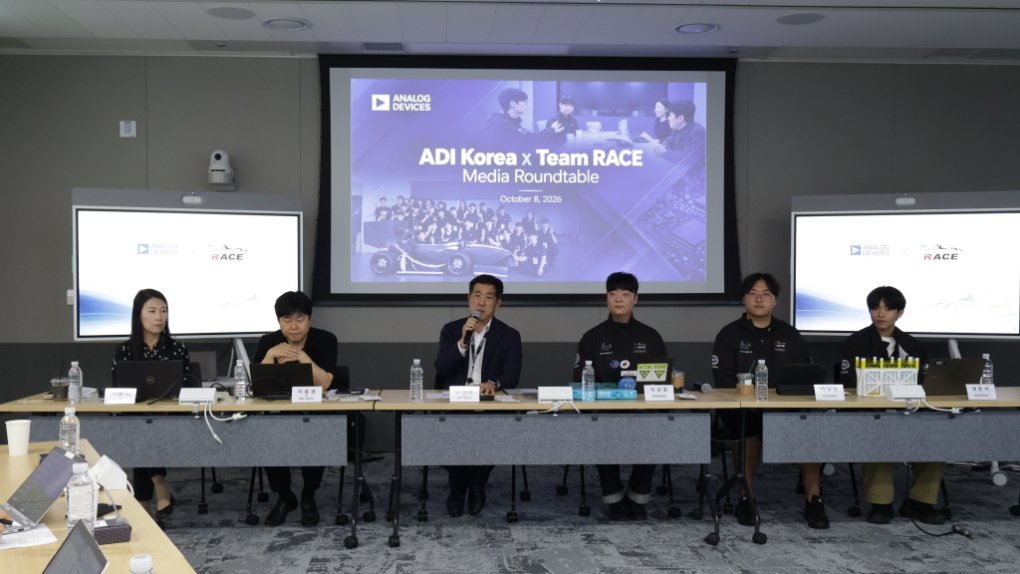
Three-Year Journey with Hanyang University Team RACE, Presenting a New Model of Industry-Academic Cooperation
BMS Development Technical Consultation and Solutions Provision, Sharing Real Engineering Experience
Global semiconductor company Analog Devices (ADI) is drawing attention for moving beyond simply sponsoring university student car projects to serve as a partner in nurturing future engineers. Over the past three years, ADI has collaborated with Hanyang University's automotive research club Team RACE to support electric formula vehicle development, and recently has been providing technical consultation and semiconductor solutions to enable students to directly develop battery management systems (BMS), creating a model case of industry-academic cooperation.
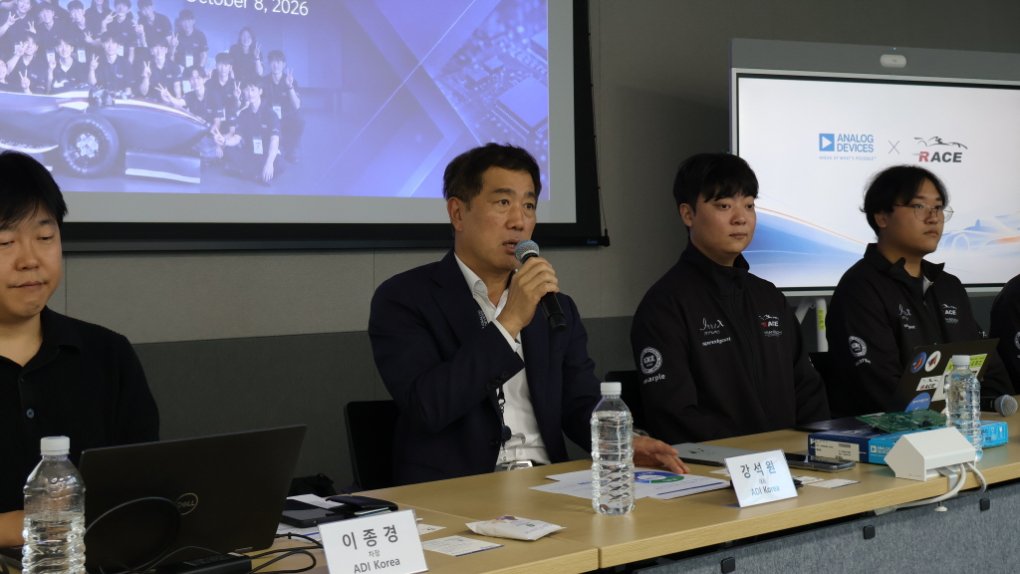
ADI Korea (President Kang Suk-won) held the 'ADI-Hanyang University Team RACE Industry-Academic Cooperation Media Briefing' at its Seoul office on the 8th, introducing cooperation cases and achievements of both parties.
At the event, the focus was placed on sharing the process by which industrial field technologies and expertise were connected to students' actual engineering experience, going beyond simple material support.
ADI is a global analog semiconductor company active in various fields including automotive semiconductors, industrial automation, communications, energy, and data centers.
In particular, it continues to invest approximately 1.9 billion dollars annually in research and development (R&D), demonstrating active commitment to technological innovation, and operates a large-scale engineering workforce in Korea for customer support.
ADI is actively leveraging such technological capabilities not only in industrial fields but also in nurturing future talent.
In fact, ADI has been consistently supporting student competitions, operating educational programs, and providing technical support.
Since 2023, it has sponsored the Korea Society of Automotive Engineers (KSAE) student car competition and provided semiconductor components to Incheon University, Dongguk University, and Hanyang University.
Subsequently, cooperation with Hanyang University Team RACE deepened further.
It evolved beyond simply providing components to jointly resolving technical problems students encountered in actual development processes.
The core of this cooperation was the development of BMS, which serves as the brain of electric vehicles.
Team RACE set the goal of designing an independent BMS rather than relying on existing commercial products to improve vehicle performance.
However, the task of developing a system to control high-voltage batteries from scratch was a formidable challenge for students.
Accordingly, ADI provided the ADBMS6830B battery monitoring IC and related semiconductors and evaluation kits (EVK), and conducted technical consultation necessary for actual product development processes including PCB design, isoSPI communication implementation, and component selection.
What is notable is that ADI maximized respect for student autonomy.
Rather than delivering completed designs, ADI engineers focused on providing industrial knowhow and design guides.
The actual BMS design and implementation, system integration, testing and verification were entirely carried out by the students.
This was intended to help students resolve engineering problems through trial and error on their own.
Lee Jong-gyeong, ADI section chief in charge of technical support, explained that when students initially stated they would design the BMS themselves, he confirmed considerable determination and potential.
Subsequently, ADI reviewed the students' development objectives and provided appropriate solutions, with engineers continuing technical support throughout the development process.
In particular, consultation was provided focusing on elements considered important in actual industrial settings, including PCB layout design, voltage, current and temperature measurement solution configuration, and communication interface implementation.
As a result, Team RACE succeeded in developing its own BMS.
The system developed by the students utilized ADI's ADBMS6830B to monitor 144 battery cells and also implemented SOC (State of Charge) estimation functionality.
Notably, the independently developed BMS increased battery pack design flexibility while achieving vehicle weight reduction.
The battery pack weight was reduced from 65 kg to 55 kg, and SOC estimation error was also reduced by 54% compared to commercial BMS.
This is evaluated as having achieved meaningful technological results that went beyond the level of a student project to actual vehicle development processes.
Students likewise agreed that ADI's support was an opportunity for practical learning that went beyond simple sponsorship.
Team RACE explained that the most difficult part was not the design itself but the verification process.
While they needed to complete a stable system within a limited timeframe, the design guides and technical advice provided by ADI engineers played a decisive role in shortening the development schedule and enhancing completeness.
This case makes one reconsider what industry-academic cooperation means.
While many companies provide equipment or research funding to universities, it is uncommon for actual industrial engineers to share technical concerns with students and jointly work through problem-solving processes.
ADI viewed students not as simple sponsorship targets but as future colleague engineers and expanded technical exchange.
As a result, students developed practical competencies by experiencing design, verification, and system integration processes, and ADI achieved the outcome of expanding contact points with future talent.
ADI plans to expand such activities going forward.
Kang Suk-won, president of ADI Korea, stated, "Beyond Hanyang University, we are cooperating with more universities, and we are also exploring industry-academic cooperation models in the fields of robotics and physical AI, which have been drawing recent industry attention. Within the scope that human resources permit, we will continuously expand opportunities for students to experience industrial field technologies."

Comments
Related news
.jpg)
ADI, “Eddy current suppression is key to power efficiency”
Engineers at Analog Devices, Inc. (ADI) discuss methods for mitigating eddy current effects caused by adjacent metals in high-density power converters.
2026.04.09by 편집부
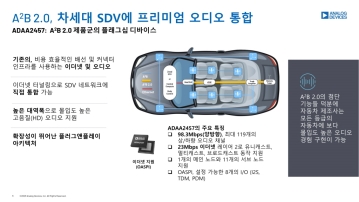
ADI Unveils A²B 2.0… The Solution to Low Latency, Ethernet Integration, and Cost Reduction in the SDV Era
As the automotive industry undergoes restructuring toward software-defined vehicles (SDVs), a new challenge has emerged: how to transfer audio, sensor, and control signals within vehicles "without latency" while seamlessly integrating them with the vehicle's Ethernet-based network. In response, Analog Devices (ADI) has provided a "realistic upgrade path" through A²B 2.0 (Automotive Audio Bus 2.0) that accommodates more channels and functionality without unnecessarily increasing network complexity as the transition to SDVs occurs.
2026.04.29by 배종인 기자

ADI Strengthens AI Power Semiconductor with Acquisition of Empower
Analog Devices (ADI) is acquiring Empower Semiconductor for $1.5 billion to expand its power management portfolio for AI data centers. The acquisition is interpreted as a strategic move to secure processor-adjacent power conversion technology, amid rising design challenges in power density and thermal management in AI servers and accelerators.
2026.05.21by 배종인 기자
ADI, “Industrial Robots Evolve into 'Intelligent Workers'”
Tracey Johnson and Margaret Naughton from Analog Devices, Inc. (ADI) discuss "A New Era of Innovation Led by Industrial Robots" as the topic.
2026.06.12by 편집부

ADI, “Equipping Robots with 'Physical Intelligence' via Multimodal Tactile Sensors”
Robots can implement tactile sensing with higher resolution than human hands by integrating diverse sensors such as pressure, temperature, acceleration, and acoustic sensors. In particular, these various sensors are being presented as foundational technology to expand robot applications across industries including manufacturing, data centers, healthcare, and hazardous environments. We heard from Analog Devices (ADI) about the importance of multi-modal tactile sensors, which are core technology necessary for robots to handle objects with the same delicacy as humans.
2026.07.07by 편집부











