


This page was machine-translated and may differ from the original. View original
We are not an FPGA company, we are an 'all programmable' company
 Published2015.09.23 15:22
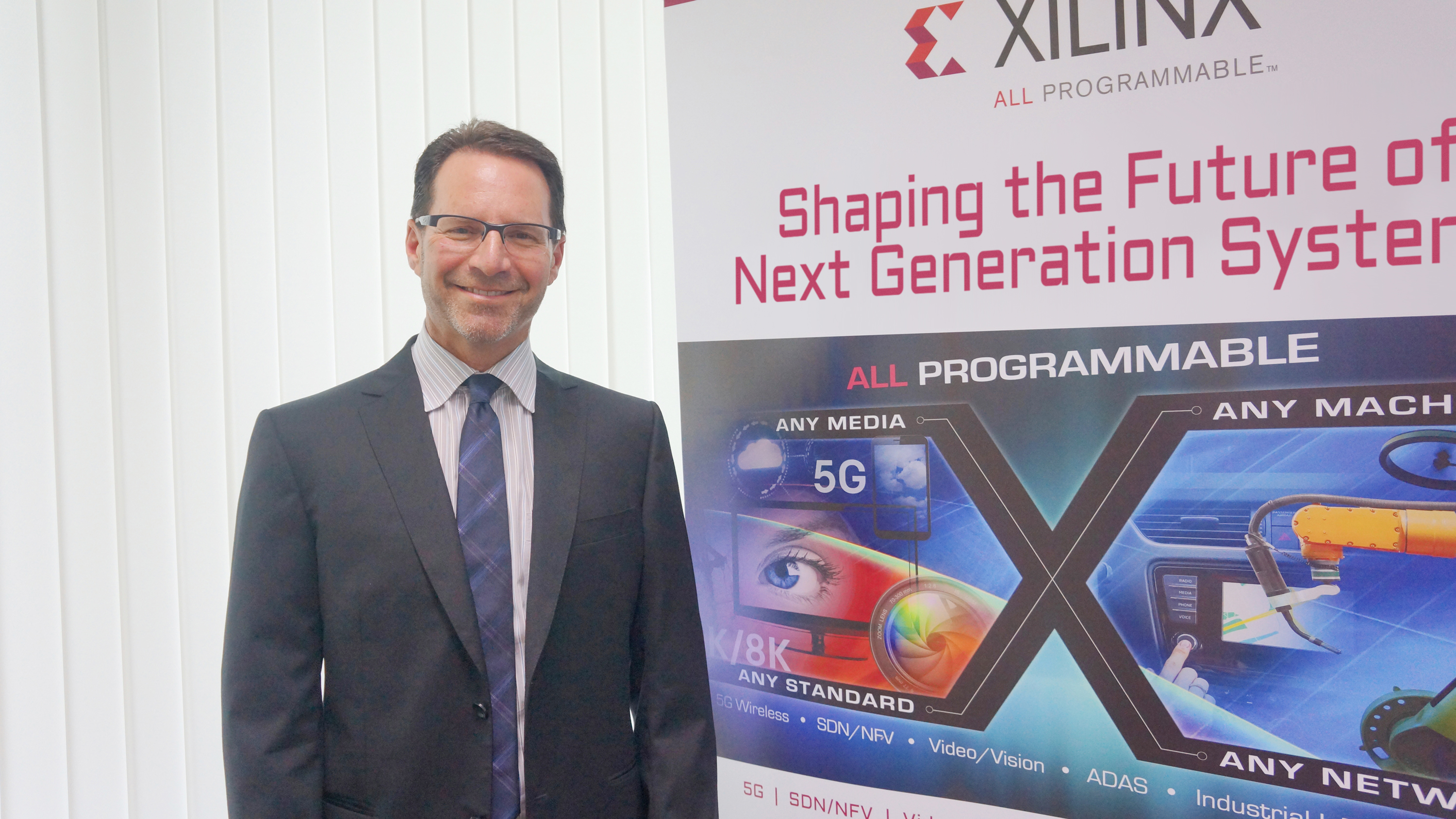 'All Programmable' Xilinx Defines Future Strategy and Goals
Xilinx has announced a new corporate strategic direction and future goals, declaring itself as an “all programmable” company.
Steve Glaser, senior vice president of corporate strategic marketing at Xilinx, said that the vision of “All Programmable,” which Xilinx has been pursuing intensively for the past five years, has reached an important milestone in 2015. He said that Xilinx has now completely shed its old shell as an “FPGA company” and is armed with the armor of “All Programmable.”
First, we spoke to Steve Glaser, senior vice president of Xilinx's Corporate Strategy and Marketing Group, about Xilinx's corporate strategy and asked him a few questions about its expected cost and security feature roadmap.
e4ds: You said that even if Xilinx's market size grows fivefold in the future, the actual market revenue will only double. How much do you expect the cost to increase? For example, if the market grows fivefold, how much do you expect the cost of support, AS, research, etc. to increase to respond to that market growth?
Steve Glaser: Fortunately, the programmability model that we have has tremendous advantages. As we increase our investment in software-defined programmability, we expect the potential user base to increase fivefold because we can develop products that can be used by a large number of different people, but the cost per user will actually decrease in terms of silicon investment. The return on investment (RoI) of our silicon technology can actually increase with a relatively small investment in the software environment because more users can use it. This is a very positive direction for both Xilinx and our users from a programmability perspective.
e4ds: Is it possible to do this with the current resources, or even by increasing them slightly?
Steve Glaser: I can't give you a specific cost, but it's part of our strategy to build a new generation of software development environments, and that's what we've done with the three new products we've introduced last year. Another thing I'll tell you is that we're leveraging the massive open source ecosystem that's out there. There are a lot of people out there building libraries and building blocks for these software-defined systems that are based on open standards. So we're trying to make all that richness of the open source community and open source resources available to our customers. That's where we can deliver a lot more than we expected. The open source communities are building all kinds of middleware for all kinds of applications, and we can tap into all of that.
e4ds: I guess you could call it smart cost.
Steve Glaser: Yeah, we have really great plans for the next phase to accomplish that.
e4ds: Next, I'd like to ask you a question about the slightly distant future. I think that in today's world, it's becoming increasingly important to have a development environment where you can participate in development without having to know everything, because no one person can understand everything. Currently, Xilinx is providing a development environment where software engineers can participate in the programming of FPGAs. Is there a roadmap for developing tools that will allow other support departments, such as marketing, to participate more actively in this software development environment, rather than just software engineers?
Steve Glaser: The marketing and technical requirements that you're talking about are going to have to be serviced by other companies that are focused on that area. There's IBM's Rational DOORS, and there are other vendors that provide requirements planning and traceability tools. We don't plan to get into that kind of product development, but we're going to work with those companies to provide everything that customers need to use those tools. We're going to provide everything that customers need to do to make sure that our development environments are compatible with those requirements management tools, including software-defined development environments.
e4ds: So you're saying it all depends on the customers?
Steve Glaser: Exactly. Our scope is hardware and software tools. Of course, we're investing in integration. Beyond IP integration, we're going to be looking at more productive system-level integration tools that bridge the gap between software and hardware domains and help us integrate all kinds of software and hardware IP more effectively. That's part of our clear roadmap. However, requirements management tools for marketing staff, for example, are not included here.
e4ds: Okay, I see. As security issues become more and more complex, it seems like they are out of the scope of many software engineers. You mentioned implementing security features at the physical level. In the future, will it be possible for software engineers with no knowledge of security technology to implement most of the physical security features using your tools?
Steve Glaser: That's the problem we're going to have to solve going forward. Our Zinq MPSoC has a lot of security features, both software and hardware, and the security is built into the processor, which handles the security subsystem and management functions of the new Zinq family. So we have to make it as easy as possible for our customers to use. Our goal going forward is to embed some of that functionality into the basic hardware platform, so that software engineers can use the new software environment. They have to be able to program the core functions using the SDx environment, and build in the security features for the platform development. So we have to think about hardware development, platform development, and platform programming.
e4ds: Yes, I understand. Thank you.
본 기사에 대한 정정·반론·추후보도 청구는 보도 청구 안내를, 그간 게재된 보도문은 정정·반론보도 모아보기를 참고해 주세요.
관련뉴스

Xilinx Completes Development of All-Programmable Multiprocessor SoC Using TSMC's 16nm FF+ Process
자일링스는 ADAS와 자율주행차, 산업용 사물인터넷 (IIoT), 5G 무선 시스템을 포함한 임베디드 비전을 목표로 TSMC의 16FF+ 공정을 이용한 올 프로그래머블 멀티 프로세서 SoC(MPSoC)를 개발 완료했다고 밝혔다. 올 프로그래머블 징크(Zynq)® 울트라스케일(UltraScale)+™ MPSoC를 이용하면 와트당 5배 이상의 시스템 레벨 성능 및 차세대 시스템에 필요한 보안과 안전성과 어디서든 가능한 연결성으로 다양한 표준 기반 플랫폼을 개발할 수 있다.
2015.07.03by 명세환 기자
Xilinx Announces LDPC Error Correction IP Core for Next-Generation Flash-Based Applications in the Cloud and Data Center Storage Markets
자일링스 코리아 (지사장 안흥식) 2015년 8월 13일 ? 자일링스는 클라우드 및 데이터 센터 스토리지 시장을 위한 차세대 플래시 기반 애플리케이션을 이용할 수 있는 저밀도 패리티 체크(Low-Density Parity-Check, LDPC) 오류보정 IP 핵심장치를 발표한다고 밝혔다. 낸드플래시가 3D NAND 기술로 발전을 거듭하면서, LDPC 오류보정 기술은 오늘날 스토리지 솔루션에서 요구하는 신뢰와 내구성에 대한 엄격한 기준을 충족하기 위해 없어서는 안 될 기능이 되었다.
2015.08.13by 명세환 기자












Sponsored Company