



[Cafe E-People] Finding a Community ③ Arduino Story, Popularizing Open Source That Even the General Public Can Use
 Published2015.12.22 13:37
- What made you start running a cafe in the first place?
In 2007, while searching for an LED-related project that my company was working on, I came across the word 'Arduino'. I was amazed to see many overseas products implemented through Arduino, and I thought it was groundbreaking because the hardware configuration was disclosed along with the open source. I chose Arduino because it is easy for beginners to access and is good for teaching children.
Until then, there was not much understanding of open source in our country, so we started making boards with employees through Arduino for the commercial purpose of 'how can we commercialize it?'
The cafe started in earnest in 2008. In order to make a profit, promotion was necessary, and after much thought, we decided to run a community cafe.
At first, creating a community for the company's profit
But open sourced for everyone to use
- What is the distribution of members by occupation?
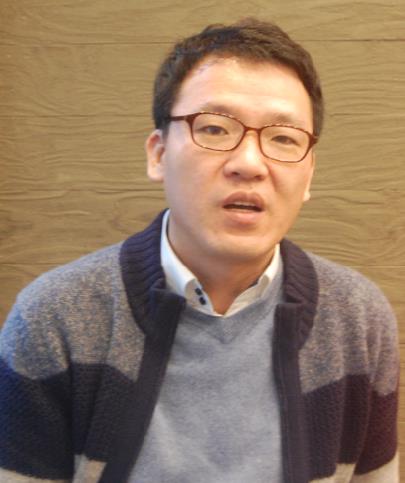
It is diverse. In the case of the famous community 'Carrot Playing with AVR', it is mainly composed of electronics and software engineers, but our 'Arduino Story' has many ordinary people. From elementary school students to college majors. It is not limited to a specific field, and there are designers, photographers, and writers.
= I wonder if this community and your current work are related.
It's in the electronics field, but it has nothing to do with Arduino. Currently, we are building energy converting, energy harvesting, and solar inverter monitoring solutions and providing services for them.
- So the main question is, there probably won't be an MCU itself.
Beginners ask how to start coding.
Since there is no need to configure the circuit if you only have an Arduino board, there are many questions about sensor components rather than questions about the MCU itself. Other than that, experts who are planning to move to China ask about coding techniques or the characteristics of devices.
- There is a company technology seminar, but I think people ask more questions in the community.
Going to school is something you do out of curiosity, but it involves dealing with too much of a vast amount of material. At that time, it was spoon-fed.
Q&A is only about 10-15 minutes long. At that time, there are many people, so there are many cases where you can't ask a question even if you want to. However, the community has the advantage of not being limited by time, and if you have a problem, you can ask it right away. Also, since there are so many people, there is the advantage of receiving various answers even if you ask just one question.
- But doesn't incorrect information also come up?
There are often comments that point out that it is 'wrong' or in the form of feedback such as 'I don't think so', but there are no slanderous comments.
I think we need experts to provide accurate information, but what percentage of them are experts?
60% of the general public and 40% of the experts.
I am also an engineer, so I am familiar with the microprocessor development environment. There is no reason to use Arduino. However, the reason for being interested in Arduino is often, like me in the early days, as a means of promoting myself by thinking, 'Will it make money?'
-There are many attempts to commercialize the community.
When I first started the course, there weren't many people. But as time went on, more and more people started asking questions.
At a time when I was thinking a lot about how to make money, I thought, 'We also use open source, but we shouldn't make money from people who use the information.'
- Are there any plans to commercialize it in the future?
There are absolutely no plans to commercialize it in the future. The operator has little 'profit'.
However, for networking events and parties hosted by cafes, money is definitely needed.
I think it's better to operate by generating community-level income rather than investing the operator's own money to create such resources.
Changes detected for Arduino since last year
From seminars to projects
- How are projects/offline meetings conducted?
I created the community in 2008, but the company was busy, so I only left technical replies occasionally. Then, a change was detected the year before last. This is because companies like Google and our country began to show increasing interest in Arduino.
At first, I was thinking of having about 50 people, so I posted the event plan on the bulletin board and asked if they would like to participate, and then I got comments saying that about 400 people would come. Encouraged by the explosive response, in December of that year, we secured a space for about 100 people and invited several lecturers who were suited to the topic of change to hold a seminar.
There were 80 people in attendance. The seminar was free of charge thanks to the support of companies. Afterwards, a personal network was formed within the cafe, and I also met many new people, which was very satisfying.
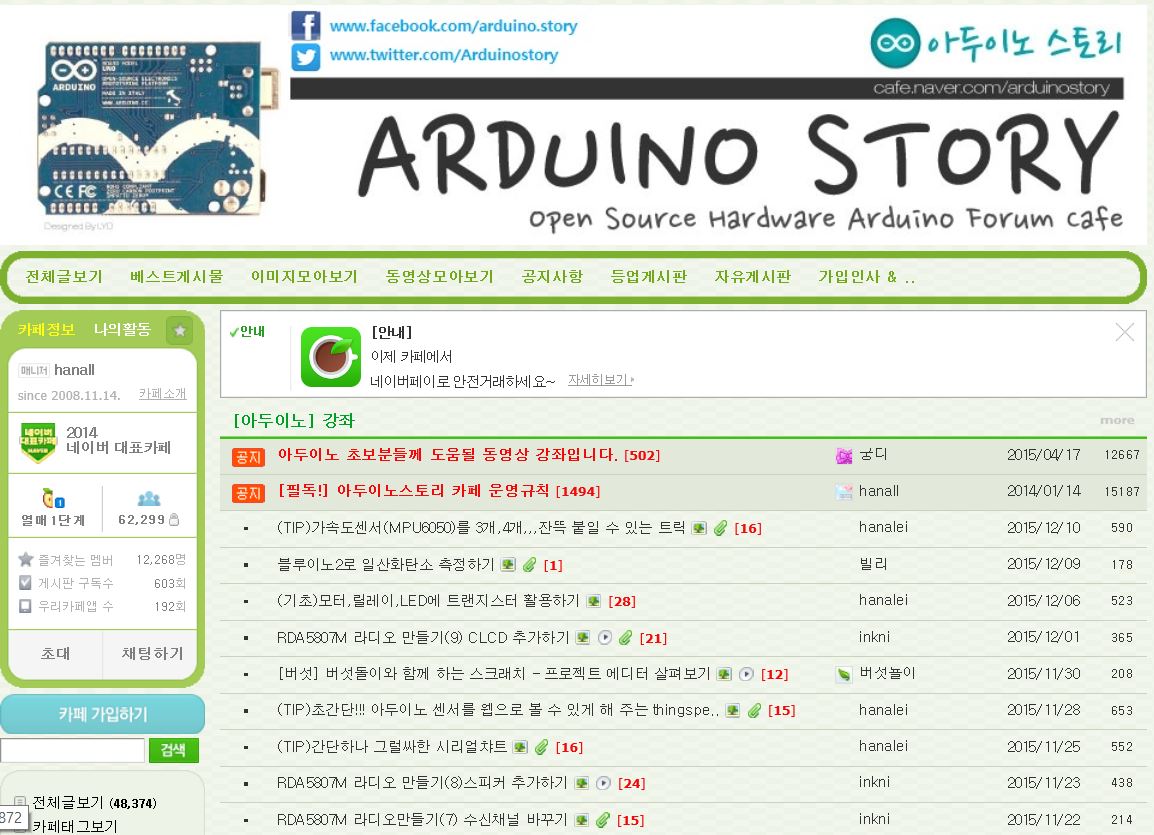
Arduino Story Cafe (http://cafe.naver.com/arduinostory)
- After the seminar, what kind of project did you proceed with as a stepping stone?
It was a joint development and distribution project for 3D printers.
In the case of 3D printers, even though I only knew the basics, I thought that I could improve the existing problems by myself because many hardware and boards were open source. That's why I started. I thought that if the members don't do it, I will do it too.
When we posted the announcement around January or February last year, the response was good, just like a seminar plan. We recruited from design to firmware, hardware, and mechanical design. There is an existing slicer program for 3D printers, but we thought it would be good to approach that as well, so we recruited people for application programs.
After deciding to recruit about 25 people in 4 groups, we held a meeting near Hongdae, and in reality, about 70 people showed up. There are about 50 people on the project roster.
- What do you think the purpose of the project is?
The purpose of the 3D printer project was to have the general public and experts meet and create a book through Cafebook that contains the development process and all sources so that the general public can easily develop.
I saw students who couldn't afford to pay for hobbies.
Start implementing support policies
- How was the project funded? Was it sponsored by the company, like an event?
At first, it was my personal investment. I paid for the coffee and the place out of my own pocket. I thought it was not a good idea to ask people for money when having a gathering. Before, I went to another cafe gathering with an acquaintance's introduction, and there were several people, from college students to seniors. However, seeing that there were always people who could pay and those who couldn't, I thought it could become a hobby that costs money. Then, what about the students? I decided not to ask for money from individuals.
I heard that you laid the foundation for project support. What efforts were made?
-
I looked into whether there were any support elements at the government-related National Information Industry Promotion Agency (NIPA) and the Korea Foundation for the Advancement of Science and Creativity. When I looked, I found that there were places that said they would provide support, but it did not materialize. So I participated in the public hearing of the Ministry of Science, ICT and Future Planning and argued that there was a lot of support needed for projects by ordinary people.
- How is it now? Are there a lot of support measures?
Yes, now there are a lot of project-specific support costs. The Korea Foundation for the Advancement of Science and Creativity also provides support of 10 million to 20 million won, and in the case of the 'Infinite Imagination Room' operated by the Korea Foundation for the Advancement of Science and Creativity, it provides support for 3D printer material costs and meeting spaces.
In line with the creative economy policy
Active projects by ordinary people
- Why did you ask the general public to actively support the project?
I thought that the activation of such projects by the general public was in line with the policy of the creative economy.
I kept talking to the Ministry of the Future. However, the government thought of it as 'money without asking questions.' It was an abstract result of providing a development environment to the general public rather than the profitability of a certain business, so they were reluctant at first, but now there is a lot of development support.
- What was the most difficult part of working on the project?
When we first started, we anticipated legal issues like licenses and received consent forms. This was to prevent those who left midway from claiming intellectual property rights. What was more difficult than support issues were those who did not want to open the results. In a project that took a year, about 22 of the best people remained. Of course, we initially expected 25 people, but we were deeply hurt by those who left midway. I think it can't be helped.
- What do you think you will gain from doing a project?
There are two aspects. The project was completed as desired. The profits were also quite high, so there were people who started a business.
The value is enormous, as it is quite difficult to meet verified experts. Through the project, I went to various meetings, asked questions, and got mentored. It was a great opportunity to learn about new fields.
Another thing is that we tried to create a cost basis for these project activities. We went around to governments and organizations and made requests, and now we have project support and are satisfied. Those who were in our project also received project cost support from the Korea Foundation for the Advancement of Science and Creativity last year and are developing a 3D scanner.
I hope that through these examples, other project teams will proceed step by step from the beginning. Since our team made the trial and error, I hope that other teams will not do the same.
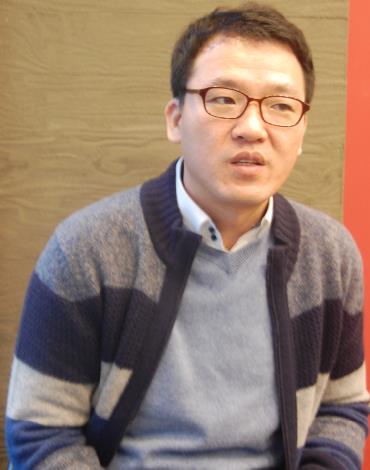
"I hope that through these examples, other project teams will proceed step by step from the beginning. Since our team made the mistakes, I hope that other teams will not do the same."
- Now that the project is complete, what are the remaining tasks?
Clearly, there is a need for income within the community itself.
Sometimes, we have provided advertising services to organizations, companies, and research labs, and paid mailing services to companies like MS. I used that money to support the community, but I couldn't make a steady income. Currently, education and promotion within the community are provided free of charge. If there's a way, there are a few people who contribute to the community's operation, and I'd like to repay them.
- It seems like you carry out projects systematically?
As I said earlier, there was someone who was reluctant to disclose it when it was time to open. At that time, I said that I would exercise legal force regarding the consent form. I had no choice but to strongly say, "You did not do this alone." This is because because of that person, an unprecedented situation could have occurred where the results of a year's work could not be improved.
One of the challenges of running a community is asking project members to take responsibility. Of course, a community is a place where people come together to help, but a project is a little different.
From the operator's perspective, the purpose of the recruitment was to achieve the project, not to exchange opinions. Many of the people who ask, "Why are you dividing up the workload when this isn't even a company?" are actually people who do not take responsibility for the work they have been assigned.
- So then, what kind of community do you think it is?
We need to think about the purpose of the community.
It is not difficult to create a community, that is, to start or maintain one. The operator does not have to do much. All he has to do is set rules, warn people who break the rules, and expel them. He does not even have to encourage activities within the cafe.
There are no operational difficulties, such as holding seminars occasionally when necessary, and only sanctioning people who engage in illegal or fraudulent practices.
This is an extremely subjective opinion, but I think these activities are a result of meeting many people and making the results public. Anyone can form a project and do it. That's why the power of projects within the community is strong. Contents are enriched and interest increases. People outside say, "Isn't this just to increase the number of members?" or "Isn't this just for a certain person to secure profits?" but I think the purpose of a community is for each individual to learn new things through projects and small groups and for them to help people who want to learn again after some time has passed.
What are the specific community plans for next year?
I was planning to plan an event next year. However, the agency that had the Pangyo accident was too busy to do it when we made the pre-planning. After hearing the news of the accident, I was worried about other things in the community, even though the event was good.
We decided to refrain from holding the event because we were concerned about, 'What if someone gets hurt?' and 'How can the community afford to hire security to prevent this from happening?'
Next year's project is to protect bees from wasps.
I want to create things that I can give to the next generation.
- What are your plans?
Before that, I was interested in LEDs and I was able to produce satisfactory results by visualizing sound using FFT algorithms. Also, it is important to convert the natural energy we are currently using into usable energy, but I am also interested in using very small things to help reduce power consumption or extend the life of energy.
Also, next year's project is a bee protection project, and we are thinking about a system that can protect against wasps. I have some ideas and implementation methods ready, and I would like to get support from people for the project so I don't have to worry about money.
- Lastly, if you were to introduce the community to e4ds readers,
The principle is to disclose all project results. Those who want to return the results we have done to members and create an ecosystem that helps members gain experience and confidence again are always welcome.
관련뉴스
[Cafe e-People] Visiting the MCU Community ① Embedded Workshop, MCU Helper Who Reads Beginners' Minds
E4ds News meets with community operators who share information related to MCUs (Micro Controller Units). The first community in 'Finding MCU Communities' is 'Embedded Workshop'.
2015.11.30by 명세환 기자
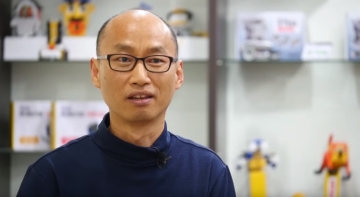
[Cafe E-People] Visiting the MCU Community ② Oroka, Reborn as a System Engineer through Robots
E4ds 뉴스는 MCU(Micro Controller Unit) 관련 정보를 공유하는 커뮤니티 운영자들을 만난다. ‘MCU 커뮤니티를 찾아’의 두 번째 커뮤니티는 바로 ‘오픈 로보틱스 커뮤니티 ‘오픈 로보틱스 커뮤니티 오로카’이다. 과학의 종합 예술이라 부르는 로봇에는 각종 센서감지와 동작을 구현하는 MCU가 필수적이다. 이곳은 현재 3만명의 회원을 보유하고 있으며 프로젝트를 기반한 오프라인 모임을 통해 실질적인 정보 교류를 활발하게 진행하고 있다. 이 까페에 ‘코 꼈다’라고 웃으면서 말하는 부운영자인 박형일(사진)씨는 “이 분야에서 우리 까페가 더 발전적인 역할을 할 수 있으면 좋겠다.”라고 밝히며 '커뮤니티의 진정한 가치는 나눔에 있다'고도 전하였다. 오로카의 과거와 미래의 이야기를 웃으며 때로는 푸념하여 들려주는 모습 속에 까페에 대한 애증을 느낄 수 있는 시간이였다.
2015.12.07by 명세환 기자
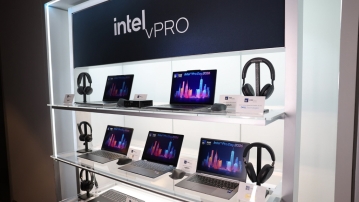
Intel Unveils Next-Generation 'Core Ultra Series 3' and vPro Platform for Enterprise PCs
Intel has officially unveiled the "Intel Core Ultra Series 3" for next-generation enterprise PCs and the latest vPro platform, addressing a wide range of demands from enterprise notebooks to high-performance workstations.
2026.03.26by 배종인 기자
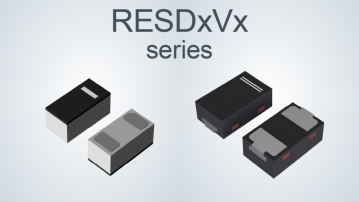
ROHM Launches ESD Protection Diode Compatible with High-Speed Interfaces of 10Gbps or Higher
반도체 전문 기업 로옴(ROHM)이 10Gbps를 넘어서는 차세대 고속 데이터 통신 환경에 대응할 수 있는 ESD(정전기 방전) 보호 다이오드 ‘RESDxVx 시리즈’를 개발하며, 고속 인터페이스에서 요구되는 신호 품질 유지와 IC 보호 성능을 동시에 끌어올렸다.
2026.03.26by 배종인 기자

ST Launches 75V Drive IC Targeting 48V Industrial Motor Driving
ST마이크로일렉트로닉스가 48V급 산업용 구동 시스템 설계에 맞춘 75V 모터 드라이브 IC ‘STSPIN9P’ 시리즈를 공개했다. 새 제품군은 하프 브리지와 풀 브리지 구조로 구성돼 모터 종류와 출력 조건에 따라 설계를 확장할 수 있도록 한 것이 특징이다. 전원 회로와 보호 기능, 전류 감지 회로를 칩에 통합해 시스템 구성을 단순화했으며, 최대 500W급 애플리케이션까지 대응하도록 설계됐다. 회사는 레퍼런스 디자인과 데모 보드도 함께 제공해 산업 자동화, 로보틱스, 펌프, 팬, 조명, 섬유 기계 등에서 개발과 평가를 지원할 계획이다.
2026.03.26by 배종인 기자











