


[Cafe E-People] Find a community and share the information created by the collective intelligence of 'Mycombox'.
 Published2016.01.05 13:38
Our country's engineers are weak in documentation
Created to help with organization
- What was the reason for creating the community?
In fact, Korean engineers are generally very weak at "documentation," which is often referred to as "Development by Document." I started this documentation work with the idea that it would be easier to fill in the gaps through feedback whenever it becomes clear what an engineer knows and doesn't know.
Even for beginners, it is much easier to receive help from others during the organization process rather than struggling alone. For example, someone who cannot even ask questions has the opportunity to at least grasp the terminology because other people's questions contain content they do not know. I also thought it would be good if people who already know could verify their knowledge, and if this kind of mutual exchange led to further development.
 You started on a Naver Cafe; when did you create the website?
It has been 10 years since I created this website. I initially operated it on Naver for a year or two before moving it.
- What is the special reason for moving?
I felt that there were many restrictions or unsupported services when operating the community. Engineers wanted to insert formulas and highlight text in their posts, but their freedom was limited. Although things have improved recently, the small screen made it difficult to view circuit diagrams and source code, so even when we tried to use PDF files, Naver did not support them.
Furthermore, the community was not searchable overseas or on Google, and it was difficult to link to external materials. Consequently, content was frequently copied without permission. At the time, people were unaware of the importance of copyright, and controlling this individually was also challenging. We decided that it would be better to build a system that could automate these various inconveniences, which led us to create the website. In another area, we were concerned about backups. This was because we felt that even a leading domestic company could discontinue the cafe service at any time.
Community posts are valuable knowledge contributed by an unspecified number of experts. I believe it is our duty to preserve, pass on, and develop them for the next generation.
I was surprised by the systematic structure for a website created by an individual. Did you make this alone?
I used to work on website development. Since I am capable of implementing systems myself, I developed features little by little, and over time, it seems to have evolved into a systematic structure. Rather than building it alone, I used the ZeroBoard system for creating servers in the past, and nowadays, with the Express Engine, I can implement modules directly. Whenever I had time, I developed the necessary features and utilized them effectively.
I noticed that members' ranks were divided based on a point called 'Nap'.
The term 'point' was named 'lead.' This is because electronics students are familiar with the word 'lead' from the term 'solderer.'
There is a lot of backstory to the Nap system. To be honest, I also disliked the membership ranking system when I was browsing online cafes. The reason I opened the cafe in the early days was because the information one could view was limited based on the status of the posts they had uploaded. After moving to a website a year or two later, I operated the homepage without any ranking restrictions even during its initial operation.
Operating membership levels with 'Nap' points
From recruit to officer depending on points
- Is there a decisive moment that led to the creation of the 'lead' point?
When we first operated without restrictions, the server would crash if just a few dozen people accessed it and downloaded a file exceeding 50 gigabytes all day long. So, we had no choice but to create a point system called 'Nap' with the intention of preventing simultaneous downloads.
Also, as is likely the case in all communities, the person providing the answer wants feedback from the questioner. Therefore, we integrated a 'Nap' system to allow users to express their gratitude to respondents. Through Nab, we implemented a membership tier system similar to the military rank system, allowing users to advance from recruit to officer and general. The tier serves as an indicator of a member's activity level.
I noticed a menu called 'Training Camp' for beginners; is it for members with the Recruit rank?
This is not a place for special membership tiers. The materials for the "Training Center" section are organized primarily for those who do not even know the terminology. The users are likely mostly regular soldiers. Posts with high review counts and many comments from the Q&A board have been moved to the Training Center board. We select and post essential information that beginners must know, even if it is difficult, or we personally edit and upload content if professional details need to be added.
I am curious about the ratio of beginners to experts.
Based on the ranking, it seems that beginners who have recently started posting make up about 50%. In reality, those who are active regularly account for 30%, and long-time members account for 20%.
Isn't an overall expert ratio of around 50% very high?
It seems to be because of the premise of a long period of time. While newcomers sometimes leave immediately after hearing about the activity, there have often been special cases during the long operation. For instance, users came to this website to find hints or solve problems when working on university projects, master's theses, or encountering major challenges. Then, after forgetting about it for a while, they returned here via Google search when they hit another wall after getting a job. I heard that there are often cases where people come back only to find that they are already registered and have even written posts themselves.
- What are the most frequently asked questions?
Beginners often ask random and broad questions. Examples include, “What is an MCU? Please tell me about AVR. Please teach me circuits and coding.” Since these individuals are unfamiliar with the terminology and concepts, I usually answer, “Please buy a book.” Intermediate users ask, “What is the problem with this circuit?” However, they do not explain the surrounding circuit context. Nevertheless, through feedback from respondents, they gradually grow as they begin to upload their circuit diagrams or datasheets.
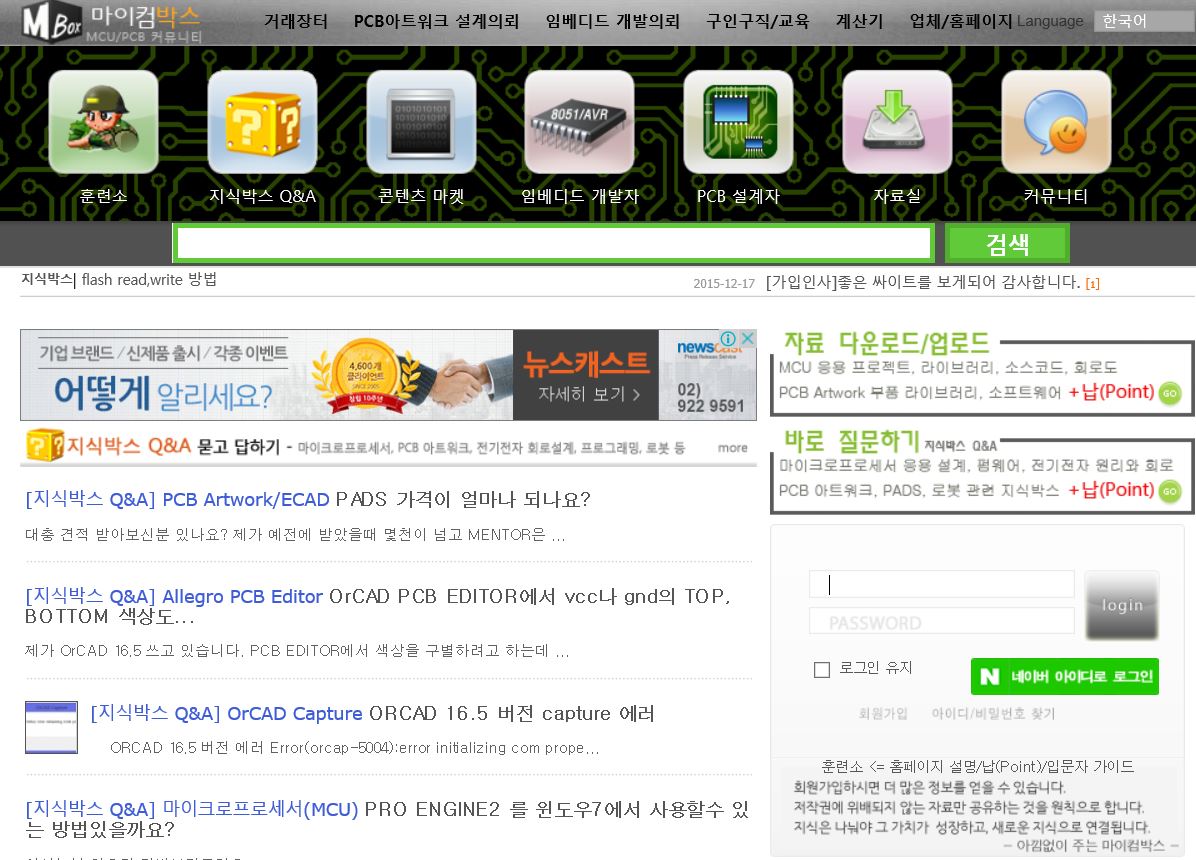
Micombox website ( www.micombox.com )
A multi-functional automation system and
Mycombox, freely operated through collective intelligence
I noticed there was a used goods sales board as well; I wonder how you operate it.
All we have done is create a bulletin board for transactions. We established it in a separate section because the constant stream of second-hand sales posts on the forum and Q&A boards was blurring the essence of each board. In this way, we strive for an autonomous atmosphere in operating the website. There is no problem even if you do not log into the system for a month or two. Spam posts are automatically filtered out. This is partly because it relies on the collective intelligence of the community. If a malicious post is uploaded, points are automatically deducted through downvotes, and naturally, the rank becomes too low to post.
As you mentioned, it seems that 'collective intelligence' and the automation system are operating in tandem.
That is correct. It seems there are quite a few working professionals. Judging by the time responses are posted, I can predict that most users are in their 30s and 40s using the website while working. Therefore, my hope is that we can continue to be a community that provides them with help they can utilize even at work, just as we do now. After all, isn't the fact that they are using it in their daily work proof that it is proving to be helpful?
I even implemented a mobile site a year ago. Since most people use mobile devices rather than computers these days, I tend to provide short responses during my commute.
It seems to have a lot of convenient features for a community website.
It is quite fun to build systems. Another advantage of mobile is that the 'clock-in' feature on the website can be used most conveniently. It was created to reduce the inconvenience of accessing via PC. It wasn't designed from the start, but since users inevitably had to invest a lot of time writing posts to collect payments, I made it possible to collect them through attendance instead. The site is renewed at midnight, and the traffic spikes at that time. Among them are a few surprising people, some of whom record their progress like 'Day 3159'.
When the system was first created, the maximum score was 30,000. Even during development, I thought, "Will it be easy to reach 30,000 points quickly if it's done in points per day?" However, someone exceeded 30,000 points and was sent back to the training camp due to a bug caused by a system reset. After receiving protest emails about that, we raised the threshold to 100,000. Additionally, after adding a system that awards extra points to those who attend for a week or are the first to check in at 12:00, the passion of those trying to achieve these goals is becoming increasingly intense. I think, "What is the big deal?" but it is fascinating and fun.
Trivial development systems like the operator's 'clock-in'
Leads to active participation of members
There are many interesting episodes compared to typical communities, and it seems the operator's lighthearted humor is spreading to the members as well.
That is right. It is good that this kind of system allows for the pursuit of small pleasures. In the past, there was also a lead-based lottery. However, one person actually won the lottery and their rank skyrocketed, so it was removed out of consideration for those who had worked hard to save up.
- Are there any other systems?
Internal website searches are conducted via Google, and foreign languages are supported by integrating with the Google system. Although the translation is not perfect, most technical terms are in English, so users can obtain hints from source code and other sources without detailed comments, making it accessible to foreigners. While foreigners may not be able to participate actively, we have enabled them to view materials and ask questions.
There is also the Knowledge iN system. While a general inquiry board is available, the Knowledge iN board is divided by category, allowing you to ask professional and specific questions. Answering questions grants half of the 'Lead', encouraging active information exchange. Additionally, regarding downloads—one of the reasons for the creation of Lead—the amount deducted is given to the uploader, with half of the amount going to them. This is intended to reward the effort put into finding and uploading even free programs and managing them systematically.
- What is the reason you have been able to run a community for such a long time?
Community posts represent valuable knowledge contributed by a diverse group of experts. As a product of collective intelligence that presents new knowledge and milestones, I believe they should be shared. Since those who post do so for others to refer to, investing time and effort to respond is no easy task, as the respondent must also conduct research and verification. I am doing this with the belief that maintaining, passing on, and developing these resources is a duty for the next generation.
- What is the best thing about running this?
The best part is the sense of fulfillment. I feel proud that this system allows people to freely exchange information. I intend to continue operating this even after 10 years, but if I am able to do so, it feels good to look back at my past posts, provide hints so that I don't repeat mistakes or failures, and become a cherished memory.
This anecdote came to mind while we were talking. I once solved a problem on the internet using a single sentence that served as a hint, even though it wasn't the definitive answer. A few years later, while struggling with a similar issue, I searched for the same information but found that the site was no longer in operation. Since I operated small bulletin boards—whether they were King's Board, K-Board, or web-posting platforms—there were frequent instances where all my data would be lost without any backups if the license expired or the contract wasn't renewed. That was so unfortunate.
While good solutions may emerge on these bulletin boards over time, the same problems could recur. Therefore, our goal was to ensure that even after a long time, users could find hints for solutions when searching. We wanted to act like a lighthouse for a ship lost in the vast ocean.
And I want to enable them to live with the pride of an engineer, looking back at their past writings to reflect on how they used to struggle but have since grown, thinking, "I should answer the concerns of others." So, I wondered if I should run this community for over 30 years if I created it.

Kim Dae-young described the phenomenon of application concentration as follows: “Only a few low-level engineers will remain, and a group of engineers will emerge who use development tools stacked in layers based on the concept of layers.” "If that happens, it will be difficult to develop core technologies," he said.
Interest focused on applications
The trend of decreasing basic engineers
I imagine the things members want have changed over time.
In the past, the approach was to learn microprocessors, build a foundation, and expand into various application genres, but the current trend is to focus on new applications such as drones or robots.
The application is predetermined, and you start learning to build it. Additionally, since vendors provide basic open libraries or source code, or offer targeted applications, there is no need to develop it from scratch.
That is correct. Companies are releasing simple solutions that are easy and quick to develop, but are there any downsides to this?
It does not matter when implementing a simple application. If I have an application to build, and the features available for it are already functionalized so that they can be directly applied in most libraries, I can implement the desired functionality quickly with only minor modifications.
The downside is that while it is not an issue for those who learned from the basics, troubleshooting is difficult for those who started with applications from the beginning. They lack the ability to resolve problems when they arise. Because the fundamentals were lacking, development was limited to what was given, making it impossible to see the big picture.
Is it inevitable that Korea is weak in low-level engineering because it currently focuses only on businesses that can generate immediate revenue rather than core technologies?
That is correct. It is true that the importance of hardware is declining as system platforms, such as mobile phones, become standardized. This is because one only needs to configure software on hardware that has been proven as a platform. Naturally, there will be a significant shift toward software.
However, it is a self-evident fact that good products can only be produced by understanding both software and hardware together. This is also one of the reasons why Apple is so successful.
The more you know, the faster you can resolve issues, so the process of solving those problems can become a patent or relate to intellectual property rights. However, approaching the issue quickly by starting with applications will likely make it difficult to be recognized for your technical prowess as an engineer.
My current job is medical device system development.
Later on, I want to build a drone control system as a hobby.
It seems like the work you are currently doing is related to the community.
That is correct. As a system engineer, I work on hardware design. I oversee a significant portion of systems that interact with firmware. To be more specific, my job involves configuring hardware circuits—such as MCUs and FPGAs—creating boards, and building a complete system through collaboration on firmware development. Currently, I am developing medical devices. You can consider it medical device hardware.
- Are there any things you develop as a hobby?
Previously, I made micro mice, remote controls, robots, etc. I haven't been able to do it recently because I've been busy, but I'm planning to try doing at least something small next year.
Actually, I have a strong interest in drones and want to develop drone control algorithms. I have recently developed software and am distributing useful tools, such as those for PCB pattern calculation. I created them because I needed them myself, but I am uploading them so that others can use them as well. I understand that they are getting quite a lot of downloads.
Lastly, if I were to introduce 'MycomBox' to the readers of E4ds...
As 'Mycombox, the Giver,' we plan to continue serving as a platform for exchange for a long time to come. I believe that the senior generation has an obligation to pass on as much as they have received from the senior generation. I also hope that the junior generation will share what they have received with many others.

관련뉴스

[Cafe e-People] Visiting the MCU Community ① Embedded Workshop, MCU Helper Who Reads Beginners' Minds
E4ds News meets with community operators who share information related to MCUs (Micro Controller Units). The first community in 'Finding MCU Communities' is 'Embedded Workshop'.
2015.11.30by 명세환 기자
[Cafe E-People] Visiting the MCU Community ② Oroka, Reborn as a System Engineer through Robots
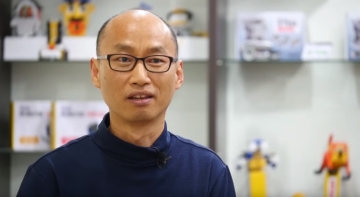
E4ds News meets with community operators who share information related to MCU (Micro Controller Unit). The second community in 'In Search of MCU Community' is the 'Open Robotics Community Oroca'. Robots, which are called the comprehensive art of science, require MCUs that implement various sensor detection and motion control. This community currently has 30,000 members and actively conducts practical information exchange through offline meetings based on projects. Park Hyung-il (photo), a sub-operator of this café who speaks with a smile about "sticking one's nose in," expressed, "It would be good if our café could play a more progressive role in this field," and also conveyed that "the true value of a community lies in sharing." In listening to the stories of Oroca's past and future told with laughter and sometimes complaints, it was a time where one could sense both affection and ambivalence toward the café.
2015.12.07by 명세환 기자

[Cafe E-People] Finding a Community ③ Arduino Story, Popularizing Open Source That Even the General Public Can Use
E4ds News meets with community operators who share information related to MCU (Micro Controller Unit). The third community in 'Finding MCU Communities' is 'Arduino Story'. 'Arduino' is a device control board equipped with an open-source oriented microcontroller, characterized as a simplified version of a computer motherboard that can connect various devices such as sensors and components. Since it operates through software when connected to a computer, it can be called 'open-source hardware' capable of creating everything from control electronic devices to robots. As a result, even non-experts can easily create a variety of products, leading to an enthusiastic trend in Korea since last year of developing Arduino-based drones and 3D printers. Joo Seung-hyun (pictured), who sensed this change early, has played a significant role as Korea's first-generation Arduino advocate by laying the foundation for project support to enable anyone to pursue their hobbies. In his sincere wish that 'while we went through trial and error, I hope other projects are enjoyed,' it was a time when we could once again feel the sense of responsibility and passion of community operators.
2015.12.22by 명세환 기자
.jpg)
SalePoint Signs Multi-Year Partnership Agreement with AWS… Promoting Identity Security that Integrates Even AI Agents
Sailpoint has entered into a multi-year strategic partnership agreement with AWS and is moving forward with establishing an integrated governance system that manages both human and non-human identities together. The plan is to consistently manage access permissions in an environment where AI agents are increasing as work execution entities, while applying the principle of least privilege and automated policy enforcement. The two companies plan to jointly expand capabilities to manage the identities of various entities, including AI agents, within a single layer in the AWS environment. This collaboration is interpreted as a move to design security and governance together in corporate environments where AI adoption is expanding.
2026.03.26by 배종인 기자
.png)
Databricks Unveils Open AI Security Monitoring 'Lakewatch'
Databricks entered the security market on March 24 by unveiling LakeWatch, an open-source agentic SIEM. The core functionality of this product is to integrate and analyze security, IT, and business data in a single environment to support AI-based threat detection and investigation. The company explained that it reduces the limitations of existing security operations centers, which have had to forgo some data due to high cost structures, and enables large-scale data analysis and automation based on open formats and ecosystems. LakeWatch is currently offered as a private preview, with Adobe and Dropbox mentioned as early customers. Databricks also announced an expanded partnership with Anthropic as well as the acquisition of Antimatter and SiftD.ai.
2026.03.26by 배종인 기자











