



Korean students who distinguished themselves at the Intel International Science Fair
 Published2016.05.18 13:55
Winner of the top prize for the development of a fuel cell that converts organic waste into electricity
Austin Wang, an 18-year-old boy from Canada, won the Intel International Science and Engineering Fair (hereinafter Intel ISEF) 2016, sponsored by Intel and the Society for the Advancement of Science (SSP), thanks to his development of microbial fuel cells (MFCs) that convert organic waste into electricity more efficiently.
Austin Wang identified a specific gene in genetically advanced E. coli bacteria and succeeded in generating electricity more efficiently using this gene. The system developed by Austin can produce significantly more power than existing MFCs, and because it can be implemented at a price competitive with solar energy, it has laid the foundation for the commercial success of MFCs. Austin Wang was awarded the Gordon E. Moore Award (Intel co-founder and Fellow scientist), the top prize of the competition, and a prize of $75,000.
Korean student representatives win awards in the fields of physics, chemistry, energy, environment, and robotics.
Korean students also had the honor of winning awards. Kim Dae-hyun, a student from Pungdeok High School, won third place in the main prize and a prize of $1,000 in the field of physics and astronomy for his project 'Research on the Beatings of Korean Species Using Bicycle Rims,' and also received a special prize of first place and a prize of $1,500 from the Acoustical Society of America.
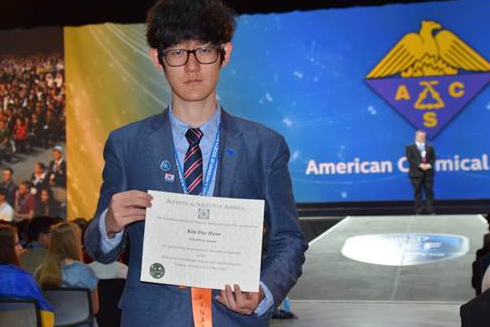
In addition, four teams won the 4th place main prize in each category and $500 in prize money. The team of students Lim Seong-ho, Kim Ji-hong, and Lee Seung-yun from Gyeongnam Science High School won 4th place in the Chemistry category with their project, "Can we determine the concentration of each solute without separating it when there is a solution containing various solutes?"; the team of students Choi Jong-ha and Kim Na-young from the Korean Minjok Leadership Academy won 4th place in the Chemical Energy category with their project, "Nanocatalyst for water-gas shift reaction using transition metals"; Choi Jae-hyuk from Myeongdeok High School won 4th place in the Environmental Engineering category with his project, "Development of Pot In Filter using the arsenic adsorption capacity of iron oxide and the principle of a ceramic filter"; and Kang Yun from Cheonan Jungang High School won 4th place in the Robotics Engineering category with his project, "Robot prosthetic arm for the physically disabled using a distance measuring sensor."
In addition, the team of Gyeongnam Science High School students Kim Seok-ho, Park Hae-jun, and Jeong Su-hwan received an Encouragement Award from the American Statistical Association as a special award for their project, 'Statistical Analysis using Music Analysis Methods and Tools'.
Syamantak Payra (15), from Texas, won the Intel Foundation Young Scientist Awards and a $50,000 prize for developing an affordable electronic knee brace that helps people with leg disabilities walk more naturally. He tested the prototype on two individuals with partial disabilities caused by polio, and they were able to regain mobility with a more natural gait.
Another recipient of the Intel Foundation Young Scientist Award and a $50,000 prize is Karan Liu, a 17-year-old from Utah, USA. Liu developed an alternative battery component that can dramatically improve battery performance and stability. The rechargeable battery she developed is smaller and lighter, and does not have the inherent fire risk of lithium-ion batteries used in airplanes, mobile phones, and even hoverboards.
Rosalind Hudnell, Intel’s Chief External Affairs Officer, Vice President of HR, and President of the Intel Foundation, said, “I sincerely congratulate the winners of this competition and hope that other young innovators will be inspired by their achievements to demonstrate their curiosity and creativity to actively solve the various problems facing the world today,” adding, “Intel ISEF is the best example of what can be achieved when students from different backgrounds, origins, and perspectives come together to share ideas and solutions.”
This year, over 1,700 young scientists participated in Intel ISEF, selected through 419 affiliated competitions held in more than 77 countries and regions. In addition to the winners mentioned above, over 600 finalists received various awards for their outstanding research results, including 22 “Best Category Awards” each with a prize of $5,000. The Intel Foundation also awarded $1,000 in prize money to the schools of the winners and the competitions affiliated with ISEF.
Maya Azmera, President and CEO of the American Association for the Public Science, stated, “Austin, Shamantek, and Cayce, the major category winners of this year’s Intel ISEF, have clearly demonstrated that age makes no difference when it comes to the ability to conduct research on critical problems and find solutions.” She added, “I commend not only their achievements but also their hard work and dedication. Furthermore, all the students who participated in this competition are rising stars in the fields of science, technology, engineering, and mathematics.” "I hope they continue to develop their research so that they can make the world a better place to live for the next generation," he said.
Intel ISEF is a competition that selects the world's most outstanding student entrepreneurs, innovators, and scientists. Final participants are selected through hundreds of related competitions worldwide, and their projects are selected through on-site evaluations by a panel of over 1,000 judges holding Ph.D.s in specific scientific fields or having more than six years of experience.
The full list of finalists can be found here. Intel ISEF 2016 was held under the joint sponsorship of Intel and the Intel Foundation, with many companies, academia, and government science agencies supporting additional awards. This year, over US$4 million in scholarships was awarded.
관련뉴스
인텔코리아, MS와 손잡고 신세계 백화점에 차세대 모바일 POS 지원
인텔코리아와 한국마이크로소프트는 주식회사 신세계(www.shinsegae.com))와 함께 IoT에 기반한 새로운 개념의 고객 반응형 백화점 구현에 협력하기로 하고, 그 첫 프로젝트로 차세대 모바일 POS(Point of Sale, 판매시점정보관리시스템)인 인텔 기반 윈도우 태블릿을 도입했다고 발표했다.
2016.03.24by 명세환 기자
Intel Leads Cloud Transition with Enterprise Microprocessors
인텔은 지난 6일, 제품 발표회를 통해 보다 뛰어난 속도와 확장성을 가진 클라우드 서비스를 위한 여러 가지 새로운 기술과 투자 계획 및 업계와의 협업 내용을 소개하고, 기업 고객들이 클라우드를 보다 용이하게 구축해 신속하게 신규 서비스를 출시하고 매출 증대를 이끌어낼 수 있도록 지원해나갈 것이라고 발표했다. 인텔 제온 프로세서 E5-2600 v4 제품군은 14nm 공정 기술로 개발됐으며 인텔 리소스 디렉터 기술(Intel Resource Director Technology)을 포함해 SDI를 위한 핵심 구성요소를 제공한다. 인텔 리소스 디렉터 기술은 프로세서 캐시(cache) 및 주 메모리와 같은 핵심 공유 자원에 대한 원활한 제어와 모니터링을 위한 뛰어난 시각화를 바탕으로 고객들이 완전히 자동화된 SDI 기반 클라우드로 이전하는 것을 가능하게 한다.
2016.04.08by 신윤오 기자
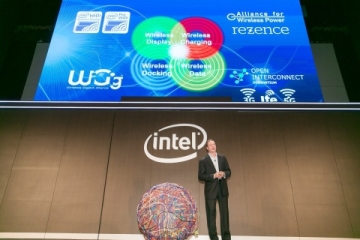
Intel Seeks to Expand Computing Horizons at Computex Taipei e21 Forum
컴퓨텍스 타이페이(COMPUTEX TAIPEI)의 가장 중요한 포럼 중 하나인 e21 포럼(e21FORUM)이 5월 31일 타이페이 국제컨벤션센터(Taipei International Convention Center) 연회장(3층)에서 열린다. 올해 주제는 “인공지능 비전 - 경이의 새 시대(Vision with Intelligence: Amazing New Era!)”로서 참가자들은 미래 기술을 함께 탐구하고 최근의 혁신 경향에 관한 정보를 얻을 수 있다.
2016.05.13by 명세환 기자
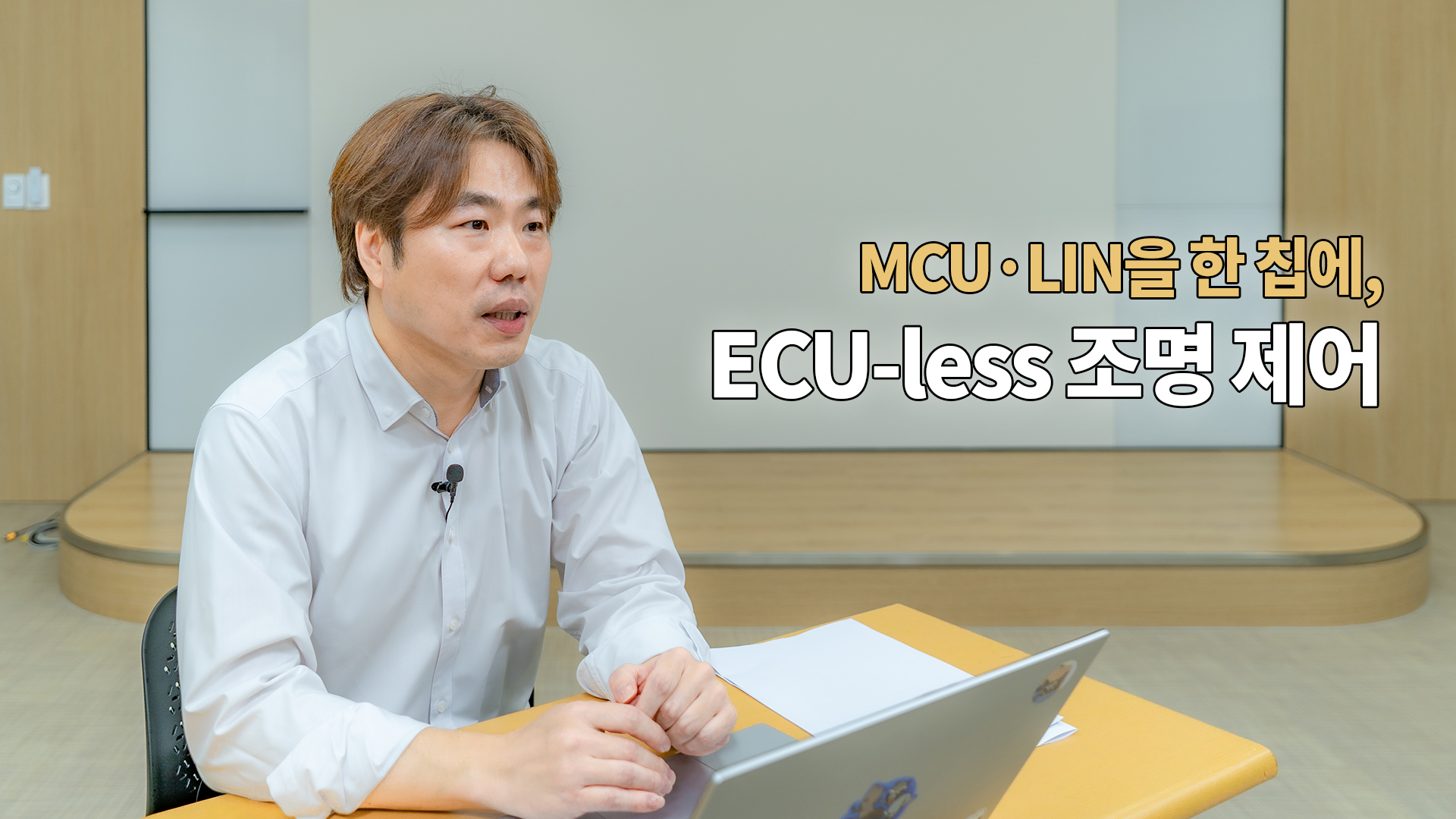
A single misaligned light means 'defect'… Vehicle interior lighting now guarded by semiconductors and software
자동차 실내조명이 '보조 조명'의 자리를 벗어나고 있다. 색상과 애니메이션으로 브랜드 아이덴티티를 드러내고 운전자 취향을 담아내는 사용자 경험(UX)의 핵심 요소로 올라서면서, LED 실내 앰비언트 시장도 빠르게 커지는 중이다. 이에 관하여 '미래 자동차를 밝히는 지능형 LED 실내 조명 솔루션' 이라는 내용으로 기술 웨비나 세션을 발표하는 최영재 다보코퍼레이션 연구위원을 앞서 만나, 시장의 온도와 설계 요구의 변화를 들었다.
2026.08.28by 명세환 기자
Ecolab and K-water Discuss Innovation Collaboration in Advanced Industry Water Management
Ecolab and the Korea Water Resources Corporation jointly discussed cooperation directions for maximizing water use efficiency in advanced industries such as semiconductors and data centers and establishing sustainable water circulation. The two companies agreed to gradually develop a long-term cooperation model that combines water resource infrastructure and water management technology to promote water efficiency optimization, water reuse, and carbon reduction.
2026.08.28by 명세환 기자











