

TI Launches 60V N-Channel Power MOSFET Achieving Lowest Resistance
 Published2016.06.23 06:22
TI (CEO Kent Tran) announced the launch of a new 60V N-channel FemtoFET power transistor product that achieves the industry's lowest resistance.
The new CSD18541F5 reduces power loss in the end system by achieving 90% lower resistance than existing 60V load switches. In addition, it is available in an ultra-small 1.53mm x 0.77mm silicon-based package, which reduces the footprint by 80% compared to load switches available in SOT-23 packages.
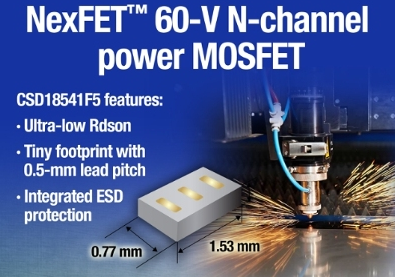
The CSD18541F5 MOSFET maintains a rated on-resistance (Rdson) of 54mW and is designed and optimized to replace standard small-signal MOSFETs in space-constrained industrial load switch applications.
In addition, the miniaturized LGA (land grid array) package has a 0.5mm pitch between pads, making it easy to mount during manufacturing.
The CSD18541F5 is a new product in the FemtoFET MOSFET family of TI NexFET™ technology portfolio that provides higher voltage and facilitates manufacturing.

Comments
Related news
TI Launches 40A, 16V Input Voltage Converter Providing Highest Current
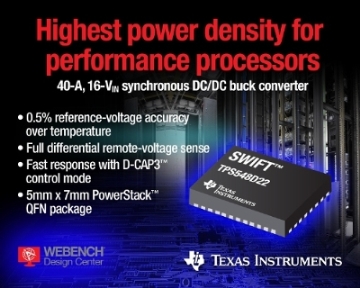
TI (CEO Kent Tran) announces the launch of the industry's first 40A, 16V input voltage (VIN) synchronous step-down DC/DC converter capable of sensing accurate differential remote voltage. The SWIFT TPS548D22 buck converter integrates MOSFETs in a compact PowerStack™ package, making it particularly suitable for driving ASIC (Application-Specific Integrated Circuits) and DSP (Digital Signal Processor) in space-constrained applications.
2016.06.08by 김수지 기자

TI Launches Resolver Sensor Interface IC for Accurate Rotational Position Detection
Texas Instruments (CEO Kent Twen) announced the launch of the industry's first resolver sensor interface IC that integrates power supply, excitation amplifier, and "functional safety" capabilities. The new device can excite resolver sensor coils while simultaneously calculating the angle and speed of the rotating motor shaft, and does not require external components used in competing solutions.
2016.06.13by 명세환 기자
TI Launches Gate Driver to Improve Powertrain Performance
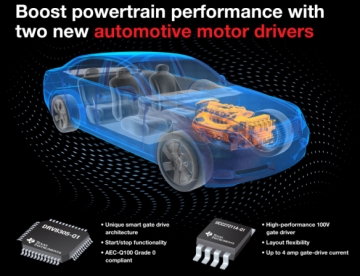
TI (CEO Kent Chun) announced the launch of two new automotive motor drivers that support high-performance powertrain applications. The DRV8305-Q1, a highly integrated three-phase brushless DC gate driver, and the UCC27211A-Q1, a high-current half-bridge gate driver, enhance system performance and provide design flexibility to meet a wide range of automotive system requirements.
2016.06.16by 명세환 기자

Intel Unveils Next-Generation 'Core Ultra Series 3' and vPro Platform for Enterprise PCs
Intel has officially unveiled the "Intel Core Ultra Series 3" for next-generation enterprise PCs and the latest vPro platform, addressing a wide range of demands from enterprise notebooks to high-performance workstations.
2026.03.26by 배종인 기자
ROHM Launches ESD Protection Diode Compatible with High-Speed Interfaces of 10Gbps or Higher
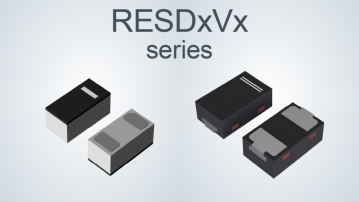
Semiconductor specialist ROHM has developed the 'RESDxVx series' of ESD (electrostatic discharge) protection diodes capable of responding to next-generation high-speed data communication environments exceeding 10Gbps, simultaneously enhancing both signal quality maintenance required in high-speed interfaces and IC protection performance.
2026.03.26by 배종인 기자