



Where is the concentrated R&D investment being spent until 2022?
 Published2016.07.18 10:40
A total of approximately 180 experts from industry, academia, and research institutes participated in formulating the roadmap since last year.
The Technology Roadmap 2022 (draft), which adds the 10 major technology fields of ICT R&D, recent key fields, and artificial intelligence fields, has been unveiled.
The Technology Roadmap 2022 (draft) announced by the government includes the 10 strategic industries of the K-ICT strategy, such as 5G and intelligent information technology, as well as three next-generation leading industries, including converged displays. In addition, R&D investment will be concentrated on the recently emerging fields of artificial intelligence and intelligent semiconductors, fields of diffusion to other industries (ICT convergence), and ICT-based smart factory technologies of Manufacturing Innovation 3.0.
The top 10 ICT R&D technologies selected by the Ministry of Science, ICT and Future Planning to strengthen the interconnectedness of science and technology and ICT and to discover new industries are convergence services, mobile communications, networks, broadcasting/smart media, radio waves, satellites, basic SW computing, software, digital content, information security, and ICT devices. The budget for projects under the comprehensive implementation plan for ICT R&D is 984.6 billion won, which is a 6.1% decrease compared to 1.0483 trillion won in 2015.
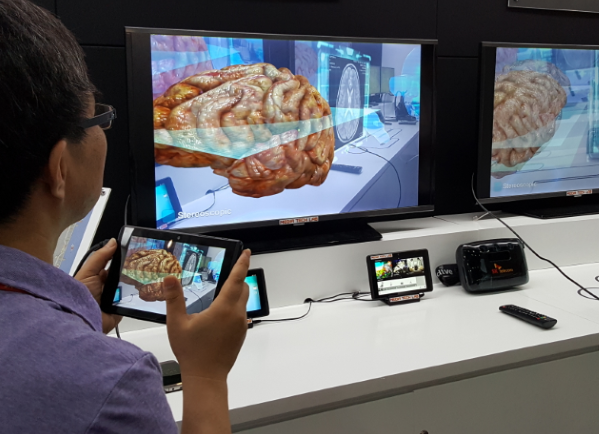
▲ A demonstration of remote consultation using SK Telecom's AR (Augmented Reality) (Reference photo)
If you look at the macro roadmaps by technology sector (2017–2022), the goals pursued by each sector are clear. Technologies in each field are targeted for completion by 2022. First, convergence services aim for IoT-based autonomous driving, and mobile communication plans for ultra-low latency wireless communication services for ultra-high-speed vehicles. The network field aims for spatial division optical communication technology and wired/wireless quantum communication technology; the broadcasting/smart media field aims for multi-sensory augmented/sensitive broadcasting; and the radio satellite field aims for IoT-based remote monitoring services.
The underlying SW computing aims for a new technology convergence cloud, the software (SW) field plans to build a terascale many-core system, and the digital content field plans to build high-quality video services based on AR glasses and intelligent/realistic interactive multi-ending cinema services. In addition, the information security and ICT device sectors plan to develop IoT security SoCs and unimaginable smartphones in 2022.
Finally, regarding the artificial intelligence field newly added to the roadmap, starting with the speech recognition and knowledge base integrated AI service (2017), plans are underway to build deep learning-based security systems and visual intelligence services, AI-based process management analysis services, AI support systems for specialized knowledge fields, and user intent recognition-based situational awareness services.
Jo Dong-ho, Chairman of the Roadmap Committee (Professor at KAIST), stated in a report on the progress of establishing the ICT R&D technology roadmap and investment direction, “We plan to collect opinions on the draft ICT R&D technology roadmap and prepare a report by July, and complete the establishment of the technology roadmap in August.” He added, “Subsequently, we plan to incorporate the planning of new ICT R&D projects for 2017 by the end of the year and reflect them in policies, such as the government’s mid-to-long-term R&D investment plan, in January of next year.”
Trends in Top 10 ICT R&D Patents: ICT Devices, Convergence Services, and Mobile Communications Showed the Largest Increases, in That Order
Positive results were also observed in the top 10 ICT R&D trends based on patent analysis. Domestic patent applications generated from government R&D increased rapidly over the past five years (a growth rate of 12.9%), and patent productivity was higher than that of overseas research institutions.
According to the top 10 ICT R&D patents analyzed by the Korea Intellectual Property Strategy Institute, the United States ranked first in overall technology, while Korea ranked second, excluding basic software/computing (3rd) and radio satellite (3rd). The annual patent application trends show the largest increases in the ICT device, convergence services, and mobile communication sectors, in that order, with an overall increase.
Among the top 10 fields in the ICT sector, Korean applicants include Samsung Electronics, ETRI, and LG Electronics, who primarily focus on convergence services and ICT devices. While Samsung Electronics files applications in similar numbers in the U.S. and Korea, LG Electronics and ETRI have focused their applications mainly on Korea. It is noteworthy that Google, Huawei, and Apple were registered as new applicants in recent years, specifically between 2007 and 2010, and between 2011 and 2014.
Oh Yoon-taek, Head of the Korea Intellectual Property Strategy Institute, explained the analysis results, stating that the broadcasting/smart media sector has the most active recent patent activity, accounting for 50.2% of applications over the past four years, while radio and satellite technology has shown sluggish activity at 20.3%. Regarding the major market securing rates by technology, networks (31.6%) and mobile communications (29.2%) were the highest, indicating that rights in overseas markets are well secured. Furthermore, digital content was analyzed to have secured the highest qualitative competitiveness with a patent citation rate of 26.2 times and active recent patent application activity at 40.1%.
Futurist Cha Won-yong: The Era of 1-2 Seater Electric Autonomous Vehicles Will Come with the Arrival of the Solo Economy
Meanwhile, futurist Dr. Cha Won-yong, who delivered a special lecture prior to the technology roadmap presentation, stated, “As we enter an era of low birth rates, the era of the Solo Economy, characterized by single-person households and single-person households, has arrived.” “From 25% in 2014, it will increase to 34.3% by 2035 when the current generation of people in their 20s becomes people in their 40s, and childless couples will reach 34%,” he stated, drawing attention by adding, “The increase in single-person households reflects the rise of prefabricated, mobile, custom-made, miniaturized, and single-person restaurants, and will also accelerate the emergence of electric autonomous vehicles for one or two people.”
In addition, Dr. Cha predicted that current social media will evolve into personal broadcasting and commerce using teleprompters, and that 3D avatars that express individuality and shop on my behalf, remotely appearing robots that represent me, and cloud-based collective robots will emerge.
He predicted that technology would evolve from the Internet of Brain to the Internet of Biosignals, which prioritizes human-centered health and life, as the population aged 65 and older reached 5.8 million in 2014 and surpassed 23% to 13.8 million in 2030, marking the entry into a super-aged society.
In response, Dr. Cha proposed the "development of a smart kitchen platform for the solo economy" as a practical measure related to these prospects. He noted that broadcasts targeting single-person households are gaining popularity, and that the kitchen, where meals can be prepared using DIY and 3D printing, is the perfect place to reflect this trend. He specifically suggested that a smart kitchen platform could be built by transforming the kitchen table into a surface table, digitally developing recipes for Korean or Western cuisine so that the position of tableware changes according to the recipe, and securing materials or biomaterials to 3D print containers or food.
Comments
Related news
AI-related patents in the U.S. are nine times higher than those in Korea
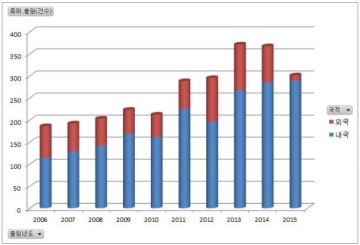
According to the Korean Intellectual Property Office (Commissioner Choi Dong-gyou), an analysis of domestic artificial intelligence-related patent applications using natural language search methods reveals that over the past 10 years (2006-2015), patent applications totaled 2,638 cases, representing an average annual increase of approximately 5%. Natural language search is a search method that enables queries at the sentence level, utilizing search terms such as 'artificial intelligence, machine learning, artificial neural networks, deep learning, and decision-making'.
2016.03.21by 신윤오 기자
[Reporter's Notebook] Have We Ever Been This Thirsty for 'Artificial Intelligence'!
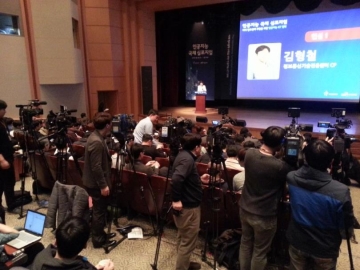
People and media outlets eager for artificial intelligence focused intently, hanging on every word of the seminar speakers. At this symposium, artificial intelligence experts from IBM's Watson—famous for defeating humans at chess—as well as Microsoft, Samsung Electronics, and MIT presented their views on the current state of artificial intelligence technology and its potential impact on humanity.
2016.03.28by 신윤오 기자
[Reporter's Notebook] VR Industry, Is There Any Good Content?
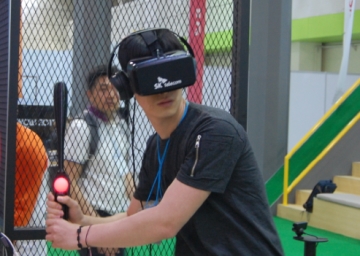
This was several years ago during the height of 3D TV competition. A major device manufacturer came forward with plans to create an ecosystem in the 3D TV field on its own, and even blocked its partner companies from collaborating with competing firms. Naturally, inter-company exchanges became closed-off, and technological development and content production failed to materialize properly, leaving 3D TV facing fundamental limitations. The lessons learned from 3D TV can be summarized into several points. First, ecosystem building is necessary for a specific market and technology to develop. Second, ecosystem building cannot be achieved through unilateral leadership by any single party. Third, a shortage of content ultimately brings about limitations in market expansion.
2016.07.04by 신윤오 기자

[Technical Contribution] Mouser: "AI Agents Help Accelerate and Standardize Industrial Field Maintenance Operations"
Abhishek Jadhav from Mouser Electronics discusses how to leverage agentic AI for predictive maintenance in industrial automation.
2026.10.23by 편집부
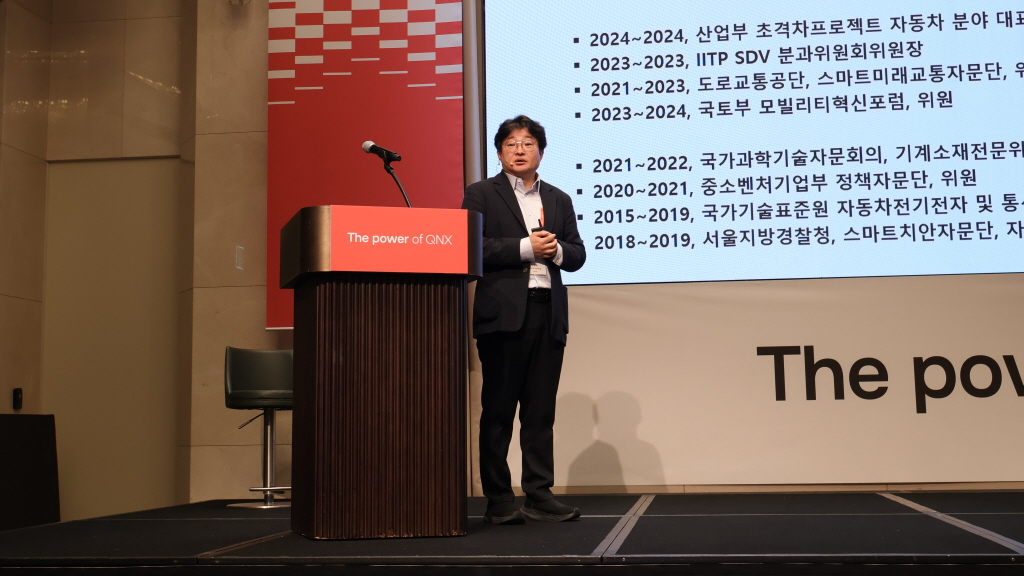
Professor Jeong Gu-min from Kookmin University, "QNX RTOS will become an important foundational technology in the physical AI era"
As software-defined vehicles (SDV) establish themselves as a new standard in the automotive industry, forecasts indicate that future competitiveness will be determined not by vehicle hardware but by software platforms and AI utilization capabilities. With the automotive industry rapidly transitioning to centralized architecture and AI-based development systems, an analysis suggests that how effectively vehicle platforms can be simplified and operated cost-efficiently will become core competitiveness for next-generation SDV and AI-defined vehicles. Professor Jeong Gu-min from Kookmin University emphasized at QNX TechForum Korea 2026 that "the automotive industry is now shifting from hardware competition to software ecosystem competition," highlighting that API-centric platforms and AI utilization will determine success or failure in the future automotive industry.
2026.10.23by 배종인 기자











