


TI launches highest-density DC/DC buck converter
 Published2016.12.08 11:08
Provides Remote Voltage Sensing and Telemetry Functions
TI announced the launch of its industry-leading highest-density 18V input, 35A synchronous DC/DC buck converter product.
The new TPS546C23 power converter features fully differential remote voltage sensing and PMBus support, enabling telemetry capabilities. Additionally, this converter provides significantly superior density compared to competing products by integrating high-side and low-side MOSFETs in a compact footprint package.
Two converters can be stacked in parallel, enabling up to 70A drive for processors in space-constrained and power-intensive applications such as wired/wireless communications, enterprise and cloud computing, and data storage systems.
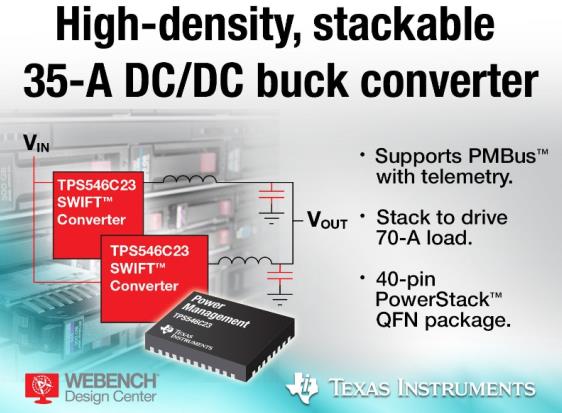
The highly integrated TPS546C23 power converter delivers 44% superior density (amperes per square millimeter) compared to competing products. Additionally, reference voltage accuracy of 0.5% across temperature and fully differential remote voltage sensing capabilities meet the voltage accuracy requirements of deep sub-micron (DSM) processors.
With current distribution capability, two converters can be stacked, and the device's single-pad, stacked die, QFN (quad flat no-lead) package achieves high efficiency and excellent thermal performance.
TI also offers the TPS546C20A PMBus converter with pin-strapping support that allows adjustment of output voltage and soft start time. Additionally, various converter products supporting PMBus interface are available.
This product integrates low Rdson power MOSFETs to provide continuous output current of 35A, and by integrating an on-chip PMBus interface and nonvolatile memory, power supply design can be simplified and customized.
Additionally, PMBus enables telemetry of output current, output voltage, and internal die temperature, allowing active power management. The voltage control mode with clock frequency synchronization and input feedforward functions improves EMI/noise and responds quickly to input voltage variations. Frequency synchronization to an external clock eliminates beat noise and reduces EMI.
Related news

The reason high-speed switching DC/DC converters have ultra-compact sizes and high power density is
TI Korea announced the launch of the industry's first 12V, 10A, 10MHz series capacitor buck converter IC that provides current density of 50A/㎤ or higher. The company's director Cha Young-gil stated, "The Chinese government is so focused on energy efficiency that it supports enterprises based on the energy efficiency rating of their products," and added, "In this way, the power conversion trends that customers demand—including energy efficiency, integration, high voltage, and power density—have become essential requirements." First, the TPS54A20 SWIFT™ synchronous DC/DC converter product that TI is launching this time achieves 4 times higher power density performance compared to other currently available 12V power management devices or solutions, director Cha emphasized.
2016.06.03by 신윤오 기자

Why high-speed switching DC/DC converters achieve high power density in ultra-compact sizes
TI Korea announced the launch of the industry's first 12V, 10A, 10MHz series capacitor buck converter IC that provides current density of 50A/㎤ or higher. Cha Young-gil, Director at the company, stated, "The Chinese government places such emphasis on energy efficiency that it provides support to companies based on their products' energy efficiency ratings," and added, "The power conversion trends that customers demand—including energy efficiency, integration, high voltage, and power density—have become essential requirements." First, the TPS54A20 SWIFT™ synchronous DC/DC converter product that TI is introducing this time achieves 4 times higher power density performance compared to other currently available 12V power management devices or solutions, Director Cha emphasized
2016.06.07by 명세환 기자
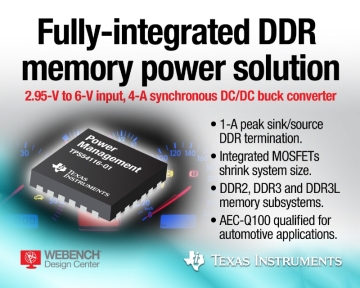
TI Launches Fully Integrated DC/DC Buck Converter for Memory Subsystems
TI has announced the launch of the industry's first fully integrated power management solution for DDR (double data rate) 2, DDR3, and DDR3L memory subsystems for automotive and industrial applications. The new TPS54116-Q1 DC/DC buck converter is a 2.95V to 6V input, 4A synchronous step-down converter. It integrates 1A peak sink/source DDR termination and a buffered reference, enabling system size reduction of up to 50% compared to discrete implementations.
2016.10.06by 홍보라 기자
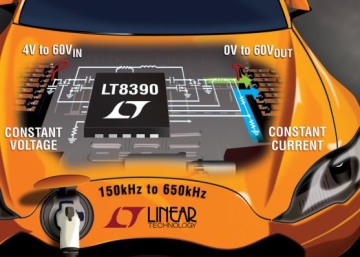
Linear Technology Announces Synchronous Buck-Boost DC/DC Controller
Linear Technology Korea (CEO Hong Sa-gwak) announced the launch of a new synchronous buck-boost DC/DC controller product (product name: LT8390). This product can regulate output voltage and input/output current from an input voltage that is higher, lower, or equal to the output voltage. The input voltage range of 4V to 60V and output voltage range of 0V to 60V make it ideal for voltage regulators used in automotive, industrial, and communications applications as well as battery-powered systems, and for battery and supercapacitor charging applications.
2016.11.24by 신윤오 기자

Intel Unveils Next-Generation 'Core Ultra Series 3' and vPro Platform for Enterprise PCs
Intel has officially unveiled the "Intel Core Ultra Series 3" for next-generation enterprise PCs and the latest vPro platform, addressing a wide range of demands from enterprise notebooks to high-performance workstations.
2026.03.26by 배종인 기자











