

.png)

[Promising Future Technologies ④] Future Displays Evolving Toward Human Interaction
 Published2017.01.23 13:09
There is no blackboard in K's classroom. Chalk and green chalkboards were replaced by whiteboards, then by LCD displays, and since the introduction of futuristic displays, rollable displays have taken the place of blackboards and textbooks. At the start of class, students unfold the rollable displays—which were rolled up like paper in their bags—on their desks; as the teacher's notes appear on the screen, students use styluses to add their own explanations. All content recorded in this way is automatically saved to a drive connected to the display. Smartphones, folded compactly and stored in bags, have various notification windows placed on their corners to allow for immediate alerts in emergency situations.
In the next 10 years, displays will provide users with completely new enjoyment and will feature various sizes and designs, rather than standardized rectangular displays. Furthermore, they will be capable of being implemented anytime and anywhere and will be able to show users what they imagine.
The emergence of flexible displays has brought innovation to displays. This is because the glass substrates of conventional flat-panel displays have been replaced with plastic. They are gradually being applied to smartphones and TVs, and the whole world is paying attention as a key element to be applied to wearable devices, which are currently actively developing in the IT market.
The next-generation transparent display, following flexible displays, is a display that uses transparent electronic elements with a transmittance of a certain level or higher. It remains transparent when not in use, but displays various information on a transparent display when needed, so it can be used in monitors, smart windows, car windshields, etc.
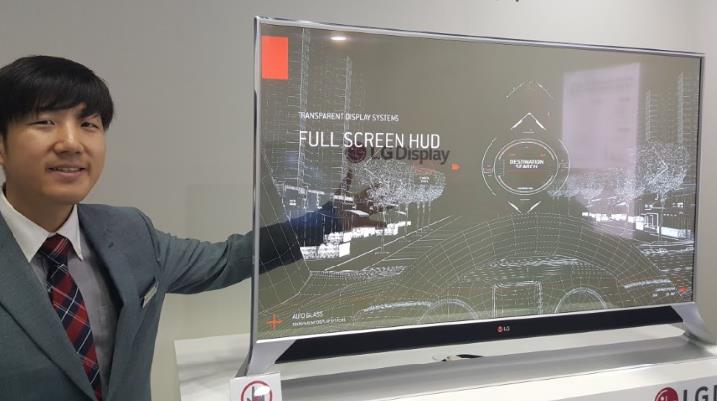
The next-generation transparent display, succeeding flexible displays, is a display that utilizes transparent electronic elements with a transmittance above a certain level. The photo shows a transparent display unveiled by LG Electronics.
Due to China's rapid growth in the display market, a differentiation strategy for Korea has become necessary. Chinese display manufacturers are aggressively investing in LCD lines. In April 2015, BOE, China's largest display manufacturer, announced an investment in the world's largest 10.5-generation line, focusing on the production of large TV panels larger than 60 inches. CSOT plans to begin investing in an 11-generation line in 2016 and commence full-scale mass production in 2018, also aiming to mass-produce ultra-large panels larger than 60 inches. The investments by China's BOE in the 10.5-generation line and CSOT in the 11-generation line pose a significant challenge for South Korea's Samsung Display and LG Display.
Samsung Electronics is actively creating a market for small and medium-sized OLEDs to strengthen its dominance in the smartphone market. Samsung Display is significantly lowering the cost of OLED panels through process improvements and yield enhancements, and the flexible displays produced by Samsung Display possess significant competitiveness in terms of IT hardware. On the other hand, the company is simultaneously restructuring the LCD industry, where market competitiveness is declining, by selling off its small and medium-sized mobile LCD lines to Chinese companies. LG Display, the number one player in the LCD market, is pioneering the market by being the first to enter the large-sized OLED market in order to secure a leading position in the next-generation display market.
Samsung Electronics possesses high competitiveness in terms of small screens, such as with next-generation 'foldable' smartphones. Samsung Electronics filed a patent for a 'foldable smartphone' with the U.S. Patent and Trademark Office in 2013. Having filed over 600 patents with the U.S. Patent and Trademark Office regarding foldable smartphones and flexible displays, Samsung holds a diverse range of patents, ranging from display manufacturing to smartphone devices and operation methods. LG Electronics has high competitiveness in large screens, as its OLED TV received the highest picture quality rating in the U.S. in September 2015. Recently, through a patent application capable of controlling the OLED light emission of OLED displays in various ways, the company has contributed to improving picture quality and reducing power consumption.
The U.S. leads the next-generation display market, with Korea ranking third in market share.
Now, let's look at the overall patent application situation. Based on the number of patent applications, the United States accounts for 36% with 8,330 applications, indicating that the U.S. is leading the field of next-generation displays. Looking at the application trends by year, patent applications are showing an increasing trend globally. While Korea saw a surge in patent applications from 2008 to 2010, it has maintained around 300 applications annually since then.
Looking at the market share of patent offices by category in the field of future displays, the U.S. Patent Office accounted for the highest share overall (average of all categories) at 36.3%, and by category, it is characterized by a decrease in applications from the Japanese Patent Office while applications from the Korean Patent Office and the Chinese Patent Office increased. Among the total of seven technologies, the most patents are being filed with the U.S. Patent Office for six technologies excluding laser/other display technology, while the most patents for laser/other display technology are being filed with the Japanese Patent Office. Based on the number of applications filed with the Korean Patent Office, it was found that 3D displays, flexible displays, and future display UI/UX are the most frequently filed technologies.
Looking at the market share by nationality of applicants in the field of future displays, U.S. nationals file the most patents with a 28.4% share, while Korean nationals rank third with a 16.0% share. Examining the market share by subcategories of future displays, the United States holds the highest share in 3D displays, HMDs, micro displays, future display UI/UX, and transparent displays, while Japan holds the highest share in flexible displays and laser/other displays. Korea was found to have the smallest gap with leading countries in transparent displays, whereas the gap was the widest in laser/other displays.

▲ In 2020, robots such as surgical robots, deep-sea exploration robots, and high-altitude testicular robots can be remotely controlled via VR. (Image captured from the Oculus website)
Looking at the lawsuits by subcategory in the field of future displays, 3D displays have the most litigation patents with 16, followed by future display UI/UX with 14. Among the litigation patents, the patents where the current rights holder is an NPE were most numerous in 3D displays with 4 cases, followed by future display UI/UX and micro displays with 2 cases.
Looking at the number of assigned patents by subcategory in the field of future displays, 3D displays recorded the highest number of transactions with 289, followed by laser/other displays with 192 and future display UI/UX with 159. Among the assigned patents, NPE-assigned patents were highest in 3D displays with 36, followed by laser/other displays with 14 and flexible displays with 12. Examining the number of assigned patents in future displays by year, the overall number of traded patents fluctuates between increases and decreases without showing a specific trend, although it appears that the number of traded patents has been decreasing recently.
By examining Oculus’s product and service scenarios, we can get a glimpse of what displays will look like in the near future. Oculus’s integrated headset features OLED displays and offers 3D spatial, 3D audio rotation, and position tracking capabilities. In 2017, one to two years from now, products are expected to be released that enhance portability while evolving to integrate with smartphones to consume VR content. By 2019, VR will be able to sense user gestures and control the device according to the user's intentions. By 2020, robots such as surgical robots, deep-sea exploration robots, and high-altitude testicular robots can be remotely controlled via VR.
The promising keywords for future displays are user gestures and OLED.
The promising keywords for future displays identified from patents are user gestures and OLED. Technologies primarily used in the early stages of next-generation displays, such as stereoscopic and glasses-free displays which are closely related to existing 3D displays, are emerging. Many keywords applicable to electronic paper and transparent displays, such as electro-wetting displays, have also emerged. Next-generation displays are expected to evolve into personalized displays (flexible, wearable, smartphone-connected, etc.) and displays with enhanced UI/UX functions, such as HMDs.
Early-stage models of next-generation displays are currently being commercialized and applied to products such as smartphones, TVs, and refrigerators. From a patent-based perspective, technological development is underway to improve the flexibility and transparency of these displays; from a long-term future perspective, they are expected to evolve into displays installed on the human body that interact with humans by combining with the ICT and bio fields. <This article references the Future Promising Products and Services Analysis Report by the Korea Institute of Intellectual Property Strategy (KISTA).>
관련뉴스
[Promising Future Technology ①] Urgent Need to Secure IoT and Industrial Convergence Technology
The Korean IoT market is projected to grow from 3.8 trillion won in 2015 to 13.7 trillion won in 2020. The global IoT market is expected to grow at an average annual rate of approximately 26%, exceeding 1 trillion dollars by 2020. In the early stages of the IoT market, devices accounted for a high proportion; however, by 2022, it is projected that 50-60% of global and Korean market revenues will be generated in the platform and service sectors.
2017.01.02by 신윤오 기자
[Promising Future Technologies ②] Smart Content: Information Tailored to You Gets You Automatically
스마트 콘텐츠 서비스(Smart Contents Service)는 스마트폰, 스마트 TV 등과 같은 스마트 기기에 제공되는 사용자 편의 중심의 콘텐츠를 말한다. 이동성, 양방향성, 사용자 친화성, 이용자 맞춤형, 실감 체험 스크린 등의 특징을 가진다. 해외에서는 모바일 데이터, 와이어리스 데이터, 셀룰러 데이터 등 이동통신 네트워크로 제공되는 데이터 서비스를 통칭한다. 최근 스마트 콘텐츠 서비스 산업은 모바일의 성장과 웹플랫폼의 활성화, 글로벌 기업의 M&A를 통한 사업영역 확대를 통해 큰 변화의 시기를 맞이하고 있다.
2017.01.09by 신윤오 기자
[미래유망기술③] 디지털 비서, 언어 알아듣고 감정 이해하는 만능 해결사될까
개인 일상 생활에 필요한 다양한 업무를 대신해 주는 소프트웨어, 디지털 어시스턴트는 머신러닝 음성인식 문장분석 등 인공 지능 기술과 결합돼 언어를 이해하고 사용자 패턴을 예측해 서비스하는 방향으로 진화하고 있다. 현재는 스마트폰 기반 음성인식이 주를 이루지만 미래에는 멀티 디바이스 기반으로 감정인식까지 가능하게 된다.
2017.01.16by 신윤오 기자

Intel Unveils Next-Generation 'Core Ultra Series 3' and vPro Platform for Enterprise PCs
Intel has officially unveiled the "Intel Core Ultra Series 3" for next-generation enterprise PCs and the latest vPro platform, addressing a wide range of demands from enterprise notebooks to high-performance workstations.
2026.03.26by 배종인 기자

ROHM Launches ESD Protection Diode Compatible with High-Speed Interfaces of 10Gbps or Higher
반도체 전문 기업 로옴(ROHM)이 10Gbps를 넘어서는 차세대 고속 데이터 통신 환경에 대응할 수 있는 ESD(정전기 방전) 보호 다이오드 ‘RESDxVx 시리즈’를 개발하며, 고속 인터페이스에서 요구되는 신호 품질 유지와 IC 보호 성능을 동시에 끌어올렸다.
2026.03.26by 배종인 기자











