



Last Year's $61.7 Billion in Semiconductor Purchases: Who Are the World's Biggest Semiconductor Buyers?
 Published2017.02.03 13:20
Cisco Falls Out of Top 10 Purchasing Companies; Chinese Companies Enter the Rankings
Samsung Electronics and Apple have emerged as the world's top semiconductor purchasers for six consecutive years.
IT advisory firm Gartner Inc. announced that Samsung Electronics and Apple maintained their positions as the two largest semiconductor-purchasing companies, accounting for 18.2% of the global semiconductor market in 2016 (refer to Table 1). The two companies purchased a combined total of $61.7 billion in semiconductors in 2016, representing an increase of $400 million compared to the previous year.

▲Reference photo: Samsung Electronics launched the 2017 'Galaxy A5' targeting the young premium segment as its first smartphone of the year on the 19th of last month.
Masatsune Yamaji, senior analyst at Gartner, stated, "In 2016, Samsung Electronics and Apple maintained their leading positions in the semiconductor purchasing index for six consecutive years," and added, "While both companies continue to exert considerable influence on technology and pricing trends in the broader semiconductor industry as in the previous year, their influence has somewhat diminished due to uncertain future growth prospects."Last year, Samsung Electronics engaged in fierce competition with Chinese original equipment manufacturer (OEM) companies across various markets including smartphones, LCD TVs, and LCD panels. However, the company expanded its design TAM (Total Available Market) and recorded a 9.3% market share, reclaiming the top position in the global design TAM market. In Apple's case, for the first time since Gartner began conducting design TAM research in 2007, the company experienced a decrease in its design TAM, capturing an 8.8% market share. Apple's 2016 performance was affected by sluggish iPad sales and declining PC market share.
Semiconductor Companies Need to Diversify Customer Base to Respond to Dynamics in Electronics Market
Of the top 10 companies in design TAM in 2015, nine companies remained on the 2016 list. Cisco Systems fell out of the top 10 rankings in 2016, with BBK, a Chinese smartphone OEM company that showed significant growth last year, taking its place. Among the top 10 companies, there were three each from the United States and China, and two from South Korea and one from Japan. This was the first time three Chinese companies appeared in the top 10, demonstrating that as China's macroeconomic growth decelerates, the domestic electronics market is becoming increasingly important.
Researcher Masatsune Yamaji stated, "Although the influence of the two dominant OEM players, Samsung Electronics and Apple, in the semiconductor industry has weakened, the combined design TAM of the top 10 companies exceeded the average growth rate of the entire semiconductor market in 2016."
He further noted, "However, due to rapidly changing market share dynamics, semiconductor companies can no longer rely solely on a small number of large customers. While BBK showed dramatic growth in 2016 with an increased design TAM, BBK's exceptional growth indicates that its domestic business operations are that much more unstable. Therefore, semiconductor companies' technology and product marketing managers must always make efforts to diversify their customer base while keeping in mind potential risks regarding their major customers."
Related news
Global semiconductor equipment sales in the third quarter increased 5% compared to the second quarter.
SEMI, the international semiconductor equipment and materials association, announced that global semiconductor manufacturing equipment shipments in the third quarter of 2016 reached $11 billion. This figure represents a 5% increase compared to the second quarter figures and a 14% increase compared to the third quarter of 2015. SEMI compiles its reports based on data collected on a monthly basis from 95 global equipment companies in cooperation with the Japan Semiconductor Equipment Association (SEAJ).
2016.12.08by 홍보라 기자
From semiconductors and sensors to artificial intelligence, the counterattack of 'IoT appliances' has begun
The intelligent home appliance industry, which plays a leading role in smart home or home IoT, is expected to expand in earnest in the new year. The global smart home market is anticipated to grow from $60 billion in 2015 to $133.6 billion in 2020, with IoT home appliances expected to grow from $5.2 billion in 2015 to $34 billion in 2020, representing an average annual growth rate of 48%. Last year, the domestic smart home market size was estimated at 10 trillion won, with IoT home appliances accounting for 3.3 trillion won.
2016.12.26by 신윤오 기자
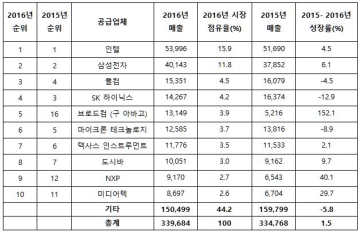
Semiconductor industry in full recovery, expected to grow 7.2% this year from 1.5% last year
Gartner Inc., a leading global IT consulting firm, announced that worldwide semiconductor revenue is expected to reach $364.1 billion in 2017, representing a 7.2% increase compared to the previous year. The semiconductor market, which recorded 1.5% growth in 2016, is showing a complete recovery this year. According to preliminary results announced by Gartner Inc., worldwide PC semiconductor revenue in 2016 reached $339.7 billion, a 1.5% increase compared to $334.8 billion in 2015. The total revenue of the top 25 semiconductor suppliers increased 7.9% year-over-year, accounting for 75.9% of the overall market.
2017.01.25by 신윤오 기자

Intel Unveils Next-Generation 'Core Ultra Series 3' and vPro Platform for Enterprise PCs
Intel has officially unveiled the "Intel Core Ultra Series 3" for next-generation enterprise PCs and the latest vPro platform, addressing a wide range of demands from enterprise notebooks to high-performance workstations.
2026.03.26by 배종인 기자

ROHM Launches ESD Protection Diode Compatible with High-Speed Interfaces of 10Gbps or Higher
Semiconductor specialist ROHM has developed the 'RESDxVx series' of ESD (electrostatic discharge) protection diodes capable of responding to next-generation high-speed data communication environments exceeding 10Gbps, simultaneously enhancing both signal quality maintenance required in high-speed interfaces and IC protection performance.
2026.03.26by 배종인 기자











