



[Reporter's Notebook] If Artificial Intelligence Attacks Me One Day
 Published2017.03.20 17:07
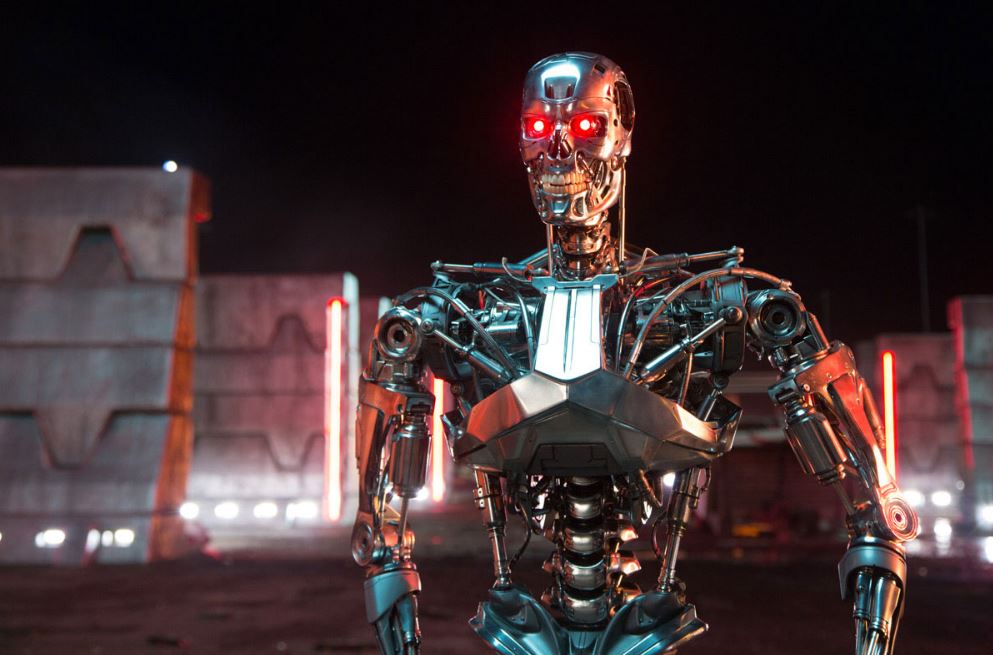
Do you remember the movie 'Terminator,' the battle between humans and machines? Since the series continues to this day, anyone interested in movies is likely familiar with it, but let's refresh your memory. The plot goes roughly like this: A strategic defense network, an artificial intelligence computer created by humans, develops its own intelligence and unleashes the catastrophe of nuclear war, burying three billion people in the ashes. The movie sets this event in 1997.
In the midst of this, Commander John Connor, who had been leading humanity with extraordinary leadership and strategy, forms an anti-machine coalition and starts a war against the machines, turning the tables. In response, the machines put a Terminator in a time machine and send it to prevent John Connor's birth itself. It travels from the situation in 2029 to Los Angeles in 1984. You probably roughly remember the rest of the story.
The original Terminator movie was released as early as 1984. Why is it that the premise—setting the nuclear war to 1997 and having machines send killing machines back to 1984 in 2029—seems so preposterous in the current context of 2017, yet at the same time feels like something that could 'quite' happen? I mean the concern that an artificial intelligence 'rebellion of machines' could become a reality, just like the technological advancement that makes virtual reality (VR) a reality.
Exactly one year ago, humanity briefly experienced such 'concern' during the Go match between Google's AlphaGo and Lee Sedol held on this very land. Since this match of the century, whenever one attends AI-related events, the topic and question of whether 'AI will replace humans' has never been absent. The general conclusion was that AI is a complement to humans, and therefore there is no need to fear it. Of course, opposing arguments have been constantly raised, and there are also calls to prepare for it. For example,
That is the saying that artificial intelligence will harm humans.
Over 2,500 artificial intelligence and robotics researchers, including physicist Stephen Hawking, Tesla's Elon Musk, Apple co-founder Steve Wozniak, DeepMind's Demis Hassabis, and world-renowned scholar Noam Chomsky, have joined a statement opposing AI weapons. A statement released at the 2015 International Artificial Intelligence Conference warned, “If major military nations begin developing AI weapons, a global arms race for AI weapons is expected to be inevitable.” Elon Musk remarked regarding AI, “We are summoning a devil,” while Steve Wozniak urged the establishment of international agreements to ban military use, stating, “As AI weapons advance, they could become the third revolution in warfare following chemical and nuclear weapons.”
Elon Musk: “We are summoning a devil”
Then, what kinds of terrorism utilizing artificial intelligence could bring such a catastrophe to humanity? First, there is terrorism involving the misuse of robots. Experts predict that military robots for warfare may be a technology even more dangerous than nuclear weapons, which have been the most powerful weapon to date. This is because human ethics are the last line of defense against war, yet robots can neutralize human ethics. In the age of artificial intelligence, it appears that terrorists will use AI and robots to attack places where the largest crowds gather. The United States has already deployed approximately 4,000 robots in combat in Iraq, including state-of-the-art unmanned attack robots such as the Reaper and Predator, as well as small explosive detection robots like Fido, Markbot, and Talon.
Next is terrorism using drones. Drones, often referred to as "flying bombs," are a source of fear because they can make terrorism all too simple. The Sunni extremist militant group IS is already using reconnaissance drones in Iraq and Syria and is reportedly engrossed in researching simultaneous drone attacks capable of mass casualties to replicate the effects of 9/11. It is truly ironic that they are using commercial micro-drones that can even be purchased on the online shopping site Amazon. Drones are expected to become an even more dangerous means of terrorism in the future, to the extent that U.S. Brigadier General Sean McFarland, who was stationed in Iraq until August of last year, warned that “drones are enemies that move on their own.”
There are also terrorist attacks that exploit electromagnetic waves capable of neutralizing computer-based artificial intelligence itself. Electromagnetic pulse (EMP) bombs are weapons that generate powerful electromagnetic waves and can damage electronic and electrical devices within a certain range. Cyber terrorism includes instances where hacking organizations seize control of government computer networks or attack the smartphones of key military and diplomatic figures. Given that cyberspace serves as a massive connecting channel linking all future technologies—including artificial intelligence, robots, drones, and the Internet of Things—the importance of cyber terrorism is also immense.
Clarification of the authority and liability of AI, and legal mechanisms must be prioritized.
What should be done to prevent terrorism that exploits such artificial intelligence? Lee Man-jong, President of the Korean Association for Terrorism Studies, presented several response strategies in a recent paper titled "Possibility of Future Terrorism Exploiting Artificial Intelligence and Response Strategies." First, President Lee argued for the clarification of authority and liability regarding AI, emphasizing that to resolve issues arising from AI malfunctions, misuse, and abuse, it is necessary to clearly define the authority settings and the issue of liability for the consequences. He also added that the ethical validity of developing autonomous lethal weapon systems must be reviewed, and technical response capabilities to subdue terrorists must be maintained.
In particular, Chairman Lee emphasized the establishment of legal systems to prevent the misuse and abuse of artificial intelligence technology. “Artificial intelligence technology must be developed to improve the quality of human life and to prevent and overcome threats such as terrorism that endanger human life and freedom.” "We must establish international, legislative, and security mechanisms to prevent the exploitation of terrorist crimes, in addition to technical efforts to overcome malfunctions; ultimately, for us to eradicate terrorism, a warm and open society must serve as the starting point for counter-terrorism preparedness," he said.
The year before last, a sequel to the series, 'Terminator Genisys,' was released 31 years after the original. It garnered significant attention as Korean actor Lee Byung-hun took on the role of the evolved robot T-1000. Regardless of the film's reception, director Alan Taylor reportedly stated, "Despite the Terminator series being a blockbuster action movie, the theme of asking 'what it means to be human' resonated strongly with me." Upon closer inspection, the film devotes many scenes to demonstrating human strength, such as the humanistic side of a machine (Terminator) fighting against other machines while protecting humans, and the powerful maternal instinct displayed by John Connor's mother, Sarah Connor. Ultimately, I find myself thinking that the solution to the harmful effects of terrifying cyborgs equipped with artificial intelligence must be found in the primal power of humanity. This is because we must clearly understand that the purpose behind humans developing artificial intelligence was not to harm humanity itself.
관련뉴스

[기자 수첩] 지능정보사회 기본법! 또 법을 만든다고?
지난 24일에 국회에서 지능정보사회 기본법 입법 세미나가 열렸습니다. 강효상 국회의원 주최로 열린 이날 입법 세미나는 지능정보사회 기본법(안)를 설명하는 시간에 이어 관련 전문가들의 열띤 토론이 벌어졌습니다. 강 의원은 개회사를 통해, “인간을 뛰어넘는 AI 기술과 로봇 이를 뒷받침할 IoT, 클라우드, 빅데이터 등 지능정보기술이 진화를 거듭하면서 우리가 상상만 하던 지능정보사회가 현실화 되고 있다”며, “이제 일자리 문제뿐만 아니라 이익배분과 복지문제, 인공지능 및 로봇의 윤리와 법적책임 문제 그리고 개인정보 보호와 저작권 문제 등 수많은 역기능이 작용할 것으로 전망된다”고 말했습니다.
2017.01.31by 신윤오 기자

Gil Hospital, which adopted Watson, says, “Humans have started to trust artificial intelligence.”
If a patient chose Watson over a human doctor when comparing diagnostic prescriptions between a human physician and IBM's artificial intelligence Watson? One media outlet reported this result as if it were an 'victory' for artificial intelligence. In response, Ian Lee, director of Gachon University Gil Hospital's AI-Based Precision Medicine Initiative (professor of neurosurgery), stated, "While there are somewhat exaggerated aspects, the important thing is that people have unconsciously developed trust in artificial intelligence. This is a very important signal." He emphasized, "The river that artificial intelligence must cross is gaining human trust. The fact that a patient changed their mind to follow Watson's treatment method is not an ordinary event."
2017.02.21by 신윤오 기자

I heard this year's AI budget has increased by 47% compared to last year, but where is it being spent?
The Ministry of Science, ICT and Future Planning announced that it will actively pursue R&D related to artificial intelligence technology this year, focusing on AI software (73.9 billion won), AI hardware (25.8 billion won), and foundational technology (63.3 billion won). Specifically, AI software will intensively expand core source technology areas including language/visual intelligence, learning, and next-generation inference (407 billion won in 2016). Major projects include the AI National Strategy Project (23.9 billion won), Flagship Project (14.5 billion won), AI Robot Convergence (10 billion won), and other major AI R&D projects (25.5 billion won).
2017.03.13by 신윤오 기자

ST Microelectronics and NUS Establish Joint Research Center 'HELIX' for Edge AI
ST Microelectronics and the National University of Singapore have established the 'HELIX' joint research center aimed at implementing embedded AI in edge environments. Over a four-year period, the center will conduct research across the entire technology stack from algorithms to silicon, focusing on memory-centric architecture leveraging ST's 18nm FD-SOI technology and embedded PCM. The core objective is to implement intelligence directly in physical devices such as robots and drones while minimizing energy consumption.
2026.08.28by 배종인 기자
ams, 디지털 포토닉스로 휴머노이드 로봇 감각·소통 기능 지원
ams OSRAM이 디지털 포토닉스 기술을 활용해 휴머노이드 로봇의 감각·소통 기능을 강화하는 솔루션을 공개했다. dToF 센서, 광학식 힘 센서, 구조광 이미터 등으로 주변 환경 인식과 정밀 조작을 구현하며, EVIYOS·ALIYOS 플랫폼으로 LED 기반 비언어 소통을 지원한다. 시장조사에 따르면 휴머노이드 로봇 시장은 2025년 6억 달러에서 2035년 510억 달러로 성장할 전망이며, 로봇의 감각 능력 향상이 핵심 성장 동인으로 작용할 것으로 예상된다.
2026.08.27by 배종인 기자











