


[Critical IT Scene] Naver Builds Deep Learning Training Data Center
 Published2017.06.07 09:45
Expected to secure unparalleled competitive advantage in AI service fields such as autonomous driving, shopping search, and object recognition
Naver is expanding deep learning technology development to secure market leadership in artificial intelligence services.
Naver (CEO Han Seong-suk) announced that by the end of June, it will establish a deep learning training data center that integrates source data, learning algorithms, usage methods, and service application results necessary for deep learning of various types of data such as videos and images.
Once the deep learning training data center is established, it will be possible to enhance research utilization across related departments and strengthen competitiveness in AI service development. Accordingly, Naver plans to broaden external exchanges for market growth and technology improvement in order to expand various AI services such as 'autonomous driving,' 'shopping search,' and 'object recognition' where deep learning technology is applied.
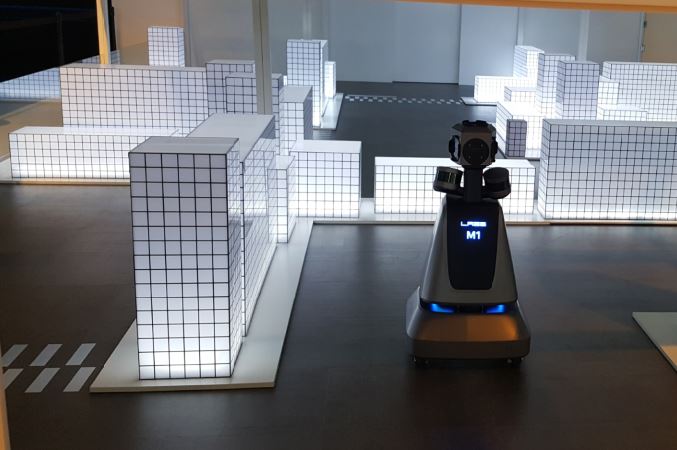
Naver has been implementing a separate TF project to integrate big data and AI technology accumulated through search services and apply them to various user services. The deep learning training data center is expected to accumulate not only search term information based on text input, but also various forms of search input information such as voice, images, and videos, along with corresponding trained background data in a database.
For example, in autonomous vehicle driving, the data center provides data that can recognize object images in the surrounding environment and proactively address risk factors. Additionally, when searching by image of a specific person, deep learning training technology is applied to optimally classify segmented big data such as gender, age, race, and facial expression of the person, enabling the provision of response information that best matches the user's search request.
Leading future-type technology platform ecosystem construction through deep learning technology sharing and various technical collaborations
The department dedicated to building Naver's training data is analyzing hundreds of thousands of materials related to road conditions, facial recognition, shopping, and other areas to construct learning data in order to increase the accuracy of information matching technology. Through this, it aims to increase the accuracy of machine learning results to nearly 100%. In particular, it expects to deliver high user satisfaction when providing AI technology-applied services such as autonomous driving, facial recognition, shopping search, and location-based travel search.
Naver also held a search colloquium in April to disclose AI technology applied to search for next-generation AI experts. Kim Gwang-hyun, Naver Search Leader, said, "This construction of the deep learning big data center is a result of consolidating Naver's distinctive capabilities as an AI technology-leading company based on unique search data," and added, "We will not only strengthen the competitiveness of user AI services in various environments, but will also lead the construction of a new technology platform ecosystem through external collaborations with research institutions."
Related news
Naver Introduces AI-Based Automatic Translation App 'Papago'
Naver has launched 'Papago,' an automatic interpretation app based on artificial intelligence technology. Papago is the result of integrating Naver Labs' accumulated research expertise in speech recognition and synthesis, machine translation, and optical character recognition with artificial intelligence capabilities. The app introduced this time supports translation across all language combinations of four languages including Korean, Japanese, Chinese, and English, and is capable of translating not only text and speech but also characters in photographs.
2016.08.09by 신윤오 기자
[Planning-Autonomous Vehicles①] Domestic Technology 'Cannot Stand Alone' - Strategic Collaboration Ecosystem Must Be Established
The most striking aspect of the 2017 Seoul Motor Show that concluded last week was the first-time participation of NAVER, a leading domestic IT company. While IT companies developing automobiles is no longer an unfamiliar sight, the appearance of a leading domestic IT company at Korea's representative auto show holds significant symbolic meaning for the automotive sector. NAVER became the first domestic IT company to receive temporary road-driving approval from the Ministry of Land, Infrastructure and Transport for autonomous vehicles. Presenting a Level 3 autonomous vehicle, NAVER is developing autonomous vehicles as part of environmental implementation with 'living environment intelligence' as its technological direction. Prior to this, Hyundai Motor presented a Level 4 vehicle where the system can safely operate without driver intervention. Hyundai achieved autonomous driving by adding only minimal sensors such as radar and LiDAR to sensors already applied in mass-production vehicles.
2017.04.10by 김지혜 기자
[Reporter's Notebook] Would you like to place an AI speaker at your father's house?
Leading companies have all taken on the role of "assistant." With Alexa, Google Assistant, Cortana and others, we now have—and will continue to have—multiple voice assistants to choose from. Amazon, which opened the voice assistant speaker market in 2014 with the Echo, has since launched the Echo Dot and Echo Look, followed by the Echo Show with a touch screen. Domestic companies are also moving actively. In the Korean market, KT and SK have launched speakers, while LG, Naver, and Kakao are in the preparation stage. SK announced that NUGU, which began sales in September of last year, has surpassed 1 million units sold. In June, SK will introduce Aibril, a Korean-type Watson developed in cooperation with IBM's Watson. An SK C&C Aibril official stated, "There were no open-type API companies in Korea, and Watson has already emerged as a strong player in natural language processing. We chose a strategy to secure data rather than allocate time to platform construction." KT's GiGaGenie has presented an integrated speaker with a set-top box to existing Olleh TV customers. Naver disclosed artificial intelligence "Clova" before launching a speaker. Kakao began artificial intelligence development by establishing Kakao Brain in February.
2017.05.22by 김자영 기자
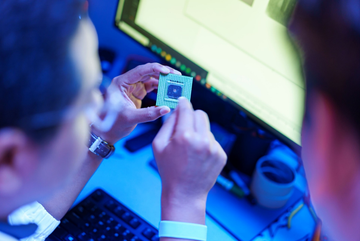
ST Microelectronics and NUS Establish Joint Research Center 'HELIX' for Edge AI
ST Microelectronics and the National University of Singapore have established the 'HELIX' joint research center aimed at implementing embedded AI in edge environments. Over a four-year period, the center will conduct research across the entire technology stack from algorithms to silicon, focusing on memory-centric architecture leveraging ST's 18nm FD-SOI technology and embedded PCM. The core objective is to implement intelligence directly in physical devices such as robots and drones while minimizing energy consumption.
2026.08.28by 배종인 기자
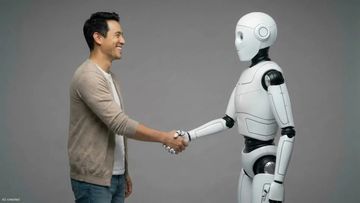
ams, Enhancing Humanoid Robot Sensing and Communication with Digital Photonics
ams OSRAM has unveiled solutions that leverage digital photonics technology to enhance the sensing and communication capabilities of humanoid robots. The company implements environmental awareness and precision manipulation through dToF sensors, optical force sensors, and structured light emitters, while supporting LED-based non-verbal communication through the EVIYOS and ALIYOS platforms. According to market research, the humanoid robot market is projected to grow from $600 million in 2025 to $51 billion in 2035, with improvements in robot sensing capabilities expected to serve as a key growth driver.
2026.08.27by 배종인 기자











