

.png)

Strengthened Bluetooth, Testing and Certification Services Enhanced
 Published2017.09.01 15:39
TTA Information and Communications Testing and Certification Research Institute to Provide Protocol Conformance Testing from January Next Year
Recently, Bluetooth technology, which has finalized mesh standards, has also enhanced its testing and certification services, establishing itself as a representative wireless communication technology in the Internet of Things era.
In this regard, the Korea Information and Communications Technology Association (TTA) Information and Communications Testing and Certification Research Institute announced its plan to expand Bluetooth testing and certification services. Currently, the TTA Information and Communications Testing and Certification Research Institute can conduct Bluetooth 2.1 to 5.0 RF/RF-PHY conformance testing, and can perform Bluetooth protocol conformance testing and Bluetooth profile interoperability testing. However, Bluetooth 5.0 version protocol conformance testing and others are available from January next year onwards.
The TTA Bluetooth Test Facility (BQTF) is an ISO/IEC 17025 accredited testing laboratory that has held the Bluetooth International Accredited Test Facility credential since May 2003 and obtained the CTIA Bluetooth International Accredited Test Facility qualification in 2009.

Regarding certification policies, the Bluetooth SIG announced TCRL (Test Case Reference List) 2017-1 in June and also disclosed the Mesh Model. Since TCRL 2017-2 is scheduled to be announced in December, users requiring Bluetooth testing and certification can refer to the new regulations. Additionally, the Bluetooth SIG has announced a new tool, BLS (Bluetooth Launch Studio), which will replace the certification tool and is scheduled to be serviced within the second half of this year. While there are no major changes in functionality, the UI has been modified and cloud features have been strengthened.
In this manner, the Bluetooth SIG plans to strengthen its testing and certification capabilities and services in the future. Accordingly, new BQTF/BRTF/BQC programs will also be announced. The Bluetooth Certification Expert (BQE) designation will be changed to BQC and must be renewed annually. The current BQE list will be removed and the BQC list will be updated.
During a Bluetooth technology seminar hosted by the association, Jung Ji-ye, a senior researcher at the TTA Information and Communications Testing and Certification Research Institute, stated, "Bluetooth RF and profile testing and certification typically takes about three weeks depending on debugging issues, while protocol testing and certification usually takes two to three months," adding that related companies should refer to this in their development schedules.
Meanwhile, Bluetooth technology version 5.0, which is currently announced by the Bluetooth SIG, has intellectual property rights regardless of whether the technology or logo is used, so certification must be obtained for use. For Bluetooth certification, membership with the Bluetooth SIG is required as a basic requirement, which includes Associate membership, Adopter membership, and IIP membership for startups and small and medium-sized enterprises, and the prescribed certification procedures must be followed.
There are separate costs for membership registration, and IIP membership can receive discounts if the company has never been certified or has annual sales of 1 billion won or less. Testing and certification costs are divided into three major categories: testing costs and listing costs (registration fees) are mandatory, while BQE review costs are separate. The scope of certification also differs significantly by end product, subsystem, and component, so it is necessary to confirm how far certification needs to be obtained according to the purpose for which the product will be developed and sold.
Related news
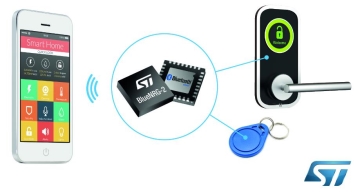
ST Expands Applications with Next-Generation BLE Chips
STMicroelectronics (hereinafter ST) has unveiled BlueNRG-2, a next-generation Bluetooth Low Energy (BLE) System-on-Chip (SoC). This new product will contribute to the proliferation of interconnected smart devices across diverse applications including home, retail, industrial, toys, gaming consoles, personal medical devices, and infrastructure. ST sees potential in Bluetooth Low Energy connectivity applications that are simple, feature-focused, and capable of operating for several months or even years on a single small battery. The new BlueNRG-2 chip can meet all these requirements through its ultra-low-power programmable processor and low-power features including ultra-low-power standby mode.
2017.07.06by 김지혜 기자
[Interview] Bluetooth 5.0, “Widely applicable from Home IoT to Advertising”
Discussions are ongoing about which field—home, factory, building, or automotive—will first adopt Bluetooth 5.0, which offers lower power consumption and extended reception distance. There is no predetermined answer. If we prioritize convenience that touches everyday life, it would likely enter Home IoT first, just as the Galaxy S8 quietly adopted Bluetooth 5.0. When Bluetooth 5.0 is integrated into door locks that previously operated on a 1:1 Beacon method through a gateway, the intermediate step is eliminated. Users can control and monitor door locks from anywhere in the home using their mobile phones. This Bluetooth connection list method reduces retransmission frequency and current consumption, enabling operation even with coin cell batteries. Then, what is the barrier to overcome for IoT activation using Bluetooth? Currently, there are no established standards for IoT applications.
2017.07.25by 김자영 기자
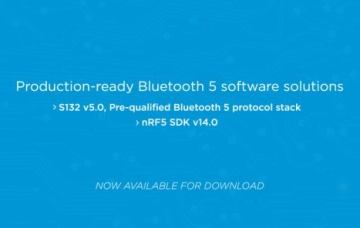
Nordic Semiconductor Launches Production-Ready Bluetooth 5 Development Solution
Nordic Semiconductor has announced the completion of preparations for S132 v5.0 and nRF5 SDK v14.0, production-ready Bluetooth 5 software solutions for its nRF52832 SoC. Through this solution, developers can implement high-performance Bluetooth 5-ready products based on the nRF52832 SoC. Nordic Semiconductor has announced the launch of S132 v5.0 and nRF5 SDK v14.0, production-ready Bluetooth 5 software solutions that enable immediate development of Bluetooth 5 products based on its nRF52832 SoC.
2017.08.18by 김자영 기자
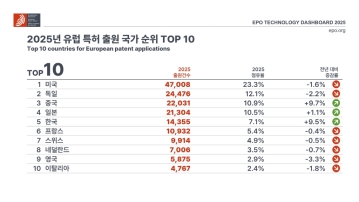
European Patent Applications Surpass 200,000 for the First Time… South Korea Maintains 5th Place, Led by Batteries and Telecommunications
According to the European Patent Office (EPO)'s 'Technology Dashboard 2025', European patent applications last year reached 201,974, surpassing 200,000 for the first time. Korean companies and inventors filed 14,355 applications, representing a 9.5% increase from the previous year and maintaining 5th place by country. Battery, digital communication, and semiconductor technologies led the growth, with Samsung ranking as the top EPO applicant for the second consecutive year and LG reaching 3rd place. The presence of major domestic cities such as Seoul, Suwon, and Yongin was also confirmed. It was also revealed that Korea's European patent strategy is expanding beyond individual technologies to span the entire industry.
2026.03.24by 명세환 기자

SK Telecom First Applies AI-Based Network Operations at Gwanghwamun K-Pop Concert
SK Telecom announced that it applied an AI-based network operation system for the first time at a large-scale K-pop concert held in the Gwanghwamun area of Seoul on March 21st, managing communication quality throughout the event. Mobile data usage during the three hours before and after the concert reached 12.15TB, approximately doubling compared to the same time slot the previous weekend. SK Telecom monitored traffic using the AI system 'A-One' in five-minute and 50-meter units to respond to potential overload situations, while also operating temporary communication facilities and on-site personnel in parallel. This case is interpreted as confirmation of the practical applicability of AI-based autonomous network operation in an environment where demand from dense events and foreign users increases simultaneously.
2026.03.23by 명세환 기자











