


KT, "Measuring Fine Dust Nationwide Using National ICT Network"
 Published2017.09.20 16:27
After Selecting 1,500 Optimal Locations Through Big Data Analysis, Will Install and Operate Until Next Year
Domestic fine dust is becoming increasingly severe. With research reports indicating that fine dust will persist for over 20 years, South Korea ranks among the worst in fine dust exposure levels among OECD countries. On the 20th, KT held a press briefing and announced plans to install IoT-based air quality measurement devices throughout the nation utilizing ICT infrastructure to address fine dust issues.
The IoT-based air quality measurement devices to be installed in cooperation with domestic specialized companies measure six types of air quality data—ultrafine dust, fine dust, volatile organic compounds, carbon dioxide, noise, and humidity—on a minute-by-minute basis.
KT's 'Air Map Korea' project will collect and analyze nationwide pedestrian traffic data, meteorological data, and hazardous facility data by year-end, and select 1,500 optimal locations from among 5 million ICT infrastructure assets (telephone poles, base stations, public phone booths, telecommunications facilities, etc.) capable of effectively measuring air quality. The measurement devices will be installed by the first quarter of next year, with data provided to the government.
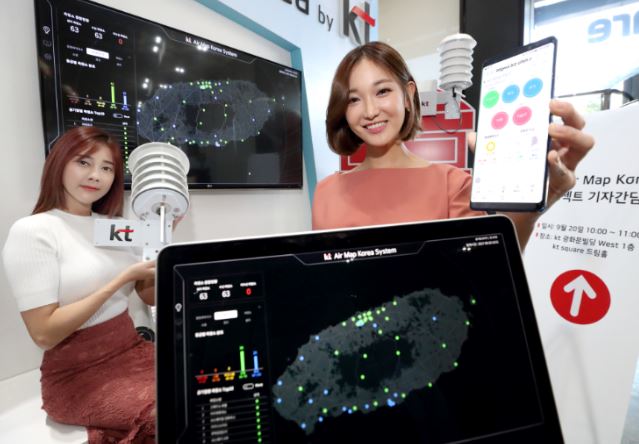
KT-operated air quality measurement devices and Jeju air quality measurement distribution map
Once air quality measurement devices are installed and big data utilization systems are established, benefits include: ▲identifying fine dust pathways to determine root causes, ▲enabling water trucks to move to areas with high fine dust concentrations, ▲selecting high-traffic pedestrian areas with elevated fine dust levels to cultivate plants effective in fine dust reduction such as moss, and ▲forecasting dispersal areas to send advance warnings.
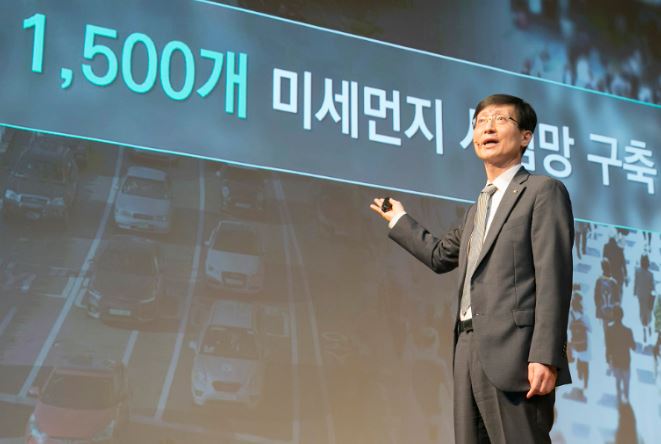
Kim Hyung-wook, Executive Vice President of KT Platform Business Planning
Kim further mentioned previous examples of KT's big data analysis technology capabilities, such as tracking infectious disease pathways and operating late-night bus services, stating: "After gaining recognition for the reliability of fine dust data analysis technology, we plan to open the data to the general public through consultation with the government so that anyone can access the information."
Related news
KT Demonstrates AI and Big Data-Based Smart Energy to the Ministry of Trade, Industry and Energy
"By applying KT-MEG to domestic energy-intensive buildings and factories, reducing consumption by just 10% can cut energy equivalent to 3.61 million TOE (Ton of Oil Equivalent)." KT demonstrated a smart energy service based on the KT-MEG platform equipped with an artificial intelligence (AI) analysis engine called 'e-Brain' to Minister of Trade, Industry and Energy Baek Woon-gyu. Minister Baek visited the KT-MEG control center located in Gwacheon, Gyeonggi Province on the afternoon of the 5th to confirm the on-site application of energy Fourth Industrial Revolution leading-edge technologies, and discussed plans to activate future energy new industries with energy specialized companies including KT, Korea Electric Power, Omni System, and I&C Technology.
2017.09.05by 김자영 기자
KT Declares Co-Growth with SMEs Through Future Convergence Technology
KT announced on the 6th that it will conduct a 'demonstration project in energy and security sectors' aimed at enhancing the competitiveness of small and medium-sized enterprises by leveraging its energy efficiency and security service platforms and technologies, targeting companies located in Incheon's Namdong Industrial Complex, which is primarily composed of manufacturing businesses.
2017.09.06by 김자영 기자
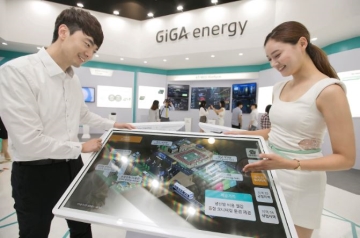
KT Unveils AI-Based GiGA Energy Service
KT will participate in the "2017 Korea Energy Expo," the nation's largest comprehensive energy exhibition held at KINTEX in Ilsan from the 19th to the 22nd, operating an exhibition booth that showcases the present and future of KT's energy business. The KT exhibition booth is composed of sections introducing KT's representative energy services centered on the ▲'KT-MEG' platform, including ▲GiGA energy manager, ▲GiGA energy DR, ▲GiGA energy Gen, and ▲GiGA energy charge.
2017.09.19by 김자영 기자
Ecolab and K-water Discuss Innovation Collaboration in Advanced Industry Water Management
Ecolab and the Korea Water Resources Corporation jointly discussed cooperation directions for maximizing water use efficiency in advanced industries such as semiconductors and data centers and establishing sustainable water circulation. The two companies agreed to gradually develop a long-term cooperation model that combines water resource infrastructure and water management technology to promote water efficiency optimization, water reuse, and carbon reduction.
2026.08.28by 명세환 기자
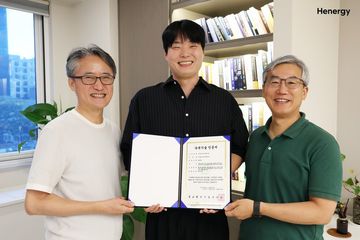
H.Energy Obtains Green Technology Certification…SolarOnCare Operating at 99.82% Uptime
H.Energy has obtained green technology certification from the Small and Medium Business Administration for solar power generation forecasting and I-V curve anomaly diagnosis technology. The AI-based asset management platform SolarOnCare is deployed across more than 3,000 power plants nationwide, achieving a system uptime of 99.82% and a 3.7% improvement in power generation performance. Through real-time data analysis, it protects power generation revenue by detecting and managing minor losses such as module degradation and partial shading early on.
2026.08.25by 명세환 기자











