


In the Hyper-connected Era, What Technology Trends Will Change Business Models?
 Published2017.12.05 17:11
2020 will be a hyper-connected society
Choi Yoon-seok, Executive Director of Gartner Korea, summarized the mobile and digital business markets and provided a 2018 outlook, explaining that the society ultimately created through the evolution of technology trends such as Intelligent, Digital, and Mesh is 'hyper-connected'.
He added, “Looking at global device shipments, mobile devices have caught up in 10 years with the volume of PCs shipped over 30 years,” stating, “This means we have shifted from a static environment to a dynamic environment, and from a device-centric information system to a data-centric system.”
With the advent of the hyper-connected era, what technology trends will change business models?
It is projected that 7 billion Internet of Things (IoT) devices will be connected by 2020. Currently, IoT is widely used for simple sensing or monitoring. However, it has high utility because it possesses attributes such as detection, data analysis, communication between objects, and acts.
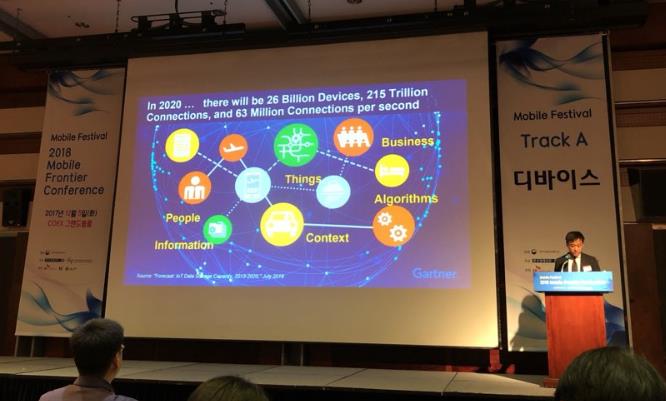
Executive Director Choi stated, “New business models are emerging as the Internet of Things and artificial intelligence are added to mobile,” adding, “2019 will be the Post-app era, dominated by conversational interfaces such as gestures and voice.”
Gartner broadly categorized technology trends into three types: Intelligent, Digital, and Mesh. For 2018, it identified the following as the top 10 strategic technologies: AI-enhanced systems, intelligent apps and analytics, intelligent things, digital twins, edge computing, conversational platforms, immersive experiences, blockchain, event-driven models, and continuous and adaptive approaches to risk and trust assessment.
The top 10 technologies defined by Gartner are selected based on three criteria: unproven technologies, technologies showing an inflection point opportunity within 2 to 3 years, and technologies with two sides.
Executive Director Choi explained, “Artificial intelligence will be applied across all industries to implement more flexible and autonomous systems,” adding that “what companies actually need to adopt, rather than General AI, is Narrow AI.” This means that instead of adopting AI capable of thinking like a human, there is a need to introduce AI that is trained by inputting data to perform specific tasks.
The introduction of such artificial intelligence becomes an important technology for creating conversational interfaces, or conversational platforms. He stated, “Interactive platforms will provide new experiences based on various senses such as sight, hearing, smell, taste, sensation, heat/humidity, and location,” adding, “The value of interactive platforms lies in technology understanding and teaching people, rather than people understanding and learning technology as they have traditionally done.”
관련뉴스
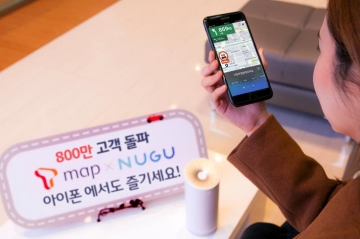
SKT's AI-powered T Map app, which understands speech, is now available on iPhone.
SK텔레콤은 말로 하는 인공지능 내비 ‘T맵x누구’의 다운로드 수가 800만을 넘어서며, T맵 전체 고객의 절반 가량이 음성인식이 가능한 내비게이션을 경험했다고 밝혔다. ‘T맵X누구’는 운전 중 화면 터치 없이 음성만으로 목적지를 검색/변경 할 수 있어 교통 안전성을 크게 높였다는 평을 받고 있다. SK텔레콤은 iOS 버전을 출시하며, 기존 안드로이드에서만 제공하던 ‘T맵X누구’ 이용 범위를 아이폰까지 확대했다. 아이폰 고객은 앱스토어에서 ‘T맵’을 다운받아 이용할 수 있으며, 기존 ‘T맵’ 사용 고객은 앱 업그레이드를 통해 바로 이용 가능하다.
2017.11.22by 김지혜 기자
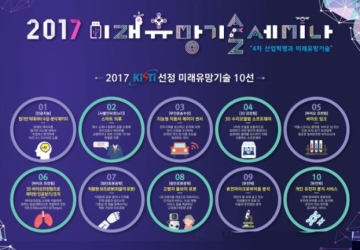
10 Things Small and Medium-Sized Enterprises Should Commercialize in the Fourth Industrial Revolution
빅데이터, 자율주행차, IoT, 인공지능까지 4차 산업혁명을 이끌 기술들은 많다. 4차 산업혁명을 준비해야 한다는 목소리는 높지만, 막상 어떤 아이템이 사업화에 적합한지는 모호하다. 이에 한국과학기술정보연구원(KISTI)은 4차 산업혁명에 대응하기 위해 중소기업들이 주목해야 할 사업화 아이템을 제시했다. 벤처캐피털 투자데이터, 시장데이터, 기술 트렌드 등을 기반으로 중소기업에 적합한지, 시장성이 있는지, 기술개발이 가능한지, 시장파급 효과가 높은지 등을 분석해 11개 분야에서 50개 기술을 선정했다. 이 중 유망사업화 아이템 10선을 소개한다.
2017.11.24by 김지혜 기자
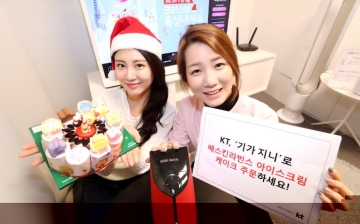
KT, “Now order ice cream from home by voice”
KT announced that it is launching a service that allows customers to order Baskin-Robbins ice cream by voice through its AI TV 'Giga Genie' by linking it with SPC Group's 'Happy Order'. 'Happy Order' is a mobile ordering service provided by SPC Group that enables customers to order various SPC brand products including bakery items, ice cream, hamburgers, pizza, and coffee through the 'Happy Point' app and pick them up at stores or have them delivered. KT will first provide a Baskin-Robbins ice cream cake pre-reservation service through the Happy Order service linked to Giga Genie until the 15th. For example, when a customer says "Genie, order me a Baskin-Robbins ice cream cake," a push notification message is sent to the Giga Genie app installed on the mobile device. Clicking the notification message launches the Happy Point app and connects to the Christmas ice cream cake reservation page for Giga Genie customers. Pre-ordered ice cream can be picked up at stores from the 19th to the 24th.
2017.12.04by 김지혜 기자
Nvidia invests $5 billion in Intel
NVIDIA and Intel, leaders in global AI computing technology, are now forging ahead in providing cutting-edge solutions through NVLink-based architecture integration. NVIDIA and Intel have officially announced a strategic partnership and stated that they will jointly develop customized data center and personal computing products to accelerate diverse applications and workloads ranging from hyperscale to enterprise and consumer markets, thereby laying the foundation for the next generation computing era.
2025.09.22by 배종인 기자
.jpg)
Applied Materials Launches Environmental Protection Campaign to Mark World Cleanup Day
어플라이드 머티어리얼즈 코리아(대표 박광선)가 ‘세계 청소의 날(World Cleanup Day)’을 맞아 동탄 신리천 일대에서 임직원 및 가족과 함께 환경 정화 활동을 펼치며, 기술 혁신을 넘어 지역사회와 함께하는 기업으로 거듭나고 있다.
2025.09.22by 명세환 기자











