


"There is no second place in the autonomous vehicle market; cooperation is the only way to survive"
 Published2018.02.12 14:36
Lack of core technology and software makes it difficult to enter as a latecomer.
Currently, the domestic autonomous vehicle industry lacks both technology and regulations. Testbeds and related personnel have also not been secured.
With forecasts emerging that four out of ten new cars will be autonomous vehicles by 2030, opinions have been raised that the future of the domestic autonomous vehicle industry is not bright.
Lee Hang-gu, a senior research fellow at the Korea Institute for Industrial Economics and Trade, explained, “Countries such as the U.S., the U.K., and China have roadmaps for autonomous vehicles. Korea, however, lacks a roadmap that encompasses the entire autonomous vehicle industry.” He added, “While roadmaps in other countries include all aspects of the industry, such as technology and demand, Korea views technology and demand separately, resulting in frequent changes to the technology roadmap.”
According to the 'Autonomous Vehicle Readiness Index Report' released by KPMG International, South Korea ranked 10th out of 20 countries. It ranked 14th in policy and regulations, 11th in consumer acceptance, 9th in technology and innovation, and 4th in infrastructure.
The researcher stated, “Autonomous vehicles are driven by multi-convergence and the convergence of science, not independent growth. Small and medium-sized enterprises (SMEs) should take the lead rather than large corporations,” adding, “The biggest problem is the lack of core technology and software. Without technology, it will be difficult to even catch up as a latecomer.”
Due to the limitations of fuel efficiency reduction technology for internal combustion engine vehicles and environmental concerns, autonomous vehicles are expected to use electric power. Accordingly, the United States is developing 350kW fast chargers with large-scale investment. Japan is conducting research on autonomous vehicles using hydrogen fuel cells, led by Toyota. Europe and India have gradually begun restricting fossil fuel vehicles.
The researcher pointed out that while the electric vehicle parts market itself is expanding as powertrain technology, lightweighting, aerodynamics, and friction loss reduction become increasingly important, domestic companies are failing to respond. Furthermore, stating that “the landscape of the autonomous vehicle industry is not determined by automakers,” the researcher emphasized the shift from automobile manufacturing to smart mobility services.
He explained, “The domestic autonomous vehicle market’s heavy dependence on existing automakers is due to the failure of policies and the lack of a formed market.” He added, “Compared to the number of EVs in circulation, there are many fast-charging stations installed here compared to other countries. The problem is that due to a lack of promotion, few people are properly aware of and use them. For the autonomous vehicle market, it will be crucial how the initial market is formed based on consumer demand.”
The Ministry of Land, Infrastructure and Transport aims to establish a foundation for Level 4 fully autonomous driving in stages by 2026. Accordingly, it is pursuing policies such as unmanned shuttle pilot projects, the construction of road infrastructure (C-ITS), precision maps, safety standards, and insurance/recall systems.
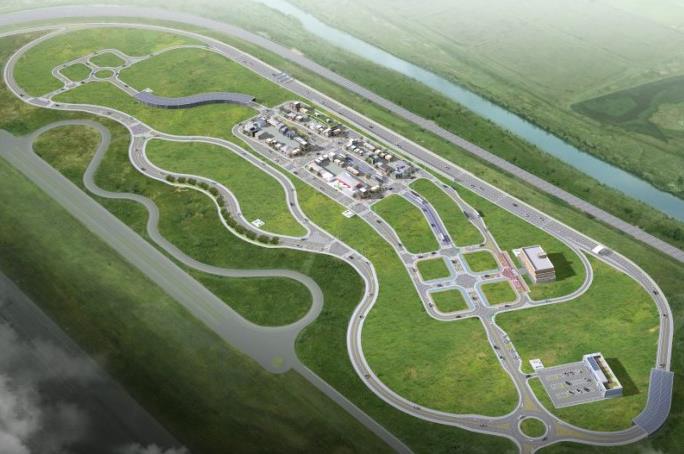
K-City, which is set to be fully opened this year, is a testbed that reflects various environments ranging from urban centers and parking facilities to expressways and outer roads. C-ITS is also planned to be expanded to enable traffic monitoring via V2I on expressways nationwide by 2020. High-precision 3D map information is also being made available to the public for free to support the development of autonomous vehicles.
The researcher pointed out, “K-City cannot conduct tests under extreme conditions. It only has straight tunnel courses. The autonomous vehicle test track under construction in Willow Run, USA, allows for testing even in extreme situations through high-speed driving and curved tunnels,” adding, “While it may be possible to create high-precision maps for the domestic market, creating maps for the entire world is difficult.”
He predicted that future cars would run on data rather than fuel. “We must view the autonomous vehicle industry pessimistically and prepare accordingly. Entering the market before its direction is determined is a problem, but entering too late is also a problem. There is no second place in this market,” he emphasized. “Since it is dominated by core technology and software, imitation is difficult, so there is no possibility as a latecomer. We must expand the market not only domestically but also overseas and catch up through cooperation.”
Comments
Related news
Self-driving cars have driven 190,000 kilometers in Korea.
The Ministry of Land, Infrastructure and Transport announced the driving performance of autonomous vehicles that received temporary operation permits for research purposes in 2017. The temporary operation permit system for autonomous vehicles was introduced starting in February 2016, and by the end of last year, 30 autonomous vehicles from 17 institutions had received permits.
2018.01.19by 김지혜 기자
Smart City/Autonomous Vehicle/Drone Deregulation Accelerates Growth
The Ministry of Land, Infrastructure and Transport has announced the direction and tasks for regulatory innovation regarding △smart cities △autonomous vehicles △drones, which are leading innovation growth initiatives. As new technologies and industries are being introduced, there are concerns about safety and security. Taking these points into consideration, measures have been reviewed to establish safety standards and enable their timely introduction. In particular, in the process of establishing these systems, the Ministry plans to have opportunities for exchanging opinions with the private sector, including industry and civic organizations, in order to build public consensus.
2018.01.23by 김지혜 기자
Stop worrying about accidents and emergencies with 5G autonomous vehicles!
SK Telecom (hereinafter SKT) Park Jin-hyo, Head of ICT Technology, said at a 5G autonomous vehicle demonstration conducted by SKT and the Korea Road Traffic Authority, "I am pleased to be able to showcase 5G technology," and "Through autonomous driving, we will prevent traffic accidents and create a world without accidents, improving quality of life." For safe and convenient autonomous vehicle operation, which SKT emphasized on this day, 5G implementation is essential. At CES 2017, Intel announced a 5G modem, signaling innovation in various fields such as wireless broadband and the Internet of Things. 5G, which is a concern for mobile carriers, the automotive industry, and various companies, has the following characteristics in autonomous vehicle operation.
2018.02.08by 김학준 기자
Signal-level HIL Solution for EV Power Conversion Controllers, NI ITS
EV power conversion circuits are becoming faster and more complex with SiC and GaN application and X-in-1 functional integration, and ECU verification requires the capability to simulate circuit behavior at nanosecond-level resolution in real time. This white paper organizes the position of signal-level HIL (sHIL) in the development flow and describes the hardware and software architecture, model implementation workflow, and application boundaries of NI ITS (Inverter Test System), which responds to this requirement through FPGA-based real-time simulation, based on webinar materials.
2026.10.16by 편집부
Microchip and Elektrobit Join Hands on AUTOSAR Solution
Microchip Technology and Elektrobit have unveiled a collaborative solution with pre-integrated automotive hardware and AUTOSAR software. With MCAL software based on EB tresos, the solution can reduce development effort for OEMs and Tier 1 suppliers and accelerate time-to-market. The two companies will employ an "Integration-as-Code" automation method to lower integration risk while beginning support in the Asian two-wheeler market.
2026.10.16by 배종인 기자











