



ARM Disrupts SIM Card Business with Integrated IoT SoC Architecture at MWC 2018
 Published2018.02.26 15:40
Integration of MCU, Cellular Modem, and SIM Identity into a Single IoT SoC
Devices that must support all communications regardless of CDMA or GSMA currently require SIM card insertion. Each telecom provider provides individual identity, which is used as the device's unique communication key. However, once a current SIM card is issued, changing the telecom provider or individual device identity is impossible without physically replacing the SIM card.
This is not a problem for small quantities of devices or personal mobile devices. However, when the number of connected devices based on IoT increases to over 1 trillion by 2035, the situation changes.
ARM, which designs low-power, high-efficiency semiconductor architecture, will announce ARM Kigen OS and CryptoIsland, which integrate SIM cards, at the MWC 2018 keynote. ARM's integrated SIM identity will target IoT cellular connectivity communication devices to be used in smart cities, connected rural areas, and digitalized industrial environments.
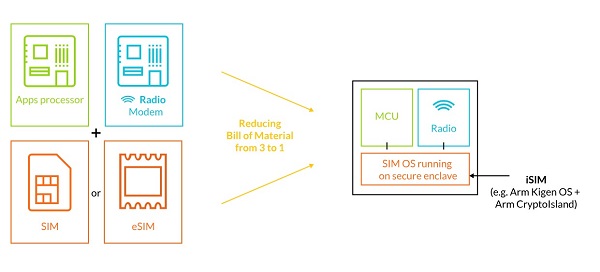
Arm Kigen OS and CryptoIsland providing secure identity to cellular IoT devices
An ARM official stated, "In addition to the existing physical SIM replacement issue, conventional SIM technology has difficulties in applying to small IoT devices in situations with large deployment scale and cost sensitivity. As the IoT market grows, simplification and cost efficiency are essential to ensure transparency and compatibility in credential management," suggesting that the evolution toward embedded SIM (eSIM) and the latest integrated SIM (iSIM) form factor stages is important in providing secure identity to cellular IoT devices.
Based on these issues and development directions, ARM explained that by utilizing hardware security on-chip (On-Chip) solutions such as ARM's CryptoIsland along with service providers' cellular IoT applications, microcontrollers (MCU), cellular modems, and SIM identity can be integrated into a single IoT SoC.
According to a 2017 Machina Research report, up to 4.4 trillion IoT devices are expected to support cellular connectivity by 2025. ARM highly evaluates this cellular IoT market potential and is collaborating with major companies such as BT, SoftBank, and Sprint for concrete market approaches.
Paul Williamson, General Manager of ARM's IoT Device IP Business Division, said, "ARM's technology will enable a new level of cellular IoT integration, allowing companies in the cellular IoT ecosystem to build new services, businesses, and revenue streams."

Comments
Related news

New ARM processor announced to boost AI performance 50-fold within the next 5 years
ARM has launched the Cortex-A75 and Cortex-A55, the first processors designed based on ARM DynamIQ technology announced in March, and also introduced the ARM Mali-G72 based on the Bifrost architecture. ARM DynamIQ technology, first unveiled in March, was the first milestone toward distributed intelligence from chip to cloud. The ARM Cortex-A75 and Cortex-A55 processors, designed based on this technology, set a goal to improve AI performance by 50 times within the next 3-5 years and are equipped with dedicated instruction set features necessary for AI performance work through DynamIQ technology.
2017.05.30by 신윤오 기자
ARM Announces Platform for Building Secure Connected Devices
Arm has announced the Platform Security Architecture (PSA), the industry's first universal industrial framework for building secure connected devices. Masayoshi Son, Chairman of Arm and SoftBank, previously announced at last year's Arm TechCon event that the number of connected devices is expected to reach 1 trillion by 2035. Ahead of the Arm TechCon 2017, which runs for four days starting today, Arm has now announced measures to protect these 1 trillion devices. To realize this vision, people worldwide must acquire greater knowledge about device security, and the IT industry must be confident that it is doing its best to protect devices and data. Fighting hackers who continually seek vulnerabilities to penetrate users' lives, and establishing trust with users is not an easy task for enterprises.
2017.10.25by 김지혜 기자
Arm: "We will provide IoT device security and data management gateway solutions."
With the proliferation of the Internet of Things (IoT), security concerns for connected devices have become a key issue. IoT lacks unified standards, making management difficult. There are also risks of connection disconnection and hacking. To address these network connectivity and security issues, ARM has proposed a universal industry framework. ARM held the 'ARM Tech Symposia 2017' on the 28th at the Grand InterContinental in Gangnam-gu, Seoul, and announced that it has expanded the capabilities of Mbed Cloud, which enables devices to be deployed, controlled, and managed through an IoT gateway. Nandan Nayampalli, head of ARM's Client Computing division, stated, "Over the past two years, cases of hacking tire pressure monitoring systems and security cameras have been increasing," and emphasized that "security in IoT design is now a requirement, not an option."
2017.11.29by 김지혜 기자

[Technical Contribution] Mouser: "AI Agents Help Accelerate and Standardize Industrial Field Maintenance Operations"
Abhishek Jadhav from Mouser Electronics discusses how to leverage agentic AI for predictive maintenance in industrial automation.
2026.10.23by 편집부

Schneider Electric Unveils Modular Power Solution for AI Data Centers
Schneider Electric has launched prefabricated power modules and power skids for AI data centers, jointly developed with NVIDIA. Based on the GB300 NVL72 reference design, the solution applies standardized design and factory pre-fabrication methods to build power infrastructure in as little as 6 months. Galaxy VXL UPS technology is integrated, with capacity options ranging from 2MW to 2.5MW.
2026.10.23by 배종인 기자











