


ADI Launches 44GHz Silicon Switch
 Published2018.06.08 09:32
ADI Launches 44GHz Silicon Switch
Achieves Industry-Leading Insertion Loss in Compact LGA Package
Adopts Proprietary Reflective Architecture, Operating Temperature Range –40 ~ 105°C
Analog Devices announced the launch of new 44GHz SPDT (single-pole, double-throw) switch products ADRF5024 and ADRF5025, manufactured based on the latest SOI (silicon-on-insulator) technology.
Both switch products offer a wide frequency range, insertion loss better than 1.7dB, and channel-to-channel isolation of 35dB. The frequency response range of ADRF5024 is 100MHz ~ 44GHz, while ADRF5025 is 9kHz ~ 44GHz.
Both products support a rated power of 27dBm in both continuous operation and hot switching modes.
These new products are supplied in a compact surface-mount (SMT) package measuring 2.25mm x 2.25mm with very high reliability, and provide superior electrical performance compared to conventional solutions.
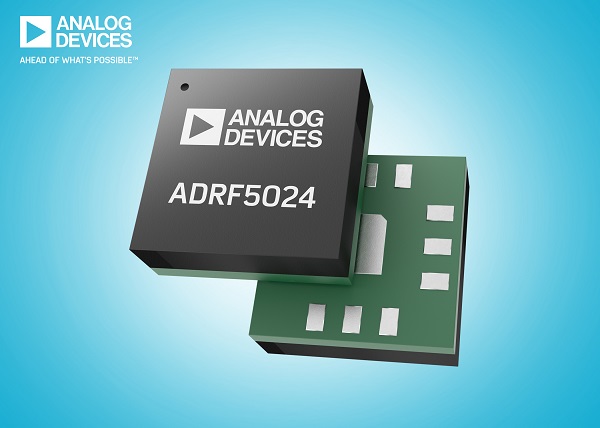
ADI's 44GHz Silicon Switch / 2.25mm * 2.25mm Size
Accordingly, RF and microwave design specialists can reduce bias power in phased array systems, portable test equipment, high-resolution body scanners, and next-generation millimeter-wave communication infrastructure for emerging 5G and large-scale satellite constellation networks, eliminating the need for peripheral components and further increasing integration levels.
ADRF5024 and ADRF5025 adopt a proprietary reflective architecture and are designed to operate over a temperature range of –40°C ~ 105°C.
Each pin includes robust ESD (electrostatic discharge) protection. These devices typically operate with ±3.3V power supply and consume low current typically below 120µA.
Additionally, by using standard positive logic control voltage, interface design is simplified. ADRF5024 and ADRF5025 do not require external components for bias generation or matching, and the signal pins are internally biased to the ground (GND) reference, eliminating the need for DC blocking capacitors, making them ideal for replacing PIN diode-based components.
ADRF5024 is optimized for high-speed switching applications requiring speed below 10ns and edge speed of 2ns, while ADRF5025 is optimized for UWB (ultra wideband) applications with excellent low-frequency characteristics below 9kHz. Since all other characteristics are identical, the two products are drop-in replaceable with each other and compatible on the same PCB footprint.

관련뉴스
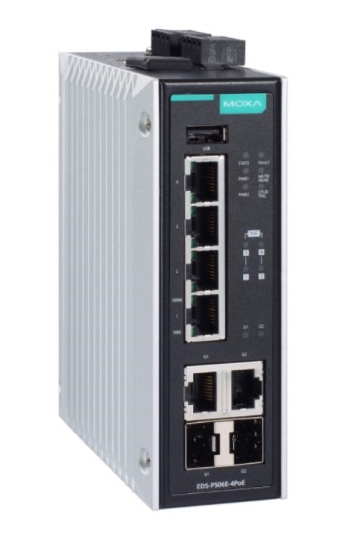
Moxa Launches Switch Series for IP Cameras Operating in Harsh Environments
Moxa announced the launch of the EDS-P506E-4PoE series, a PoE switch product. These products deliver up to 60W per PoE port for integrated data and power transmission. The power output is designed to be suitable for IP cameras using power-consuming functions such as PTZ, lighting, heaters, and fans in harsh environments. The EDS-P506E-4PoE switch product features built-in device-level cybersecurity, remote control capability, and powered device (PD) monitoring functionality required when operating in industrial applications such as highways, roadsides, and public facilities.
2018.04.10by 김지혜 기자
2MHz Boost/SEPIC/Inverter with 2A, 100V Power Switch and 9µA IQ Launched
Burst mode operation characterized by ultra-low quiescent current and low ripple, achieving IQ = 9μA Programmable and synchronizable over 300kHz ~ 2MHz frequency range
2018.05.29by 명세환 기자

STMicroelectronics Launches Highly Integrated Quad Low-Side Switch IPS4260L, Offering Versatile Diagnostic Capabilities for Smart Automation
ST has released a new quad low-side intelligent power switch IPS4260L. The product features four 260mΩ TYP RDS(ON) power switches and protection functions in a space-efficient package with enhanced thermal performance, improving efficiency and reliability in industrial automation applications.
2018.06.04by 명세환 기자

Intel Unveils Next-Generation 'Core Ultra Series 3' and vPro Platform for Enterprise PCs
Intel has officially unveiled the "Intel Core Ultra Series 3" for next-generation enterprise PCs and the latest vPro platform, addressing a wide range of demands from enterprise notebooks to high-performance workstations.
2026.03.26by 배종인 기자
ROHM Launches ESD Protection Diode Compatible with High-Speed Interfaces of 10Gbps or Higher
Semiconductor specialist ROHM has developed the 'RESDxVx series' of ESD (electrostatic discharge) protection diodes capable of responding to next-generation high-speed data communication environments exceeding 10Gbps, simultaneously enhancing both signal quality maintenance required in high-speed interfaces and IC protection performance.
2026.03.26by 배종인 기자











