



iMachine's "Beginner's Electronic Circuit Part 1" - The 3 Elements of Electricity
 Published2018.07.30 20:28
1. 전압 (V)
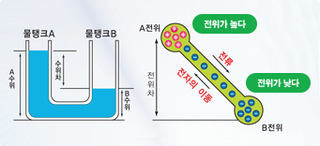
두 점간의 전위차(Potential)를 말하며 전류를 흐르게 하는 힘입니다.
개념적으로 아래 그림의 A, B의 물탱크가 있을 때 두 물탱크의 수위의 차이가
전압이라고 보시면 됩니다. 물탱크 A의 수위가 높으면 물탱크B 가
받는 압력의 크기는 커지게 됩니다.
이와 같이 전압이 높으면 흐르는 전기의 힘도 강해지게 됩니다
단위로는 Volt로 쓰고 기호는 “V” “mV” 입니다. (1V=1000mV)
그럼 1V는 어느 정도의 힘일까요?
1V는 1A의 전하량을만들어 낼 수 있는 압력입니다.
1V는 1W의 일에해당됩니다
여기서 와트(W)는 전기의 힘 즉 전력의 단위입니다.
전력은 와트(W) 또는 킬로와트(kW)를사용하며, 1W는 1A(암페어)의 전류가 1V(볼트)의 전압이 걸린 곳을 흐를 때
소비되는 전력의 크기입니다.
1W=1J/s
1J 는 1뉴튼의물체를 1m움직이는 데 필요한일입니다.
또한 1N은 1Kg 질량의물체를 초당 1미터씩 움직이는 데 필요한 힘입니다.
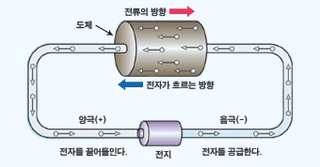
전류는 도체를 흐르는 전하의 량을말합니다.
전자의 전하량의 단위는 쿨롱(Coulomb)이며 1쿨롱(C)은 6.25x10¹⁸(625경)개의 전자가 가지는전하량을 말합니다.
전류의 단위는 암페어(A)라는단위를 사용하여 표시합니다. (1A=1000mA)
1A는 1초에 1쿨롱의 전하량이 흘러가는 것을 말합니다.
3. 저항 (R)
전류는 자유전자의 흐름이며 자유전자가 이동할 때 원자핵의 인력과 다른 자유전자의 척력에 방해를 받게 됩니다. 이러한 전류 흐름의 방해요소를 저항이라고 하며 도체를 포함한 모든 물질은 저항이 있습니다. 저항이 작아 전기가 잘 흐르는 물질을 도체라고 하며, 저항이 커서 전기가 잘 흐르지 않는 물질을 부도체라고 하며 그 중간영역을 반도체라고합니다.
저항이 “0”에 가까운 물질을 초전도체라고 합니다.
전압이높을수록, 전류가 많을수록, 저항이 작을수록 전기의 힘은 커진다고 할 수 있습니다..
저항의 단위는 "옴"(Ohm, 기호 Ω)을 사용합니다.
1V의 전압을 가했을 때 1A의 전류가 흐르는경우의 저항을 1Ω이라 하며 1000Ω은 1kΩ(킬로오옴), 1000kΩ은 1MΩ(메가오옴)이라 합니다.
전자회로에서는 사용하는 부품의 허용전류에 맞춰 저항 소자를 사용하게 됩니다.
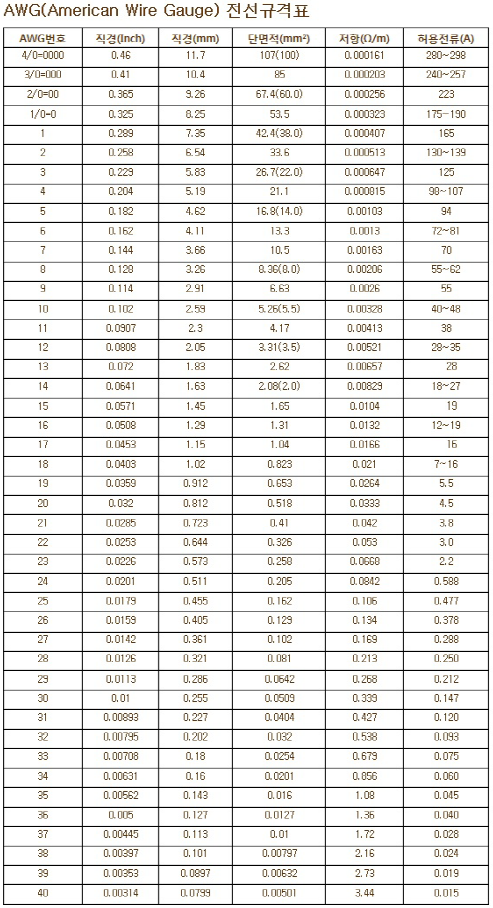
저항의 성질은 아래 그림처럼 같은물질일때 단면적이 클수록 저항이 작고. 길이가 길수록 저항이 커지게 됩니다. 그러므로 저항은 물질의 종류에 따라 다르고(원자 구조가 다르므로) 전선의 굵기에 반비례하고 전선의 길이에 비례하는 값을 갖게 됩니다

아래의 표는 미국의 전선 규격표이며 선의직경은 외피를 제외한 직경입니다.
선의 길이가 길 때는 저항 및 허용 전류를 고려해야 합니다.
전자 회로에서는 보통 AWG24~AWG28을 많이 사용합니다.

Comments 1
1 Comments:
Related news

The financial services industry is the most active in adopting hybrid cloud.
Nutanix announced the cloud adoption status and outlook for the financial services industry through its Enterprise Cloud Index report. According to a survey of current hybrid cloud adoption rates by industry, the financial services industry's hybrid cloud adoption rate was 21%, which was higher than the industry average of 18.5%. Financial services companies are facing the challenge of providing differentiated experiences to customers through methods such as leveraging emerging technologies like blockchain, while simultaneously simplifying operations.
2019.04.02by 이수민 기자

IBM Blockchain World Wire… Real-time global financial payment network expands to over 50 countries worldwide
IBM announced on the 19th the expansion of IBM Blockchain World Wire, a real-time global financial settlement network for financial institutions. World Wire was developed to accelerate and optimize foreign exchange transactions and cross-border payment and remittance speeds. Additionally, it integrates payment message transmission, clearing, and settlement procedures into a single network while supporting network participants in selecting various types of digital assets for settlement. Starting from the 19th, the payment service area will be expanded to 72 countries, including 47 global currencies and 44 financial endpoints. Busan Bank became the first domestic bank to join World Wire.
2019.03.19by 이수민 기자
MSIT and KISA to Achieve Transparent Donation Culture and Guarantee Reliability in Used Car Market via Blockchain
The Ministry of Science and ICT and the Korea Internet & Security Agency will launch a private-led national project for the first time this year to create an initial market for blockchain. This private-led national project, promoted as part of the Ministry of Science and ICT's blockchain development strategy, is an initiative that supports the development of blockchain services applicable to real-life use cases and facilitates early commercialization based on creative ideas from the private sector. Through an evaluation committee composed of private sector experts, three consortiums were selected as preferred negotiation partners after careful evaluation of feasibility and the degree of improvement through blockchain application. Following technology consultations and agreement execution in mid-March, a project worth a total of 8.7 billion won is scheduled to commence.
2019.03.04by 이수민 기자
Cyberattacks in 2018: Ransomware Declines, Cryptojacking Increases
Ransomware used in cyber attacks declined significantly over the past year, while the number of cryptojacking attacks nearly doubled that of ransomware attacks. According to a report released by IBM X-Force Security Research on the 27th, cryptocurrency-related cryptojacking cyber attacks showed the largest increase over the past year. In the fourth quarter of 2018, attempts to install ransomware on devices decreased by 45% compared to the first quarter, while the growth rate of cryptojacking attacks reached 450%, an increase of more than four times during the same period. This indicates that as cryptocurrency prices surged last year, hackers illegally mined cryptocurrency using victims' computers and generated profits through this activity.
2019.02.28by 이수민 기자
Akamai and a leading Japanese financial group have jointly launched a blockchain-based online payment network.
Akamai will establish GO-NET, a joint venture company with Japan's Mitsubishi UFJ Financial Group. Through this joint investment, both companies plan to not only expand their cooperative relationship but also provide a new blockchain-based online payment network that strengthens next-generation payment security and enhances scalability and response speed. Akamai has demonstrated BaaS technology through decades of experience accumulated in developing and building globally-scaled distributed systems, along with industry-leading performance and security services. Mitsubishi UFJ Financial Group leverages its global influence and expertise to provide financial services on a worldwide scale.
2019.02.18by 이수민 기자












감사합니다.