


Implementation of the 'ICT Convergence and Industrial Convergence Regulatory Sandbox System' to indiscriminately block regulations on new technologies and services
 Published2019.01.21 09:01
Application for mobile electronic notifications, urban hydrogen refueling stations, etc.
Deliberation on granting special exemptions is scheduled for February following the preliminary review committee.
The Ministry of Science and ICT and the Ministry of Trade, Industry and Energy announced that the regulatory sandbox system will be fully implemented as the 'Information and Communications Convergence Act' and the 'Industrial Convergence Promotion Act,' which serve as the legal basis for the ICT convergence and industrial convergence regulatory sandbox systems, came into effect on the 17th (Thursday).
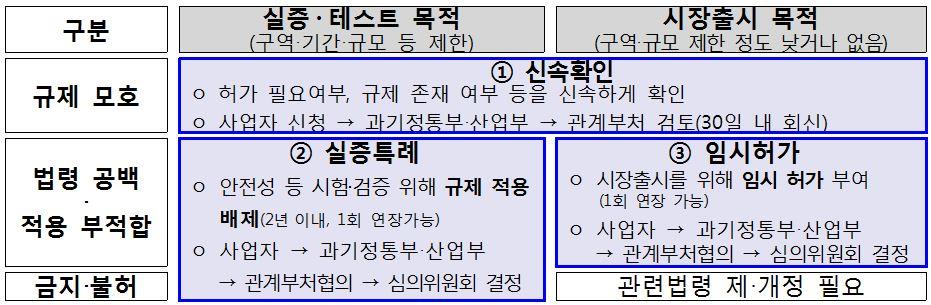
Application Requirements and Procedures for the 3 Types of Regulatory Sandbox Systems
A regulatory sandbox is a system that supports the demonstration (special exception for demonstration) or market launch (temporary permit) of rapidly emerging new technologies and services, provided that they do not jeopardize the lives and safety of the public, despite existing laws or regulations.
The Ministry of Science and ICT and the Ministry of Trade, Industry and Energy revised the enforcement decrees on January 8, after the Information and Communications Convergence Act and the Industrial Convergence Promotion Act passed the National Assembly on September 20 of last year.
The two departments have been conducting a series of briefing sessions for companies in cooperation with the Korea Chamber of Commerce and Industry ('18.11.7), the Korea Startup Forum ('18.11.9), and the Korea Venture Business Association ('18.11.16) to help companies better understand the regulatory sandbox system.
Regulatory Sandbox homepage screen
In addition, a dedicated website was launched on December 31 of last year to provide guidance on the regulatory sandbox process, including expedited processing, temporary permits, and special demonstration exceptions, and a consultation center was established to assist with legal and technical interpretations and the establishment of plans for special demonstration exceptions.
Application for mobile electronic notifications, urban hydrogen refueling stations, etc.
The Ministry of Science and ICT and the Ministry of Trade, Industry and Energy announced that they received a total of 19 applications from companies on the first day of the implementation of the regulatory sandbox system.
The cases received on the first day of implementation were from companies that had previously expressed their intention to apply for the regulatory sandbox system through explanatory sessions and consultation centers for companies, and the Ministry of Science and ICT and the Ministry of Trade, Industry and Energy have supported the drafting of applications and legal and technical reviews.
KT and Kakao Pay have each applied for temporary permits at the ICT Convergence (Ministry of Science and ICT) Regulatory Sandbox to "promote mobile electronic notifications for public institutions, etc."
Until now, public institutions such as the National Pension Service and the National Police Agency have carried out notification duties via paper mail. However, by utilizing mobile electronic notifications, recipients can receive information easily and quickly via KakaoTalk alerts or text messages.
However, for mobile electronic notifications, it is necessary for public institutions to send information they possess to an accredited electronic document intermediary (hereinafter referred to as the "intermediary," such as KT or KakaoPay), and for the intermediary to obtain the user's consent and compare it with information already secured.
While the Korea Communications Commission and others agree on the need to "promote mobile electronic notifications," there were limitations due to the lack of relevant regulations in the Information and Communications Network Act and other relevant laws. If temporary approval is granted by the deliberation committee in the future, mobile electronic notifications for public and administrative agencies are expected to be activated through KT (MMS) and Kakao Pay (KakaoTalk notifications).
In addition, startups and small and medium-sized enterprises have applied for nine temporary permits and demonstration exceptions, including 'blockchain-based overseas remittance service (Moin)', 'VR truck (VRisVR)', 'online scrap car quote comparison service (Joins Auto)', 'online service for brokering prospective clinical trial participants (Olive Healthcare)', and 'sensor detection signal transmitter-based maritime distress signal device (Blockstone)'.
A representative case of the regulatory sandbox in the industrial convergence sector (Ministry of Trade, Industry and Energy) was Hyundai Motor Company's request to install hydrogen vehicle charging stations in urban areas.
Hyundai Motor has requested temporary permits and special demonstration exceptions for the installation of hydrogen vehicle charging stations in five areas of Seoul, taking into consideration the convenience and accessibility for hydrogen vehicle drivers.
Currently, the application areas cannot install hydrogen refueling stations due to regulations such as location restrictions and building coverage ratio limits under the 'National Land Planning and Utilization Act' and the 'Seoul Metropolitan City Urban Planning Ordinance,' separation distance restrictions under the 'High-Pressure Gas Safety Management Act,' and land lease restrictions under the 'Public Property and Goods Management Act.'
The Ministry of Trade, Industry and Energy plans to review and discuss whether to grant special demonstration exceptions or temporary permits to allow the installation of hydrogen refueling station infrastructure in some of the applicant areas, in consultation with relevant agencies such as the Seoul Metropolitan Government and the Ministry of Land, Infrastructure and Transport.
In addition, in the field of industrial convergence, 10 applications for demonstration exceptions and temporary permits were received, including 'personalized health promotion service through genomic analysis (Macrogen)', 'digital signage bus advertising (JG Industry)', and 'electric vehicle charging billing outlet (Charge In)'.>
The Ministry of Science and ICT and the Ministry of Trade, Industry and Energy predicted that applications would continue in the future in fields such as smart medical devices, new energy industries, the Internet of Things, and O2O.
Deliberation on granting special exemptions scheduled for February
Applications received undergo review by relevant ministries (within 30 days) and a preliminary review committee, followed by deliberation and resolution by the 'New Technology and Service Deliberation Committee (chaired by the Minister of Science and ICT)' and the 'Special Regulatory Exemption Deliberation Committee (chaired by the Minister of Trade, Industry and Energy),' respectively, to determine whether temporary permits or special demonstration exemptions will be granted.
The Review Committee plans to deliberate in depth on whether it is appropriate to grant demonstration exceptions or temporary permits for the applications, taking into comprehensive consideration the innovativeness of new technologies and services, public convenience, as well as the protection of public life and health and personal information.
The Ministry of Science and ICT and the Ministry of Trade, Industry and Energy plan to appoint members of the deliberation committee in January and hold committee meetings as early as February to deliberate and decide on the prepared agenda items.
In principle, the deliberation committee will hold meetings at least once per quarter, but during the first six months of implementation, it plans to hold meetings frequently to generate results and ensure the system is established.
Meanwhile, the Ministry of Science and ICT and the Ministry of Trade, Industry and Energy plan to strengthen customized policy support for the substantive operation of the system and active support for companies.
At the application stage, support for the overall process of applying for the regulatory sandbox, including one-on-one legal and technical consultations, is provided through the already established consultation centers (ICT 043-931-1000, Industrial Convergence 02-6009-4092). At the deliberation stage, sector-specific preliminary review committees are activated to allow businesses to sufficiently explain the necessity of regulatory exceptions.
During the demonstration phase, customized support for startups and SMEs will be implemented. Business operators who have received special exemptions for demonstration projects will be provided with customized funding necessary for business development, such as prototype production and analysis of test and verification data (a total of 1.2 billion won per ministry in 2019, with a maximum of 120 million won per company).
We also plan to provide matching support for the insurance premiums of liability insurance that companies granted temporary permits or special demonstration exceptions must subscribe to for user protection (a total of 300 million won per ministry in 2019, with a maximum of 15 million won per company).
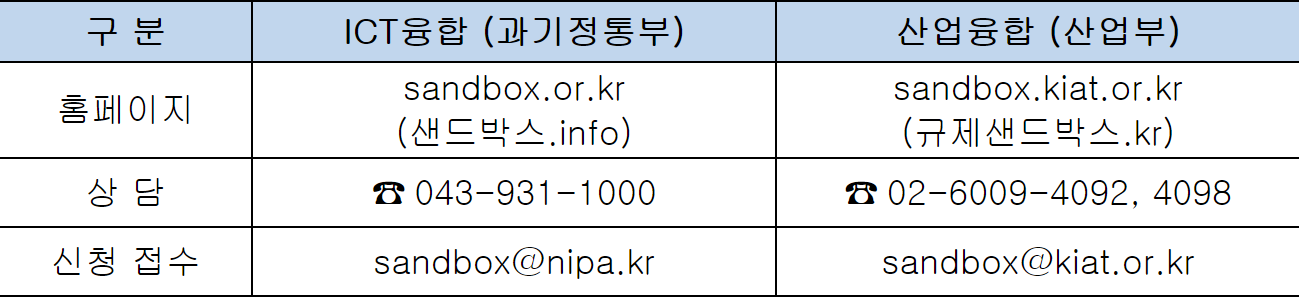
Regulatory Sandbox Website, Consultation, and Application Center
The Ministry of Science and ICT and the Ministry of Trade, Industry and Energy plan to continue communicating with companies and providing guidance and consultation on systems by continuing to hold consultations and information sessions.
Comments
Related news
Starting next year, performance certification fees for SME products will be lowered by up to 25%.
The Ministry of SMEs and Startups signed a "Memorandum of Understanding on Strengthening Market Access Support and Activating Performance Certification for Technology Development Products of SMEs" on the 4th with the Korea Chemical Convergence Test and Research Institute, Korea Mechanical and Electrical Electronics Test and Research Institute, Korea Construction and Living Environment Test and Research Institute, and Korea Industrial Technology Test Institute at the Korea Federation of SMEs in Seoul. Through this agreement, test and research institutes plan to reduce service fees by 20% or 25% for acquiring performance certification starting from January 1, 2019.
2018.12.05by 이수민 기자

The Ministry of Science and ICT and the Ministry of Foreign Affairs plan to complete the blockchain-based notarization system for overseas diplomatic missions by the end of this year.
The Ministry of Science and ICT and the Ministry of Foreign Affairs announced that they plan to complete the construction of a blockchain-based notarization issuance system for overseas diplomatic missions by December this year. Going forward, blockchain technology will be applied to the notarization process for documents issued or created overseas at overseas diplomatic missions such as embassies and consulates, enabling rapid verification and distribution of notarized documents regardless of time and space constraints.
2018.12.05by 이수민 기자

The Ministry of Science and ICT will spend 486.7 billion won more on national informatization next year than this year.
The Ministry of Science and ICT announced the comprehensive analysis results of the 2019 National Informatization Implementation Plan established by national agencies and local governments. Next year's national informatization budget will be 5 trillion 783.8 billion won, a 9.2% increase compared to this year, with national agencies investing 4 trillion 678.4 billion won and local governments investing 1 trillion 105.4 billion won. Looking at the scale of information technology projects by type in national agencies, information system construction and operation projects accounted for the largest share, followed by informatization R&D and informatization support projects. From next year onward, in response to the Fourth Industrial Revolution, a full-scale transition to intelligent conversion of national informatization projects is expected to take place.
2018.12.12by 이수민 기자
Nvidia invests $5 billion in Intel
NVIDIA and Intel, leaders in global AI computing technology, are now forging ahead in providing cutting-edge solutions through NVLink-based architecture integration. NVIDIA and Intel have officially announced a strategic partnership and stated that they will jointly develop customized data center and personal computing products to accelerate diverse applications and workloads ranging from hyperscale to enterprise and consumer markets, thereby laying the foundation for the next generation computing era.
2025.09.22by 배종인 기자
.jpg)
Applied Materials Launches Environmental Protection Campaign to Mark World Cleanup Day
Applied Materials Korea (CEO Park Kwang-seon) is carrying out environmental cleanup activities with employees and their families around the Dongtan Sinricheon area on the occasion of World Cleanup Day, evolving into a company that engages with the local community beyond technological innovation.
2025.09.22by 명세환 기자











