



Efficient battery manufacturing processes increase EV production volume
 Published2019.01.22 17:11
To reduce manufacturing costs, an integrated approach must be taken.
AD8452 enables 50% reduction in system footprint

Battery costs account for nearly half of the production costs of electric vehicles.
As carbon dioxide emission regulations become increasingly strict and consumers' environmental awareness rises, the transition to electric vehicles is accelerating.
The share of battery-powered vehicles in total car sales is projected to rise from less than 1% currently to up to 10% by 2025, despite high battery costs. Battery costs account for nearly half of the total manufacturing cost of electric vehicles.
There are many factors that determine battery prices. However, the final production stage is where manufacturers can make the most progress in reducing costs. In particular, the battery activation and testing stages account for up to 20% of the cost of an electric vehicle battery.
Battery activation and testing is a time-consuming process that involves multiple charge and discharge cycles to activate the battery compound and can take up to two days. This essential procedure is crucial for preparing the battery for use and ensuring its reliability and quality.
However, due to the slow process speed, this task becomes a serious bottleneck that prevents battery manufacturers from achieving production levels high enough to lower overall manufacturing costs.
Therefore, electric vehicle battery manufacturers can maintain the precision required for advanced battery compounds while reducing time and costs associated with key production stages by collaborating with suppliers possessing expertise in battery activation and testing systems.
High throughput that lowers battery costs
To lower battery costs, manufacturers need to adopt an integrated approach. This allows them to leverage suppliers' system-level expertise to increase the number of channels while reducing the footprint of the entire battery test circuit. All of these must perform test measurements to meet safety, performance, and reliability requirements while maintaining the accuracy, precision, reliability, and speed of battery activation.
Of course, it is not easy. The power supply driving the battery charging circuit at the front end must be strictly controlled. Going deeper, battery activation and testing must precisely monitor the current and voltage profiles used during battery cycles to prevent overcharging and undercharging. This ensures safety during testing and maximizes battery life, which can significantly lower the total cost of ownership for the end user.
For critical battery measurements, very high-quality instrumentation amplifiers (in-amps) and associated shunt resistors are required to measure battery charge and discharge currents with an accuracy of ±0.05% or higher, even in harsh factory environments. The same level of accuracy is applied to differential amplifiers used to monitor voltage across the entire thermal operating range.
While there are various ways to integrate these components into a single solution, it is quite difficult to minimize the system footprint while maximizing performance. This is why ADI integrated the analog front-end, power control, and monitoring circuits into a single IC, the AD8452.
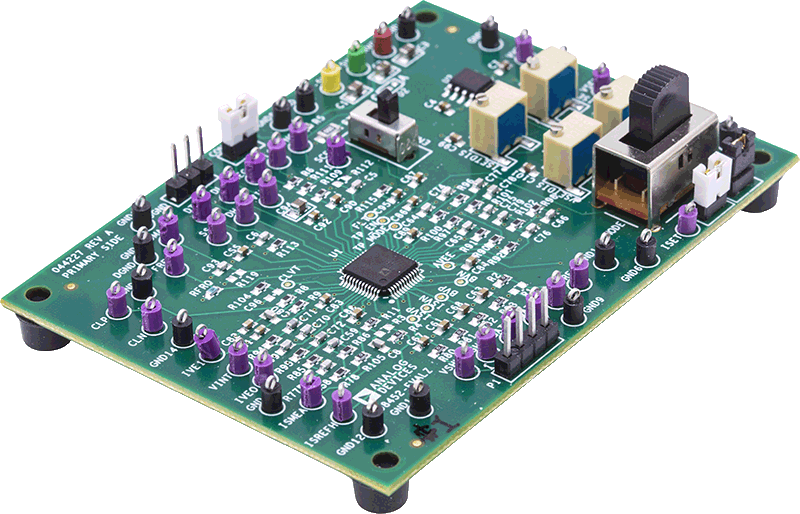
ADI AD8452 evaluation board
The AD8452 includes battery reverse polarity protection, an overvoltage protection switch, and smart control to prevent battery overcharging, enabling a 50% reduction in system footprint. These integrated features allow battery manufacturers to incorporate more functions into test systems while utilizing factory workspace more efficiently. Furthermore, this enables manufacturers to design systems with more features and more robust test procedures.
Efficient power conversion is another opportunity to enhance system performance. Through an improved switching architecture, the test system can exchange energy bidirectionally with the grid, thereby minimizing power consumption.
Furthermore, efficient power conversion reduces the need for thermal management devices that add to the system's overall cost and power consumption. This results in a reduction of wasted energy and production costs. To implement these functions, it is necessary to understand system characteristics, such as isolated gate drivers, that support the fast switching requirements of new silicon carbide (SiC) or gallium nitride (GaN) power switching technologies.
Working closely with a supplier possessing system-level expertise and an extensive product portfolio offers benefits beyond simply being able to utilize more sophisticated components and building blocks. In this case, battery manufacturers can use reference designs for system architectures that are easier to adopt, enabling them to launch products three to four times faster than if they had to develop battery activation and test systems in-house from scratch.
As global demand for electric vehicles is expected to grow by an average of 21% annually until 2021, the need for close cooperation between battery manufacturers and suppliers is higher than ever.
Suppliers need to provide reliable and proven solutions to enable manufacturers' systems to achieve new levels of efficiency. Top suppliers can help manufacturers launch these new capabilities more quickly, thereby contributing to increased production of both batteries and electric vehicles.
This article is a summary of "Scaling Electric Vehicle Production Requires Advanced Battery Formation and Test Systems" by Analog Devices engineer Vikas Choudhary.
Comments
Related news
Analog Devices Launches ADC to Simplify PLC and DSC Module Development
Analog Devices has launched two new precision ADC products (AD4111, AD4112) with multi-channel ±10V and 0~20mA inputs. These new products, which incorporate ADI's iPassives integrated precision passive technology, support up to 8 single-ended voltage inputs and 4 current inputs, and integrate precision matched current sense resistors and resistor dividers, enabling simplified development of PLC and DCS modules.
2018.10.19by 이수민 기자
ADI Announces a Range of Automation Solutions to Accelerate Industry 4.0
ADI has announced a comprehensive range of Industry 4.0 solutions that enable industrial equipment manufacturers to rapidly develop Industry 4.0 equipment. The new solutions enable today's existing factory infrastructure to be equipped with next-generation flexibility, connectivity, and efficiency. Each solution announced by ADI includes deterministic Ethernet, security, and condition-based monitoring capabilities.
2018.11.17by 이수민 기자
.jpg)
Mouser Unveils ADI RadioVerse Solutions Microsite
Mouser Electronics operates a dedicated microsite for RadioVerse technology developed by Analog Devices. Analog Devices' RadioVerse design ecosystem simplifies the development process of radios used in various applications and markets. Through the RadioVerse dedicated microsite, users can quickly search in one place for products suitable for various wireless radio design projects.
2018.12.20by 이수민 기자

[e4ds Tech Day 2026 ⑨] Sim Sang-gyu, Autocrypt CTO: "In the Physical AI Era, Automotive Security Must Extend Beyond the Vehicle"
At e4ds Tech Day 2026, Sim Sang-gyu, CTO of Autocrypt, explained automotive cybersecurity strategies in the era of Physical AI and SDV (Software-Defined Vehicle). Automobiles are evolving as part of an ecosystem connected to AI, cloud, chargers, IoT, and robots, and he emphasized that the scope of security must expand beyond the vehicle interior to the entire connected environment. In particular, AI model tampering, adversarial attacks, OTA updates, and EV charger hacking were identified as major threats. He explained that response measures require zero trust, AI model integrity protection, intrusion detection, Security by Design and Default, and full lifecycle security management, and that proactive security system establishment beyond regulatory compliance is critical for securing future mobility competitiveness.
2026.10.12by 배종인 기자

Practical HIL Construction Strategy for Automotive and Off-Highway Controller Validation
As vehicle E/E architecture transitions to zonal structures and shifts to software-defined vehicles (SDV), the number of controllers (ECUs) requiring validation and software complexity are surging dramatically. Meanwhile, real vehicle testing cannot provide repeated verification under identical conditions and entails lead time and safety concerns. This white paper explains the principles of HIL (Hardware-in-the-Loop) validation and the structure of the NI platform composed of PXI, SLSC, and VeriStand, and through two actual implementation cases—Camera Record & Replay HIL for In-Cabin Monitoring Controller (ICMU) and Forklift Controller (VCU) HILS—describes how controller-level regression testing becomes possible. Additionally, it explicitly states application boundaries and limitations, such as lack of A2B support.
2026.10.12by 편집부











