



Korean Companies Leading Global Public Cloud Adoption Trends: What Key Points to Consider?
 Published2019.01.25 09:05
Public cloud adoption rate doubles the global average
We should keep an eye on the expanding interconnectivity of the data environment.
Korea's public cloud adoption rate was found to be twice the global average and over 60% of the Asia-Pacific average.
Nutanix
On the 16th, Nutanix shared insights into the Korean enterprise cloud market through its Enterprise Cloud Index (ECI) report.
According to the Nutanix ECI report, Korean companies are using public cloud at a rate about twice as high as the global average.
This survey, conducted by Vanson Bourne at the request of Nutanix, involved over 2,300 senior IT decision-makers from mid-sized and large enterprises worldwide. Among them, 44% of Korean respondents stated that they migrated workloads and applications to a public cloud environment to keep up with new technologies and trends. This is higher than the global average of 26% and the Asia-Pacific average of 30%.
Current Situation and Advantages
According to the report, 24% of Korean respondents are already running workloads and applications in a multi-public cloud environment. This figure is double the global average and 60% ahead of the Asia-Pacific average.
It also showed a high response rate of 20% in single public cloud usage and adoption. The global and Asia-Pacific averages were 14% and 15%, respectively.
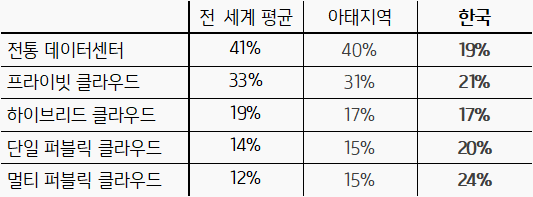
Enterprise Workload Operation Status
The most notable item is the section on the use of traditional data centers.
Korean companies participating in the survey revealed that they operate only 19% of their workloads in traditional data center environments, showing a significant difference from the global average of 41% and the Asia-Pacific average of 40%. Even within the Asia-Pacific region, there was a substantial difference, with companies in neighboring Japan responding that they operate as much as 42% of their workloads in traditional data centers.
Based on these results, it appears that Korea is far ahead of other countries worldwide in cloud adoption and is leading preparation and innovation for a hyper-connected digital future.
Future Considerations
Korean companies continued to show a high response rate in response to the question regarding public cloud adoption plans for the next 12 to 24 months. They stated that they plan to use hybrid cloud, single public cloud, and multi-public cloud evenly, each accounting for about 25%.
However, if this approach increases data risk, it may be difficult to achieve success in the long term. Unlike in Korea, companies around the world are rapidly increasing their adoption of hybrid cloud, using it as a foundation for improving productivity and securing future value.
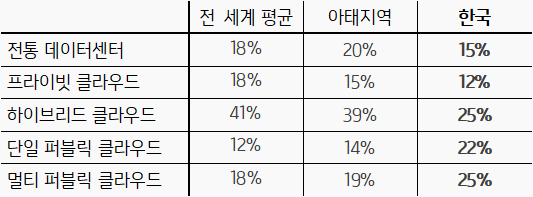
Comparison of enterprise workload operation plans for the next 12–24 months
Other countries around the world are investing in and focusing on hybrid cloud. According to research results, the global adoption rate of hybrid cloud is expected to more than double from 19% to 41% within the next one to two years, while the Asia-Pacific region is also projected to see a significant increase from 17% to 39%. In contrast, Korean companies have stated that they plan to allocate 25% of their investment to hybrid cloud.
Other notable findings regarding Korea in this report are as follows.
▲Traditional Data Centers: Korean respondents appear likely to continue reducing the use of traditional infrastructure as part of a multi-cloud strategy. The current usage rate of 19% is expected to drop to 15% within the next 1-2 years.
▲ Private Cloud: Currently, the adoption rate of private cloud in Korea is 21%, which is more than 30% lower than the global and Asia-Pacific average. This is expected to decrease to 12% within the next 1-2 years.
▲ Security and Scalability: As with many companies worldwide, when asked about the key advantages of the public cloud and key considerations for workload operating environments, Korean companies cited scalability, data security, and compliance with response rates of 12% and 25%, respectively.
"Korea is clearly ahead in public cloud adoption," said Jong-Deok Kim, General Manager of Nutanix Korea, adding, "However, as complexity, congestion, and connectivity increase, extracting true value will likely determine continued success."
He added, “While current multi-cloud strategies may be superior in terms of security, they can lead to unexpected dependencies or inefficient siloed environments,” and advised, “We should keep an eye on the moves by competitors in other countries to embrace the benefits of hybrid cloud as a business model to maximize the interconnectivity of all cloud and data environments.”
Comments
Related news
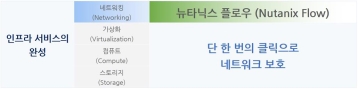
Nutanix Announces Software Defined Networking Solution 'Nutanix Flow'
Nutanix has announced "Nutanix Flow," a software-defined networking (SDN) solution targeting the multi-cloud era. Nutanix Flow is an application-centric security solution that effectively protects applications from internal and external threats that traditional parameter-based security solutions fail to detect. Nutanix Flow is fully integrated into Nutanix Acropolis software, making deployment straightforward. In particular, the technological capabilities of Netsil, which Nutanix recently acquired, enhance real-time visibility and detection capabilities for applications. Nutanix Flow automatically generates and manages application security, providing ease of use and convenience.
2018.05.16by 김지혜 기자
Nutanix Provides Real-Time Insights with Edge Computing 'Xi IoT'
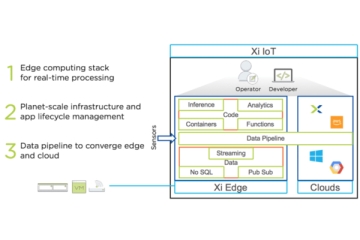
Nutanix has announced a new edge computing service, Xi IoT. Xi IoT is one of Nutanix's Xi Cloud Services, which integrates key Nutanix solutions in a simplified manner and enables developers to focus on IoT applications and services that align with their business needs.
2018.12.04by 이수민 기자
Naver, VMware Collaborate on Cloud Business “Strengthening Enterprise and Public Market Conquest”
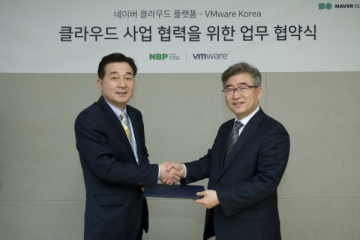
NBP and VMware Korea have announced the conclusion of a strategic business partnership agreement and are moving forward to capture the enterprise and public cloud market. To this end, NBP and VMware launched the VMware on Ncloud product on the 27th of last month, which combines VMware solutions with the infrastructure technology of Naver Cloud Platform. VMware on Ncloud provides cloud services with compatibility to VMware-based on-premises environments, enabling seamless transition to hybrid cloud, and delivers enhanced security by incorporating Naver's advanced security technology, offering higher security levels than private cloud.
2019.01.16by 이수민 기자
.jpg)
SalePoint Signs Multi-Year Partnership Agreement with AWS… Promoting Identity Security that Integrates Even AI Agents
Sailpoint has entered into a multi-year strategic partnership agreement with AWS and is moving forward with establishing an integrated governance system that manages both human and non-human identities together. The plan is to consistently manage access permissions in an environment where AI agents are increasing as work execution entities, while applying the principle of least privilege and automated policy enforcement. The two companies plan to jointly expand capabilities to manage the identities of various entities, including AI agents, within a single layer in the AWS environment. This collaboration is interpreted as a move to design security and governance together in corporate environments where AI adoption is expanding.
2026.03.26by 배종인 기자
.png)
Databricks Unveils Open AI Security Monitoring 'Lakewatch'
Databricks entered the security market on March 24 by unveiling LakeWatch, an open-source agentic SIEM. The core functionality of this product is to integrate and analyze security, IT, and business data in a single environment to support AI-based threat detection and investigation. The company explained that it reduces the limitations of existing security operations centers, which have had to forgo some data due to high cost structures, and enables large-scale data analysis and automation based on open formats and ecosystems. LakeWatch is currently offered as a private preview, with Adobe and Dropbox mentioned as early customers. Databricks also announced an expanded partnership with Anthropic as well as the acquisition of Antimatter and SiftD.ai.
2026.03.26by 배종인 기자











