



ETRI Successfully Develops Thermoelectric Device That Generates Electricity from Body Heat
 Published2019.01.28 09:09
Unlike disposable batteries, continuous energy harvesting
It served as an opportunity for global expansion in the self-generation power sector.
Domestic researchers have succeeded in developing a thermoelectric device that generates electricity using heat from human body temperature. With an output more than five times higher than that of previous research teams, the commercialization of wearable devices is expected to gain momentum.
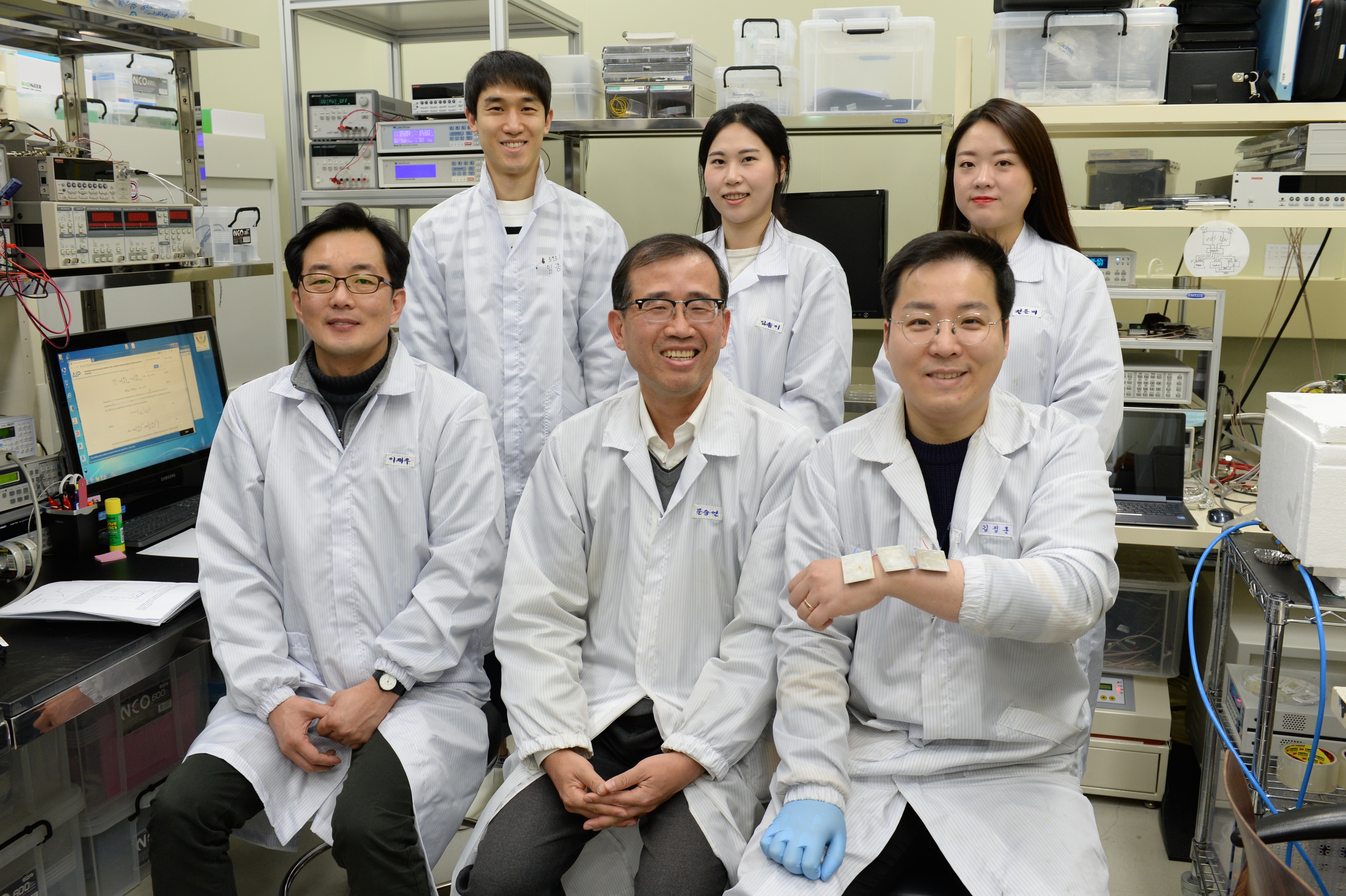
ETRI has succeeded in developing a thermoelectric power generation composite module that supplies power based on body temperature.
The Electronics and Telecommunications Research Institute (ETRI) announced on the 15th that it has succeeded in generating energy and displaying information by using only human body heat without using a battery, attaching it to the wrist like a band-type patch.
In particular, the explosive increase in wearable devices worn on the human body has increased interest in related research, making the development of thermoelectric devices a hot topic worldwide.
ETRI has developed a thermoelectric power generation composite module that supplies power based on human body temperature. It converts the thermal energy of body temperature into electricity, amplifies it, and enables it to be used as a power source for wearable devices.
The research team increased the device's output to 35 µW/cm², which is more than 1.5 times higher than the 20 µW/cm² previously announced by U.S. researchers. The team also stated that if six devices are bundled into a module, a maximum output of 2 to 3 mW is possible. This is a level suitable for immediate commercialization. This means that continuous energy harvesting is possible using human body heat, rather than being disposable like a battery.
The research team anticipates that this technology will be integrated into devices such as body temperature or pulse sensors in the future, enabling wireless data collection. This is expected to lead to applications in monitoring infants and patients, as well as tracking the location of pets.
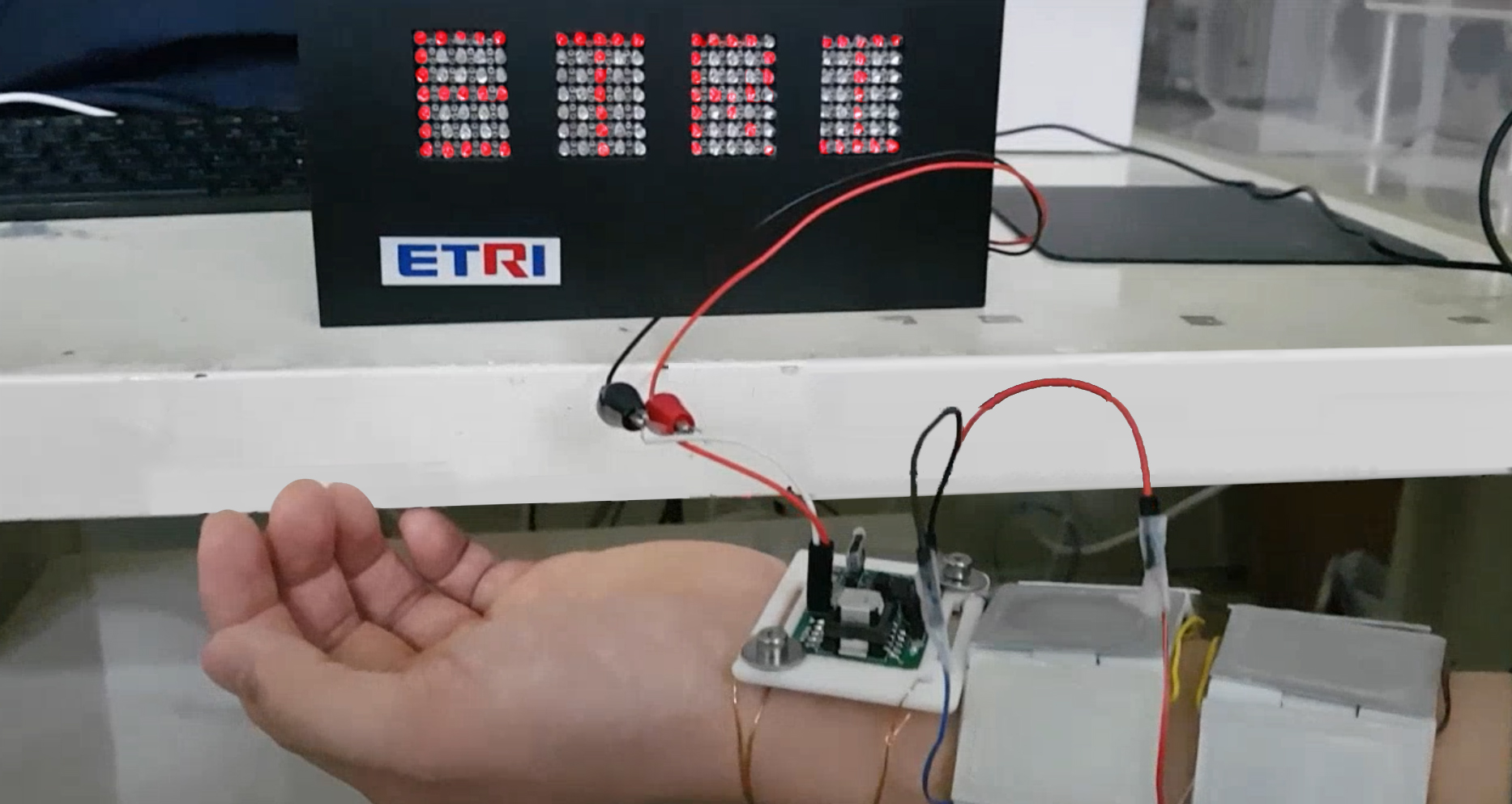
ETRI succeeded in a transmission experiment to transmit information to an LED display board using only human body heat, without a battery.
The research team created a patch in the form of a bandage measuring 5 cm x 11 cm. By attaching six patches to an adult's wrist and amplifying the voltage, they succeeded in a transmission experiment in which the letters 'ETRI' were clearly illuminated on an actual LED display using only human body heat, without a battery.
ETRI explained that the core of this technology consists of thermoelectric device design technology, biomimetic heatsinks, and power management circuits. Patent applications for the related technologies have been filed.
Thermoelectric device design technology is a technique that designs thermoelectric devices while considering thermal resistance matching to ensure efficient transfer of body heat.
A biomimetic heatsink is a structural technology that mimics the sweat glands of human skin to radiate and absorb body heat. When a patch-shaped structure is attached to the skin, a temperature difference occurs between the skin and the structure; by creating a structure similar to sweat glands, energy efficiency is maximized. The output of the thermoelectric device equipped with a biomimetic heatsink is five times greater than that of existing products.
A power management circuit is a circuit that maintains an efficiency of over 80% even at low voltages and converts the voltage to a level suitable for charging. It is an essential technology for efficiently utilizing energy obtained from body heat.
The research team explained that while similar technologies existed previously, this is the first time that commercial-level energy output has been achieved.
.jpg)
Image of the dry-adhesive flexible structure hierarchy and actual photos of the structure in use
In addition, the research team utilized a nano layer and applied a dry adhesive method to ensure the part of the module that touches the skin adheres naturally. A micro layer was used on the outer surface of the module to prevent tearing. In other words, it was developed as a micro/nano hybrid structure to achieve both stability and convenience.
ETRI plans to further advance this technology and is currently conducting additional research. The research team stated that for actual commercialization to occur, further research is needed to eliminate discomfort when wearing the patch, consider aesthetics and performance during movement, and integrate power management circuits into a single chip.
The research team anticipates the commercialization of this technology within the next two to three years. The team stated that through the project, they have published 15 SCI-level papers, filed 15 domestic and international patent applications, and completed technology transfer for the elemental technologies. The related technology was selected as the cover of the paper *Advanced Material* in February 2017 and published.
In addition, NST supported patenting and commercialization from the initial R&D stage through its rights commercialization support program.
Moon Seung-eon, head of the ICT Materials Research Group at ETRI and the leader of the project, said, “Once this system is completed, it will be utilized as a power source or hardware platform for wearable devices or IoT devices, enabling new concept services such as digital healthcare and smart homes/cities.”
ETRI believes that this technology will serve as a good opportunity for Korea to expand globally in the field of self-generating power devices for devices such as wearables and IoT.
Meanwhile, this technology was selected by the Ministry of Science and ICT as the best achievement in the mechanical materials field among the outstanding national R&D achievements of 2018.
Comments
Related news

KETI Successfully Develops Solid-State Bonding Technology for SiC Power Semiconductor Packaging
The Electronics and Telecommunications Research Institute has developed a solid-state bonding technology using silver for the assembly of silicon carbide power semiconductors. Solid-state bonding refers to the process of joining different types of materials in their unfused solid state without melting. Silicon carbide semiconductors, along with gallium nitride and others, are wide bandgap semiconductors that exhibit stable high-temperature operation, high thermal conductivity, low resistance, and high voltage withstand capability compared to conventional silicon semiconductors.
2018.12.11by 이수민 기자
ETRI Completes Commercialization of 100-Gigabit Optical Communication Components in Collaboration with 10 SMEs
The Electronics and Telecommunications Research Institute (ETRI) announced that it has successfully supported the development efforts of manufacturers of optical components for optical transceivers, including light source devices, photo-detection devices, optical wavelength division multiplexers, 100-gigabit-class ceramic optical packages, and micro optical lenses, with related companies achieving notable results. Optical component manufacturers had been experiencing a downturn and were in need of new growth drivers. Through mobilizing accumulated technological expertise, human resources, equipment, and facilities, ETRI conducted joint research with small and medium-sized enterprises and successfully achieved the commercialization of 100-gigabit-class optical communication components.
2018.12.17by 이수민 기자
ETRI Creates 4 International Patents by Preempting 3 International Low-Power IoT Standards
The Electronics and Telecommunications Research Institute announced that the final approval was granted for the recommended standard on NFC-based IPv6 communication technology, a low-power Internet of Things communication protocol, at the conference hosted by the IETF, an international standards organization, in Bangkok, Thailand last month. The standard will be officially adopted as an international standard in early January next year. This technology is a proprietary technology held by the Standards Research Division of the Electronics and Telecommunications Research Institute. It has already been verified for its technological capability by passing test items with high scores at the interoperability testing event hosted by the European Telecommunications Standards Institute in 2016. This technology was also introduced as an excellent technology by the Asia-Pacific Network Information Centre, an international Internet address management organization.
2018.12.24by 이수민 기자

Intel Unveils Next-Generation 'Core Ultra Series 3' and vPro Platform for Enterprise PCs
Intel has officially unveiled the "Intel Core Ultra Series 3" for next-generation enterprise PCs and the latest vPro platform, addressing a wide range of demands from enterprise notebooks to high-performance workstations.
2026.03.26by 배종인 기자
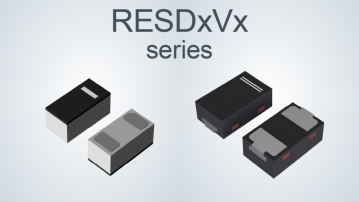
ROHM Launches ESD Protection Diode Compatible with High-Speed Interfaces of 10Gbps or Higher
Semiconductor specialist ROHM has developed the 'RESDxVx series' of ESD (electrostatic discharge) protection diodes capable of responding to next-generation high-speed data communication environments exceeding 10Gbps, simultaneously enhancing both signal quality maintenance required in high-speed interfaces and IC protection performance.
2026.03.26by 배종인 기자











