


STMicroelectronics Launches Smart Antenna Controller to Boost Smartphone Performance
 Published2019.01.30 10:29
Reduce board space, material costs, and battery load
STMicroelectronics announced on the 28th the launch of the STHVDAC-253C7, a digital controller for variable capacitors such as those in its STPTIC family.
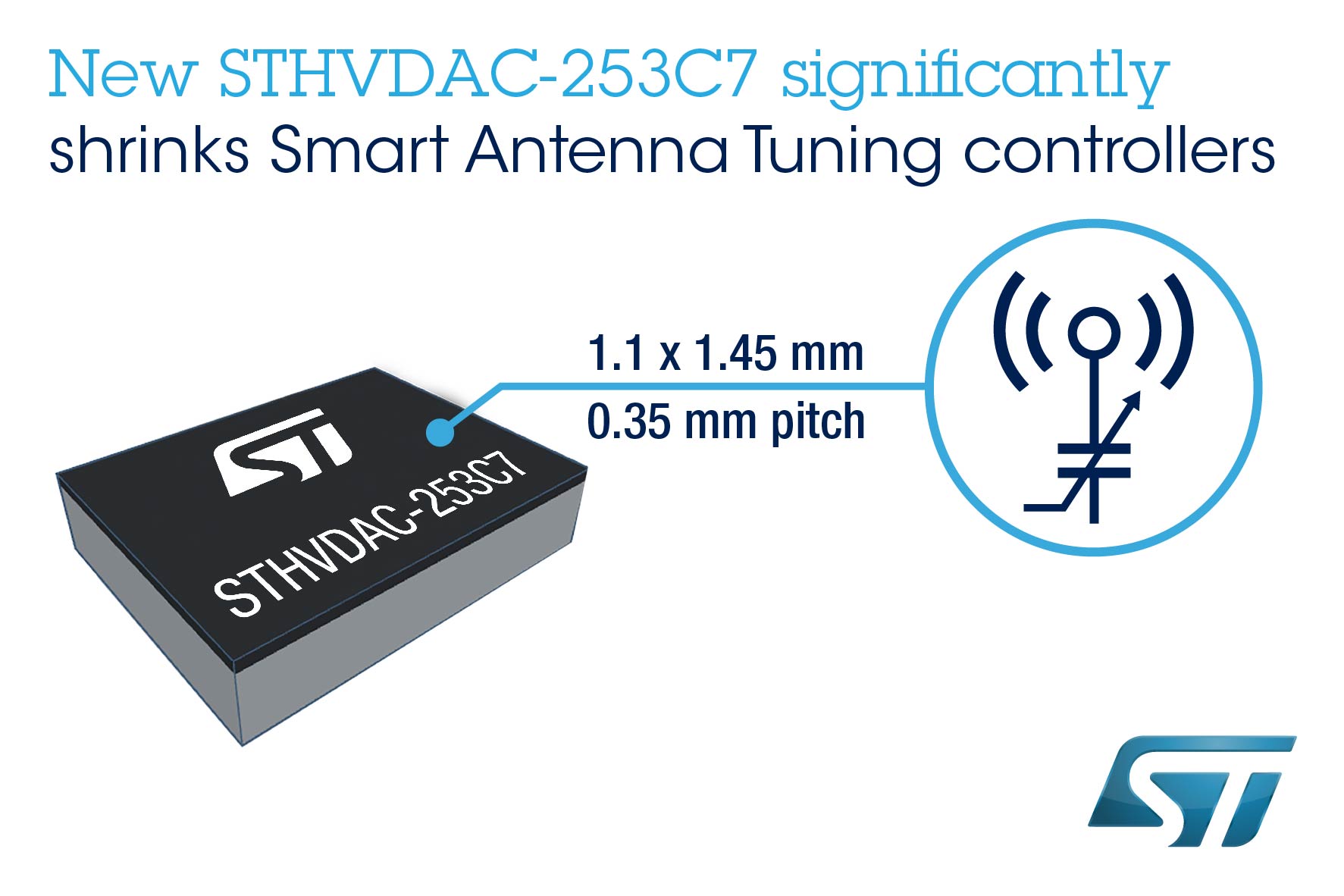
STMicroelectronics STHVDAC-253C7
This controller stabilizes the RF performance of smartphones by reducing the size, material cost, and power consumption of the antenna tuning circuit.
Using the STHVDAC-253C7 with STPTIC capacitors for impedance matching and frequency tuning virtually eliminates the effects of environmental changes.
As a result, you'll get stronger signal reception, fewer dropped calls, faster data speeds, and longer battery life for your phone.
The STHVDAC-253C7 utilizes ST's advanced 0.18µm BCD8 process and a 0.35mm-pitch flip-chip package, making it 50% smaller and consuming half the operating current of its predecessor.
This new controller operates with the latest 0402 chip-size inductors and eliminates the need for external Schottky diodes, further reducing the overall circuit footprint.
The STHVDAC-253C7 is a tunableIt is a high-voltage Digital-to-Analog Converter (DAC) specifically designed to generate bias voltages for capacitors, providing three outputs suitable for tuning three different capacitances in GSM/WCDMA/LTE mobile phones.
ST has integrated the boost converter required to generate bias voltages across the full capacitor tuning voltage range from 0 V to 24 V. The STHVDAC-253C7 can also process standard MIPI RFFE (RF Front-End) commands from the system transceiver.
Supports three RFFE USIDs (Unique Slave IDs) through a single STHVDAC-253C7, allowing management of up to three individual antennas.
The STHVDAC-253C7 supports commonly used antenna tuning modes, including Normal Mode, which transitions to a new command output voltage within 10µs, Turbo Mode, which is optimized for minimum settling time, and Glide Mode, which provides a programmable delay from 512µs to 16.84ms to meet requirements such as 3GPP phase discontinuity and enable the smoothest transition.
Additionally, GPIO pins are provided for managing two controllers on the same RFFE bus in dual-tuner handsets. Registers can be switched to manage antenna diversity designs, or settings can be adjusted to adjust antenna response when a USB cable is plugged in.
The STHVDAC-253C7 is in ramp-up production, based on a 12-bump, 0.35mm-pitch WLCSP flip-chip. Pricing starts at $0.19 for orders of 1,000 units, and samples are available immediately to support design and development.
Comments 1
1 Comments:
Related news
“Preparing for 6G Beyond 5G” LG Electronics and KAIST Open 6G Research Center
LG Electronics established the LG Electronics-KAIST 6G Research Center at the KAIST INSTITUTE located in Yuseong-gu, Daejeon, to research next-generation mobile communication technologies, and held its opening ceremony. Professor Cho Dong-ho of the Department of Electrical and Electronic Engineering at KAIST will serve as the inaugural director of the research center. LG Electronics plans to leverage KAIST's research personnel and infrastructure to jointly conduct various industry-academia projects and secure a leading position in next-generation mobile communication foundational technologies bridging 5G to 6G.
2019.01.28by 이수민 기자

ST 'NFC IC and 8-bit MCU' Adopted in ROHM Automotive Wireless Charging Reference
ST Microelectronics' automotive NFC reader IC ST25R3914 and automotive 8-bit microcontroller STM8AF have been adopted in Rohm's Qi-compatible automotive wireless charging reference design. Contactless communication based on NFC is already widely used for functions such as mobile payment on smartphones, and recently its usage has been rapidly expanding from mobile devices to industrial equipment, IoT devices, and automotive systems. Rohm's automotive wireless charging module reference design, which adopts ST's NFC reader IC and 8-bit MCU, is based on the BD57121MUF-M, a Qi-standard 15W wireless charging IC developed by Rohm to enable more widespread application of wireless charging functionality in automotive center console boxes.
2019.01.29by 이수민 기자
Infineon Launches Reverse-Conducting IGBT for IH Applications
Infineon Technologies has launched the IGBT Protected series of TRENCHSTOP technology for induction heating. The new product family integrates a dedicated driver IC for logic functions and various programmable protection functions into a single device, delivering industry-leading IGBT performance considering key parameters such as blocking voltage, static loss, and conduction loss.
2019.01.29by 이수민 기자

Intel Unveils Next-Generation 'Core Ultra Series 3' and vPro Platform for Enterprise PCs
Intel has officially unveiled the "Intel Core Ultra Series 3" for next-generation enterprise PCs and the latest vPro platform, addressing a wide range of demands from enterprise notebooks to high-performance workstations.
2026.03.26by 배종인 기자

ROHM Launches ESD Protection Diode Compatible with High-Speed Interfaces of 10Gbps or Higher
Semiconductor specialist ROHM has developed the 'RESDxVx series' of ESD (electrostatic discharge) protection diodes capable of responding to next-generation high-speed data communication environments exceeding 10Gbps, simultaneously enhancing both signal quality maintenance required in high-speed interfaces and IC protection performance.
2026.03.26by 배종인 기자












좋은 정보 감사합니다