


SK Telecom's quantum cryptography technology becomes a global standard.
 Published2019.02.07 10:01
| International standardization efforts are also accelerating, including quantum random number generators.
Building a Quantum Cryptography Ecosystem with 15 Companies

SK Telecom sets global standards for quantum cryptography technology.
SK Telecom announced on the 7th that two new quantum cryptography communication technologies proposed at the ITU-T meeting held in Geneva, Switzerland, were adopted as international standardization tasks.
The ITU-T (International Telecommunication Union Telecommunication Standardization Sector) is a subsidiary of the ITU, the world's leading international telecommunications organization. It sets standards in the communications sector. Technologies adopted for international standardization become global standards after discussion in dozens of ITU-T member countries.
The two new technologies adopted at this ITU-T meeting are ▲a system for utilizing quantum key distribution in a communication network (which defines the requirements for operating a quantum key distribution system in a communication network) and ▲a method for utilizing existing encryption systems for quantum key distribution (which defines a method for configuring a security system by providing quantum keys to existing encryption equipment). Both technologies are essential for applying quantum cryptography to communications networks.
SK Telecom announced and received approval for the final standards for ▲security framework for quantum key distribution in communication networks (which defines the method of distributing quantum keys and applying security technologies such as data encryption to improve communication security) and ▲quantum random number generator security structure (which defines the structure of QRNG that generates highly secure random numbers), which were adopted as international standardization tasks by the ITU-T in September 2018.
With the recent adoption of two additional international standardization projects, SK Telecom now carries out a total of four international standardization projects related to quantum cryptography technology within the ITU-T alone. SK Telecom is the only company in the world to have carried out four or more international standardization projects related to quantum cryptography communications.
This achievement is the result of SK Telecom's long-term efforts to advance quantum cryptography technology. In 2016, SK Telecom became the first in the world to apply quantum cryptography to LTE backhaul between Sejong and Daejeon. In 2017, it developed the world's smallest (5x5mm) quantum random number generator (QRNG) chip. In 2018, it acquired IDQ, the world's leading quantum cryptography company.
SK Telecom, representing South Korea, is pioneering the quantum cryptography ecosystem by partnering with small and medium-sized enterprises (SMEs). In 2013, SK Telecom spearheaded the establishment of the Quantum Information and Communication Research Association, Korea's first quantum cryptography research institute. Of the association's 15 member companies, 12 are SMEs. SK Telecom plans to develop core quantum cryptography technologies with small and medium-sized enterprises and create new value, thereby contributing to the national economy.
Park Jin-hyo, head of SK Telecom's ICT Technology Center, said, "The fact that SK Telecom is carrying out the most global standardization projects for quantum cryptography communication means that SK Telecom's technological prowess has been recognized worldwide," and added, "We will strengthen our quantum leadership by taking the lead in developing global standards and expanding the ecosystem in the future."
Comments
Related news
Domestically Developed Quantum Cryptography Technology Becomes International Standard
At the ITU standardization conference held in Geneva, Switzerland, the 'Quantum Cryptography Communication Network Technology' jointly proposed by seven leading domestic quantum cryptography communication companies and organizations, including KT and LG Uplus, has been approved as an international standard.
2018.07.29by 이수민 기자
.jpg)
KT Builds 5G Communication Network at Hyundai Mobis Driving Test Center
KT has established a 5G communication network at Hyundai Mobis' driving test facility located in Seosan, Chungcheongnam-do, and has begun full-scale development of connected car technology utilizing it. KT enabled 5G communication at the Seosan driving test facility so that Hyundai Mobis could proactively secure 5G-based connected car technology. Following the execution of a Memorandum of Understanding between KT and Hyundai Mobis in August for "5G-based connected car technology collaboration," a 5G network was constructed at the Seosan driving test facility. This marks the first instance of a 5G commercial network being applied to a private enterprise and utilized for technology development.
2019.01.23by 이수민 기자
SK Telecom to build 5G infrastructure on 121.4km of roads in Seoul
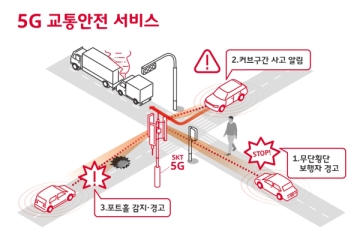
SK Telecom is advancing a next-generation intelligent transportation system demonstration project with Seoul Metropolitan Government. The Seoul next-generation intelligent transportation system demonstration project aims to establish a safer transportation system through the construction of advanced transportation infrastructure including 5G and vehicle communication technologies. Under the project, SK Telecom will deploy 5G sensors and IoT on major roads in Seoul, and distribute 5G vehicle communication terminals to buses, taxis, and other vehicles. Additionally, SK Telecom will establish a 5G control center for data collection and safety information delivery, and create a testbed for autonomous vehicles, the transportation means of the future.
2019.01.23by 이수민 기자
European Patent Applications Surpass 200,000 for the First Time… South Korea Maintains 5th Place, Led by Batteries and Telecommunications
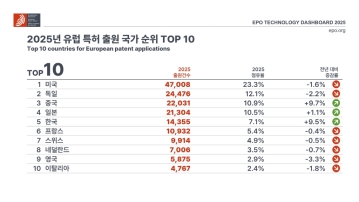
According to the European Patent Office (EPO)'s 'Technology Dashboard 2025', European patent applications last year reached 201,974, surpassing 200,000 for the first time. Korean companies and inventors filed 14,355 applications, representing a 9.5% increase from the previous year and maintaining 5th place by country. Battery, digital communication, and semiconductor technologies led the growth, with Samsung ranking as the top EPO applicant for the second consecutive year and LG reaching 3rd place. The presence of major domestic cities such as Seoul, Suwon, and Yongin was also confirmed. It was also revealed that Korea's European patent strategy is expanding beyond individual technologies to span the entire industry.
2026.03.24by 명세환 기자

SK Telecom First Applies AI-Based Network Operations at Gwanghwamun K-Pop Concert
SK Telecom announced that it applied an AI-based network operation system for the first time at a large-scale K-pop concert held in the Gwanghwamun area of Seoul on March 21st, managing communication quality throughout the event. Mobile data usage during the three hours before and after the concert reached 12.15TB, approximately doubling compared to the same time slot the previous weekend. SK Telecom monitored traffic using the AI system 'A-One' in five-minute and 50-meter units to respond to potential overload situations, while also operating temporary communication facilities and on-site personnel in parallel. This case is interpreted as confirmation of the practical applicability of AI-based autonomous network operation in an environment where demand from dense events and foreign users increases simultaneously.
2026.03.23by 명세환 기자











