


Five Challenges 5G NR Device Designers Must Overcome <2> Increasing Throughput at High Frequency and Wide Bandwidth
 Published2019.02.07 11:01
5G NR (5G New Radio) refers to wireless access technology between terminals and base stations on a 5G network.
5G NR presents new ways to use spectrum at sub-6 GHz and mmWave frequencies.
Sub-6 GHz focuses on expanding the scope and supporting low-latency applications such as low-speed IoT applications, digital control systems, security cameras, autonomous vehicles, and pacemakers.
mmWave frequencies enable data-intensive applications such as ultra-high-definition streaming, as they provide wider channel bandwidths that can support eMBB use cases.
5G NR reallocates some of the existing LTE bands and adds newly licensed spectrum in several bands.
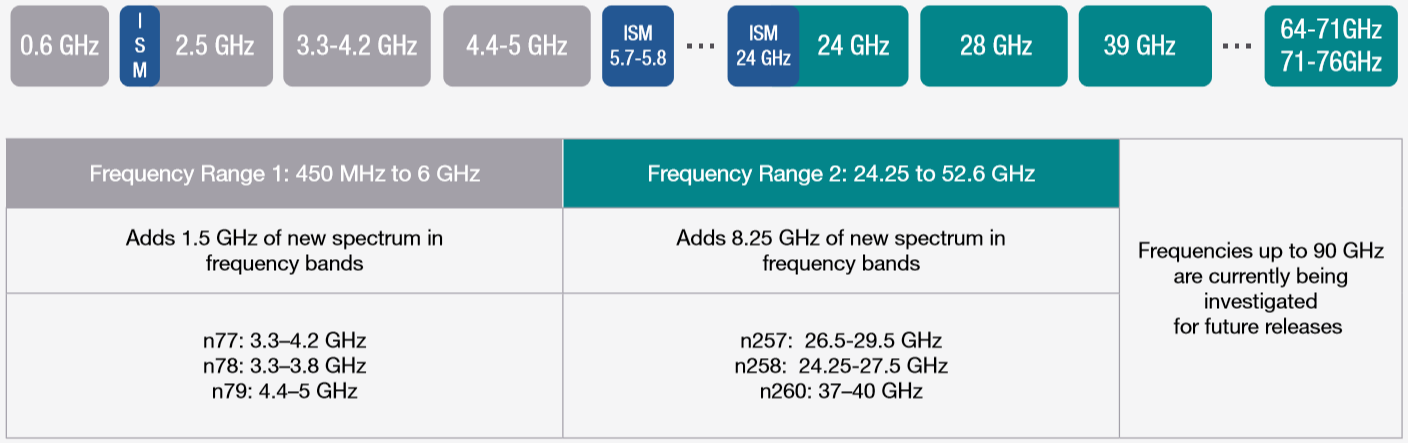
Operating Bands in 5G NR Release-15
Designing for mmWave frequencies up to 52.6 GHz is one of the most challenging aspects of 5G NR.
Signal impairments such as I/Q gain imbalance, phase noise, linear and nonlinear compression, and frequency errors increase with higher frequencies and wider bandwidths. This damage distorts the modulated signal, making it difficult for the receiver to accurately demodulate the signal.
Therefore, it is important to evaluate signal modulation characteristics by looking at the IQ array and identifying potential waveform distortion errors.
Designers can evaluate signal performance by measuring overall error vector magnitude (EVM), per-symbol EVM, and per-subcarrier EVM. A degraded EVM is an indicator of performance degradation and can lead to signal locking issues. The high-density modulation expected in 5G NR is reflected in the more stringent EVM requirements in the 3GPP specifications.
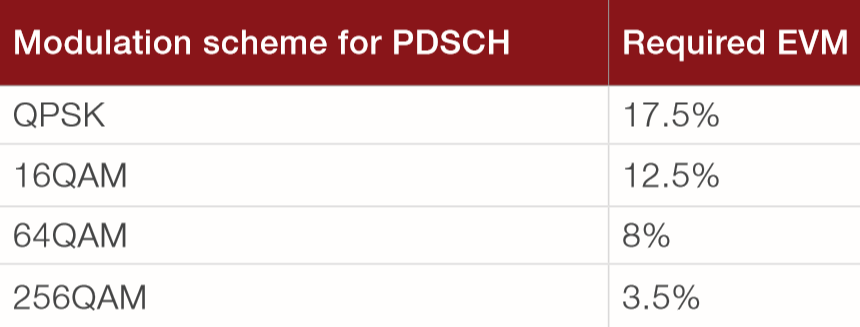
User Equipment EVM Requirements According to 3GPP TS 38.101-1
EVM for 256 QAM is much more difficult to achieve in design. Therefore, test solutions must use more dense modulation schemes to achieve higher levels of accuracy in measurement, verification, and troubleshooting.
Additional measures of signal performance include wideband frequency performance measured by Occupied Bandwidth (OBW), Adjacent Channel Power Ratio (ACPR), Spectrum Emissions Masks (SEM), and simulated emission masks.
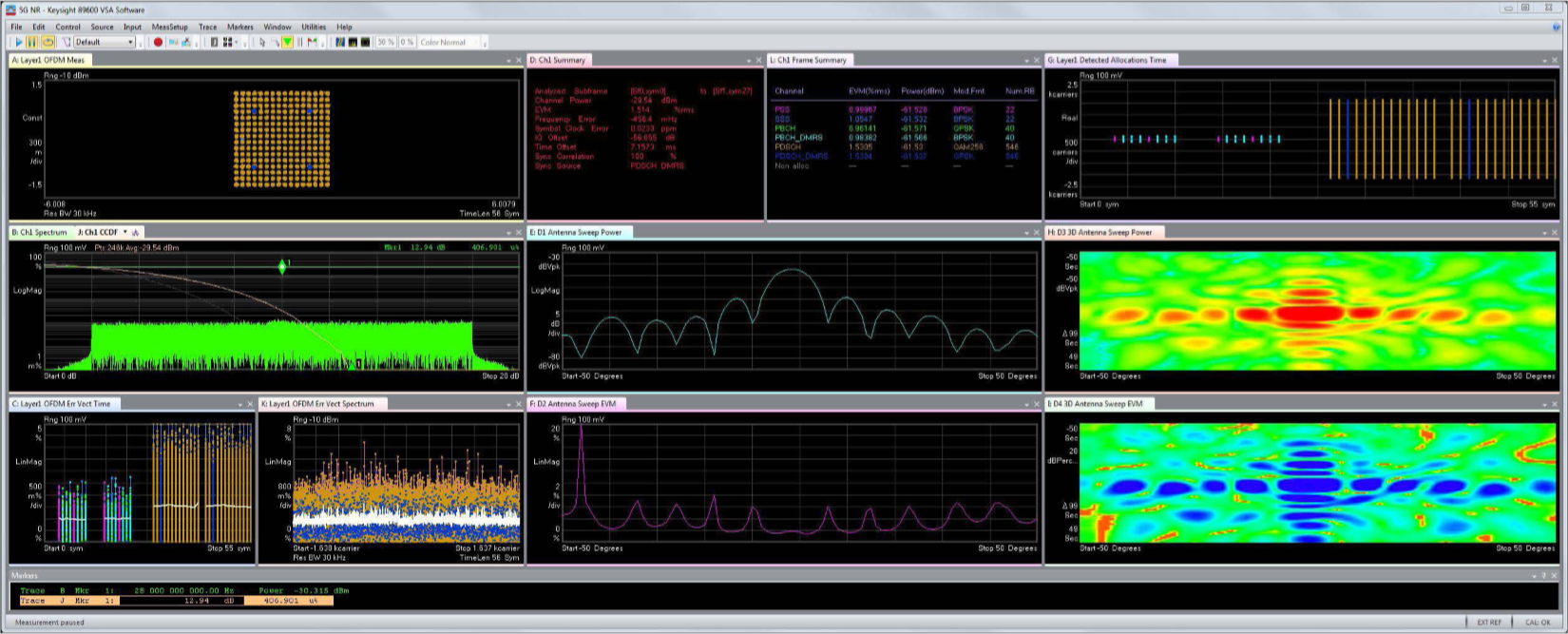
EVM and Spectrum Analysis of 5G NR 256 QAM Signals
These measurements provide insight into the overall power and signal quality outside the signal bandwidth.
In the next article, we will explore the third challenge: effectively deploying beam steering technologies at mmWave frequencies.
▒See the 5 Challenges 5G NR Device Designers Must Overcome
<1> Utilizing variable slot duration
<2> Increase throughput at high frequencies and wide bandwidths
6"><3> Effective use of beam steering technology at mmWave frequencies
<4> OTA testing on 5G mmWave devices
<5> Peaceful coexistence with LTE and other wireless communications
Comments
Related news
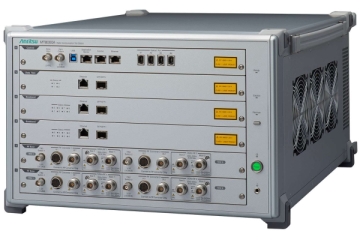
Japan's SoftBank Adopts Anritsu's 5G Test Solutions
Anritsu Corporation announced that SoftBank has decided to use its MT8000A 5G NR protocol test solution for 5G NR device performance testing. The MT8000A operates as a base station simulator for testing the functionality and performance of 5G terminals and chipsets under development, which is being developed as a test platform for next-generation technology development such as wideband signal processing and beamforming required for 5G mobile communication systems. A single MT8000A supports both sub-6 GHz and mmWave frequency bands used in 5G, and when combined with an OTA chamber, it enables mmWave signal quality and communication protocol testing in an OTA environment.
2019.01.08by 이수민 기자
5 Challenges 5G NR Device Designers Must Overcome <1> Utilizing Variable Slot Duration
5G NR refers to the wireless access technology between terminals and base stations on a 5G network. 3GPP established the NR standard with the goal of providing wireless access technology by integrating eMBB, URLLC, and mMTC, which are usage scenarios for IMT-2020 technology. Additionally, 5G NR Release-15 defined specifications to support eMBB and URLLC. In the ICT industry, the emergence of something new means that designers have more work to do. Design teams utilizing 5G NR face increasingly complex challenges and a greater number of issues. To implement 5G NR, device designers must overcome five key challenges.
2019.01.15by 이수민 기자
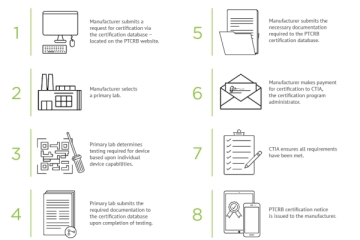
Keysight 5G Conformance Toolset Obtains PTCRB Certification “Accelerates 5G NR Device Certification”
Keysight Technologies announced that its 5G conformance toolset has obtained PTCRB certification as the first solution for 5G NR device certification. PTCRB is a certification forum composed of leading mobile operators in the industry and is focused on accelerating the commercialization of 5G mobile devices across the ecosystem. The certification was achieved as a result of long-term collaboration between Keysight and Qualcomm Technologies, a subsidiary of Qualcomm. The two companies are focused on verifying the validity and operation of RF and protocol conformance test specifications as defined by 3GPP.
2019.01.29by 이수민 기자
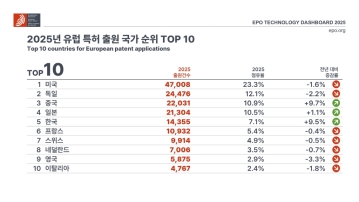
European Patent Applications Surpass 200,000 for the First Time… South Korea Maintains 5th Place, Led by Batteries and Telecommunications
According to the European Patent Office (EPO)'s 'Technology Dashboard 2025', European patent applications last year reached 201,974, surpassing 200,000 for the first time. Korean companies and inventors filed 14,355 applications, representing a 9.5% increase from the previous year and maintaining 5th place by country. Battery, digital communication, and semiconductor technologies led the growth, with Samsung ranking as the top EPO applicant for the second consecutive year and LG reaching 3rd place. The presence of major domestic cities such as Seoul, Suwon, and Yongin was also confirmed. It was also revealed that Korea's European patent strategy is expanding beyond individual technologies to span the entire industry.
2026.03.24by 명세환 기자
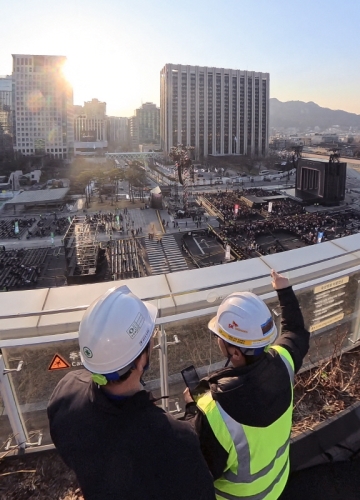
SK Telecom First Applies AI-Based Network Operations at Gwanghwamun K-Pop Concert
SK Telecom announced that it applied an AI-based network operation system for the first time at a large-scale K-pop concert held in the Gwanghwamun area of Seoul on March 21st, managing communication quality throughout the event. Mobile data usage during the three hours before and after the concert reached 12.15TB, approximately doubling compared to the same time slot the previous weekend. SK Telecom monitored traffic using the AI system 'A-One' in five-minute and 50-meter units to respond to potential overload situations, while also operating temporary communication facilities and on-site personnel in parallel. This case is interpreted as confirmation of the practical applicability of AI-based autonomous network operation in an environment where demand from dense events and foreign users increases simultaneously.
2026.03.23by 명세환 기자











